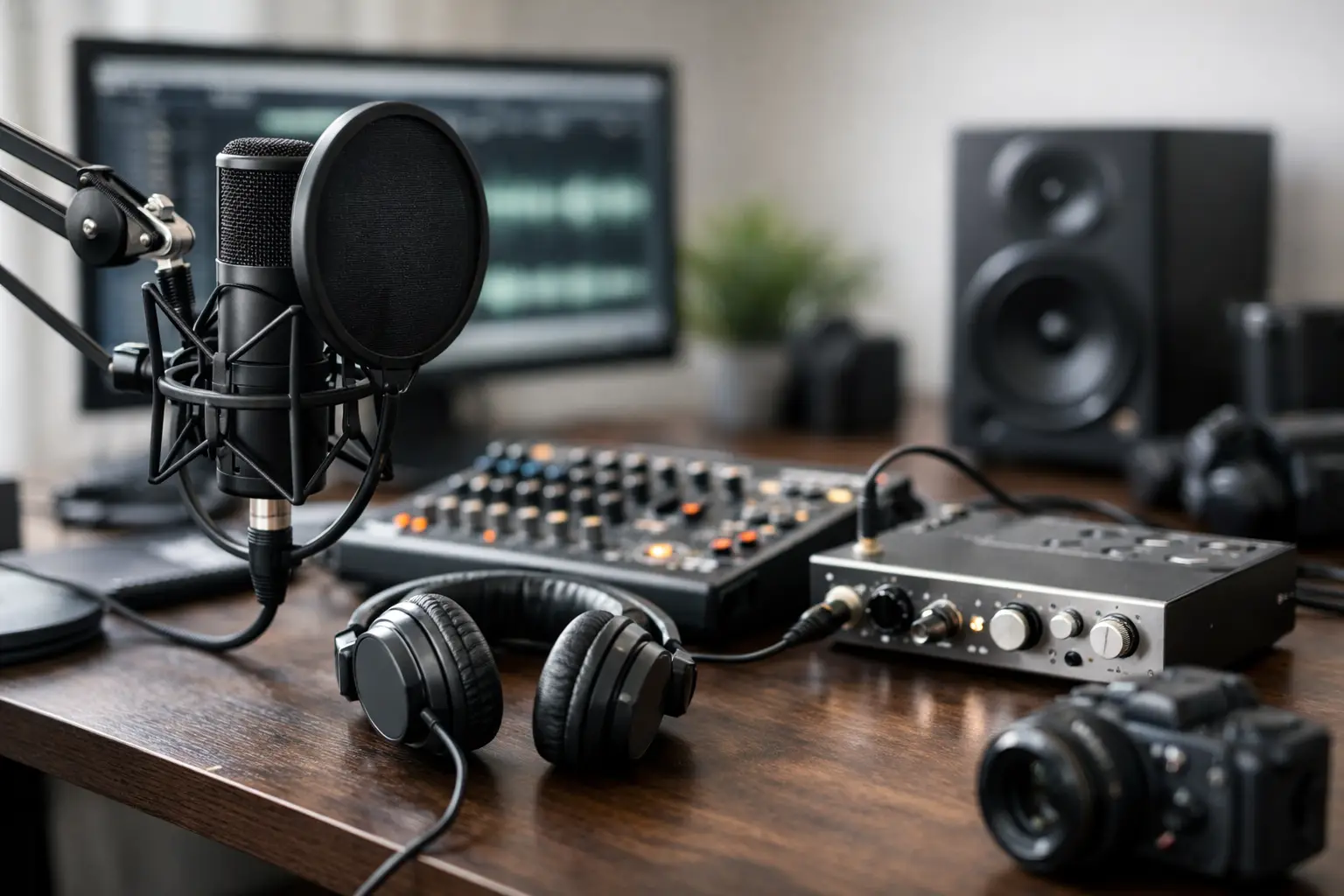
A bad image is often still forgivable to the viewer, but bad sound recording is almost never forgivable. That is exactly why an audio recording equipment guide is essential for anyone who films interviews, creates podcasts, records courses, reports, or social media content. The right audio gear immediately improves the final result, reduces post-production issues, and helps you work more confidently in any location.
In brief
- Start from the recording scenario — choose a microphone based on the use case (interview, podcast, outdoor filming).
- A lavalier or wireless system is suitable for mobile filming; for studio work, choose a condenser or dynamic microphone solution with an audio interface.
- A portable recorder is a reliable solution for field work and interviews with multiple microphones; always monitor with headphones during recording.
- Essential accessories (windshields, boom stands, XLR cables, pop filter) often determine recording quality more than an expensive microphone.
- Think about the setup growing over time — start with one high-quality microphone and monitoring, then later add a recorder or wireless system.
What to choose for different tasks
| Task | Solution | Why |
|---|---|---|
| Vlogs and social media videos with a single speaker | A compact lavalier microphone or wireless clip-on system; if working in a static location, you can also use a directional microphone combination with camera recording. | A lavalier provides consistent voice pickup, and a wireless solution allows free movement. This setup reduces handling noise and the distance between the source and the capsule. |
| Podcasts and table conversations | A podcast/dynamic microphone together with an audio interface or USB interface; closed-back headphones for monitoring. | A dynamic microphone works well in a less treated room and focuses the voice; the interface provides a stable connection to the computer. Monitoring lets you catch noise and clipping live. |
| Field interviews and reporting | A portable recorder with an XLR directional microphone or a lavalier system; a windshield and spare batteries are mandatory. | The recorder provides better preamps and backup recording, while the windshield reduces wind-related damage. This combination increases reliability in irreplaceable projects. |
| Studio recordings, voice recordings, music | A condenser studio microphone with a quality preamp/audio interface and a pop filter. | Condensers capture more detail, which is needed for voice and music recording, but they are more sensitive to room acoustics. Proper room treatment and monitoring ensure a clean result. |
| Improving in-camera recording for filming | A shotgun/directional microphone on a boom stand or a clip-on lavalier with a receiver, depending on mobility. Check the camera inputs and power before filming. | A directional microphone focuses on the speaker, while a lavalier provides a consistent signal if the speaker moves around. Compatibility with the camera is critical to avoid needing corrections in post-production. |
Frequently asked questions
Which microphones should you choose outdoors when it is windy?
Outdoors, priority should be given to directionality and a windshield. A lavalier with a good windshield or a shotgun microphone on a boom stand usually gives better results than a sensitive condenser without protection. Always test the setup before the main recording.
Is the camera’s built-in microphone enough for interviews?
Usually not — the camera’s built-in microphone picks up a lot of ambient noise and often does not capture the voice in enough detail. A better approach is to use a lavalier or a directional microphone placed closer to the sound source. This significantly reduces post-production time and improves final quality.
When is it better to choose a portable recorder instead of an audio interface?
A portable recorder is more convenient when you need to work on location, without a computer, or need автономy with multiple microphone channels. An interface is better for studio or computer-oriented sessions where direct integration and real-time processing are the priority. The choice depends on mobility and workflow.
How important is headphone monitoring during recording?
Monitoring is essential — it lets you immediately notice clipping, handling noise, radio interference, or improper levels. Without headphones, mistakes are only discovered in post-production, when re-recording may not be possible. Invest in reliable closed-back headphones for recording.
Is a wireless system always the safer choice for mobile filming?
Wireless systems provide freedom and a cleaner frame without cables, but they can have trade-offs — signal stability, operating range, and battery life. For critical recordings, it is recommended to also use a local backup recording in the transmitter or a separate recorder. Check the signal and battery status before recording.
How can you avoid compatibility problems between the microphone and the camera?
Check the camera input type (3.5mm, XLR, TRS/TRRS) and the microphone’s power requirements (phantom power or built-in battery) before buying. If needed, use a suitable adapter or receiver that provides the connection and power. Before an important recording, do test recordings with the entire device chain.
Useful links
- cameras - Check the camera inputs and compatibility with the microphone and receiver before buying.
- Microphones Sound recording (rental) - Choose specialized microphones for a short-term project or testing without buying.
- Wireless clip-on microphones - View the wireless clip-on microphone category if you need mobility and discreet mounting.
- Podcast microphones - See the selection of podcast microphones if you record regular talk-format shows.
- Audio cables, adapters - Make sure you have the correct cables and adapters to ensure compatibility between devices.
- Boom stands - A boom stand allows you to position a directional microphone optimally without visible mounts in the frame.
- Backgrounds, Holders, Reflectors (rental) - In studio conditions, backgrounds and holders help control the environment and improve recording quality.
In audio, there is no single universal kit for all scenarios. What works well in a studio may be inconvenient at an event or completely insufficient outdoors in windy conditions. That is why the choice should start not with the brand or price, but with the recording situation, the speaker’s movement, the room acoustics, and what the device will be connected to.
Audio Recording Equipment Guide by Use Case
From a practical point of view, audio equipment is easiest to choose by the type of work. If you record one speaker on camera, the requirements will be different than for a two-person interview, a podcast, or filming on the move. This is exactly where mistakes most often happen — a technically good product is bought, but it is not suitable for the specific task.
For content creators who film themselves, a compact wireless microphone system or a high-quality lavalier microphone is often enough. If the work takes place in a controlled environment at a table, a studio microphone or a dynamic podcast microphone will usually provide a more accurate and fuller voice. For interviews, documentary work, and reports, the safest solution is often a portable recorder together with an XLR microphone.
If filming takes place outdoors, the microphone’s directional pattern and wind protection become especially important, not just its quality. Indoors, echo, ventilation noise, and the speaker’s distance from the microphone play a larger role. Therefore, a good purchase is not always the most expensive one — a good purchase is one that reduces the risks of the specific project.
Main Audio Equipment Categories
Microphones
The microphone is the first and most important step in the entire chain. If the signal is weak, dull, or noisy at the time of recording, it cannot be fully fixed later. That is why, when choosing a microphone, it is worth paying attention not only to the connection, but also to the capsule type, polar pattern, and intended use.
Lavalier microphones are suitable for interviews, presentations, and situations where the speaker is moving. They are small, discreet, and allow for a consistent voice because they are close to the source. Keep in mind that clothing, jewelry, and improper attachment can cause rustling noise.
Shotgun or directional microphones are a common choice for video production. They focus on sound from a specific direction and help reduce surrounding noise. However, they are not a miracle solution — if the microphone is too far from the speaker, the recording will still sound thin and spacious.
Studio and podcast microphones are usually intended for use in a controlled environment. Condenser microphones capture a lot of detail, but are more sensitive to room acoustics. Dynamic microphones are often better for less treated rooms because they pick up a narrower range and help create a more focused voice.
Portable Recorders and Audio Interfaces
The best recording does not always come directly from the camera. In many cases, a separate portable recorder is the safer solution, providing higher-quality preamps, more flexible input settings, and backup recording options. This is especially useful for interviews, events, and multi-microphone scenarios.
An audio interface is more suitable for computer-based work — podcasts, streaming, voice recording, and studio environments. If content is produced in one specific location, an interface together with a suitable microphone is often a more stable and convenient solution than a portable recorder.
The choice between a recorder and an interface depends on mobility. If you need to work in different locations, record on site, and adapt quickly, a recorder will be more practical. If the priority is a desk setup and direct integration with a computer, an interface will be the more logical option.
Wireless Systems
Wireless microphones make filming much easier when a person is moving or wires should not be visible in the frame. They are especially suitable for wedding filming, events, moving interviews, live broadcasts, and content creation for social networks. Modern compact systems are convenient, but they still come with compromises.
It is important to assess not only sound quality, but also connection stability, range, battery life, and the receiver’s compatibility with the camera or phone. Sometimes a wireless system is ideal for convenience, but in a critically important recording it is also worth using the transmitter’s internal backup recording or a separate recorder.
Headphones and Monitoring
Audio monitoring is not an accessory that can be left for last. Without headphones, it is impossible to notice connector problems, radio interference, clipping, rustling, or background noise in time during recording. That means the mistake is only discovered in editing, when re-recording is no longer possible.
Closed-back headphones are generally more suitable for recording because they isolate the surrounding environment better. Open-back models are more often used for editing or longer listening work. If you have to choose one, the priority for a content creator is usually a reliable closed-back model.
What You Need Besides the Microphone
A good audio kit almost never consists of just a microphone. In practical work, accessories that protect the recording from typical problems make a huge difference. Windshields, boom stands, mounts, XLR cables, adapters, shock mounts, and spare batteries are not secondary items — they often determine whether the recording will be usable.
Outdoors, wind protection is mandatory. Even a slight breeze can ruin an otherwise high-quality recording. In the studio, microphone stand stability, a pop filter, and correct microphone placement relative to the speaker become essential.
If you use a camera, you should also check the input type and power requirements. Not all microphones work with every camera or phone without an additional adapter. Mistakes are common here — each piece of gear may be correct on its own, but not fully compatible with the others.
How to Choose Audio Recording Equipment Without Overpaying
In this audio recording equipment guide, the most important principle is simple — first define the work scenario, then build the system. If you record conversations at a table, there is no need to pay for a complex wireless solution. If you film dynamic content alone, a studio microphone with an interface will not be the most convenient option.
Beginners often make mistakes in two directions. Some buy a solution that is too simple, hoping to use it for everything. Others immediately purchase an overly complex system with multiple inputs, professional connections, and functions they do not use daily. In both cases, the result is an inefficient budget.
A safer approach is to think in terms of a scalable kit. For example, at first one high-quality microphone and monitoring headphones may be enough, with a recorder, a second microphone, or a wireless system added later. This approach allows you to maintain quality while avoiding unnecessary expenses.
In the professional segment, reliability becomes especially important. If the recording is tied to client work, an event, or a one-time interview, not only sound quality matters, but also backup options, quick setup, and verifiable compatibility. That is why it is often more beneficial not to look for the cheapest option, but to choose equipment that will predictably work in a specific workflow.
Buying or Renting — Which Is More Logical in a Given Situation
If audio gear is needed for regular work, buying is usually sensible. This applies to podcasts, studio recordings, company video production, and frequent content creation. In such situations, having your own familiar system that can be quickly prepared for work is important.
On the other hand, renting is often more cost-effective if you need a specific solution for one project, a test, or a larger filming task. This especially applies to more complex wireless systems, multi-channel recorders, or specialized microphones. This approach helps avoid a large investment in gear that will not be used on a daily basis.
For the Master Foto audience, this is also important from a practical point of view — often the most correct path is not to buy the entire kit right away, but first to understand what is actually needed for the specific working style.
Common Mistakes in Audio Selection
The most common mistake is focusing on camera specifications while leaving sound in the background. The second mistake is overestimating the microphone’s working distance — even a good microphone cannot compensate for too much distance to the speaker. The third is ignoring monitoring, which leads to unexpected recording losses.
Another typical problem is underestimating room acoustics. An expensive microphone in a reverberant office can sound worse than a simpler model in a well-controlled environment. That is why, when choosing audio gear, you should always look at the entire system — the microphone, recorder, mount, monitoring, and the room itself.
If you choose audio equipment with a clear goal rather than based on random reviews or generic rankings, the final result is usually significantly better. Sound is one of those areas where the right configuration delivers more than an impulsive purchase, and that is exactly why it is worth spending time on the choice before recording day.