
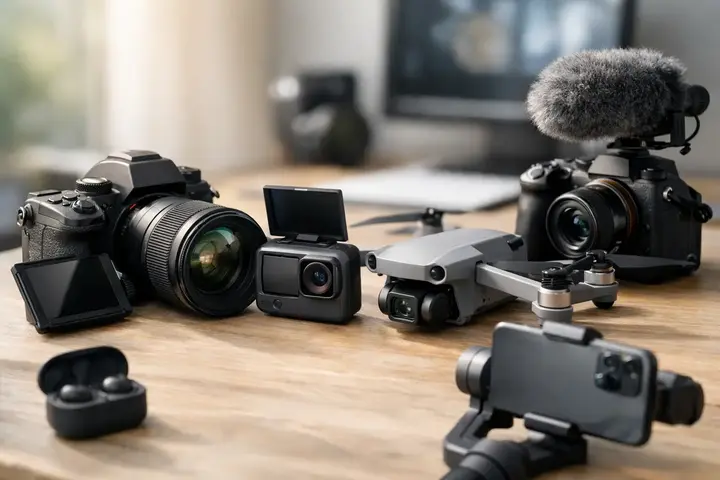
When your phone camera no longer keeps up with your ideas, choosing a dedicated camera usually comes down to one reason - you need a more predictable result. The best cameras for content creators are not simply the ones with more numbers in the spec sheet. They are cameras that, in a specific workflow, let you shoot quickly, record reliably, and get material you can publish without a struggle.
Content creators have needs that differ more than it first seems. For one, the priority is a lightweight camera for everyday vlogs; for another, reliable autofocus for product videos; for yet another, a 4K recording without limitations for interviews, courses, or promotional materials. That is exactly why the right question is not which camera is the best overall, but which camera is the most suitable for your format.
In brief
- Choose a camera based on practical needs and workflow, not just specification numbers.
- Priority for content creators: reliable autofocus, a flip screen, microphone input, battery life, and stabilization.
- If content is for business, choose a system (lenses, batteries, audio), not just the body.
- Consider renting to try the class of equipment before making a large investment.
What to choose for different tasks
| Task | Solution | Why |
|---|---|---|
| Vlogs and everyday social media content | A compact mirrorless or vlogging camera with fast autofocus, a flip screen, and light stabilization. | What matters most is a fast workflow — power-on, reliable face/eye autofocus, and convenient usability. A compact solution makes travel and quick publishing easier. |
| YouTube videos and livestream channels | A modern mirrorless body with good 4K recording, microphone and headphone ports, and the option to add brighter lenses. | YouTube requires consistent image quality and a smooth editing workflow; a system with a broader lens selection lets you develop style and quality. |
| Product reviews and close-up demonstrations | A camera with fast and accurate close focusing or easy-to-use manual focus and a suitable macro/standard lens. | The transition from face to object is critical; good focusing and the right lens make the video more professional and reduce mistakes. |
| Interviews, podcasts, and live streams | A solution with continuous power or a long-lasting battery, stable HDMI output, and high-quality audio options. | Reliability for long recordings and audio control are more important than maximum resolution; a good external microphone and headphone monitoring ensure a professional result. |
| Commercial projects and client work | A full-frame or professional mirrorless system with dual card slots, professional codecs, and good thermal management. | Reliability, color management, and flexibility in post-production are essential in client projects, where rare mistakes can be expensive. |
| Moving content and events | A camera with built-in or effective lens stabilization and an additional gimbal or tripod kit. | Good stabilization combined with a gimbal or tripod is important for smooth movement; sometimes it is better to invest in stabilization than to increase the frame rate. |
How to understand which are the best cameras for content creators
If a camera is chosen for social media content, the most important thing often is not maximum resolution. Much more important is how quickly the camera powers on, how reliably it keeps a face in focus, whether it has a flip-out screen, and whether the audio connection requires additional solutions. In practical work, these aspects affect the result more than theoretical sensor numbers.
For YouTube creators and company marketing teams, consistency is usually important. That means stable color reproduction, clean indoor image quality, a clear file workflow in editing, and the ability to connect a microphone or headphones. If filming happens regularly, battery life and overheating control during longer recordings also become important.
For those creating ads, courses, or client projects, the requirements become higher. Here there is often a need for 10-bit video, log profiles, better control of dynamic range, and broader lens options. This is already a step closer to a professional video system, where the camera is only one part of the overall solution.
Which parameters really affect the choice
Sensor size is still significant, but it is not the only criterion. Full-frame cameras usually perform better in low light and more easily achieve pronounced background blur. At the same time, APS-C or Micro Four Thirds systems are often more compact, cheaper, and more practical for everyday content production, especially if you often film handheld or on the go.
Autofocus is an area where compromises are felt immediately. If you create talking-head videos, product demonstrations, or solo vlogs, face and eye detection is a priority. Manual focus can be excellent for cinema work, but in everyday content it often only slows the process and increases the risk of mistakes.
Pay attention to stabilization as well. If filming is done indoors from a tripod, built-in stabilization is not so critical. For moving content, events, and reportage-style work, however, it can be very useful. Keep in mind that even good stabilization does not always replace a gimbal or tripod if you need consistently smooth motion.
Audio options are another point that is often underestimated. For content creation, a camera should ideally have at least a microphone input. If you plan regular filming for interviews or more professional videos, a headphone output gives much greater control over recording quality. Poor video is sometimes tolerated by viewers, but poor sound - rarely.
Camera types and what they are best suited for
Compact cameras and vlog cameras
This category is suitable for those who value speed and simplicity. A compact camera with good autofocus, quality 4K video, and a flip screen is often enough for TikTok, Instagram Reels, YouTube vlogs, and everyday travel content. Its advantage is size and a lower entry barrier.
The downside is a smaller sensor, more limited or absent lens-swapping options, and lower flexibility for more serious commercial work. If your content is dynamic and needs to be published quickly, this format is very convenient. If you plan to grow into more complex video production, over time you may run out of headroom.
Mirrorless cameras
For most people today, mirrorless systems are the most rational solution. They combine good image quality, broad video capabilities, modern autofocus, and lens choice. In this segment you can find both cameras for beginners and models for commercial work.
For a beginner, a mirrorless camera provides room to grow. You can start with a versatile zoom lens, then later add a brighter prime lens for portraits, product videos, or interviews. It is precisely this system flexibility that is often the main argument in favor of this category.
Full-frame cameras
Full-frame models usually become relevant when content is already generating income or there is a clear need for higher image quality. They often perform better in challenging lighting, offer a wider dynamic range, and deliver a more visually convincing result in ads, interviews, and professional YouTube formats.
However, the total cost must be considered here. Not only the camera, but also full-frame lenses, filters, memory cards, and often a more powerful editing computer increase the budget. If the main content is for social media, this is not always an economically justified first step.
The best cameras for content creators in different scenarios
If you film yourself alone, the safest choice is usually a camera with excellent autofocus, a flip-out screen, a simple menu, and a stable 4K recording. In this scenario, convenience is more important than the most cinematic possible image. The less time you spend in settings, the more time remains for the content itself.
If you create product reviews, e-commerce videos, or unboxing content, the camera should also be evaluated by how it focuses on close-ups. Some systems move more naturally and reliably from a face to an object held in front. This directly affects how professional the final material looks.
If the goal is podcasts, interviews, or livestreams, the camera is only part of the package. Here you also need to think about continuous power, a clean HDMI signal, long recordings without interruptions, and good compatibility with external audio. Sometimes it is more correct to choose a slightly simpler camera and invest more in lighting and sound.
If you work on client projects, reliability comes to the forefront. Two memory card slots, more professional codecs, better thermal management, and more flexible color grading become more valuable than things that seemed essential at a hobby level. Here the camera is already a work tool, not just a content device.
What not to overvalue in the first purchase
A common mistake is overpaying for features that will not be used in everyday life. 6K or 8K recording sounds impressive, but if you publish mainly on social media or in a standard YouTube format, a good autofocus, comfortable ergonomics, and sensible file handling will matter much more. A very high frame rate is also not decisive if you rarely use slow motion.
Do not ignore the importance of lenses. Even a good camera with a mediocre lens or one unsuitable for the task will not deliver the expected result. For many content creators, a single versatile fast lens or a quality wide-angle lens provides a more visible benefit than moving to a more expensive camera body.
It is also worth considering renting if you are choosing between two classes or need specific gear for a project rather than for everyday use. This helps test ergonomics, video file workflow, and whether a particular model really matches your working style. This approach often reduces the risk of a bad purchase.
A practical choice formula
If the budget is limited, choose a modern mirrorless camera with good autofocus, 4K video, a microphone input, and a flip-out screen. That will be a solid foundation for most content formats. If mobility is the priority, look at a compact camera or a lightweight APS-C system.
If content is your business, look at the system, not just the body. Evaluate the lens lineup, battery availability, audio solutions, lighting compatibility, and potential growth over the next two years. This is where a specialized approach usually pays off better than an impulsive choice based on the most popular model.
For Master Foto clients, this question often starts with a camera but ends with a complete kit - lens, microphone, tripod, lights, and sometimes even a rental solution for a specific project. That is a practical approach, because content quality is determined not by one device, but by the whole system together.
If you are looking for your next camera right now, do not try to buy the maximum for every possible case. It is much wiser to find a model that precisely matches your content today and leaves no barriers to growth tomorrow.
Frequently asked questions
How do you choose between a compact, mirrorless, and full-frame camera?
The choice should be based on the content format and growth plan. A compact camera or APS-C is good for mobility and quick publishing; a mirrorless system offers flexibility and room to grow; full-frame is justified if you need high quality and can support the cost of lenses and accessories.
How important is autofocus for a content creator?
Very important — especially if you film alone or change focus between a face and objects. Good face and eye recognition autofocus reduces mistakes and speeds up the recording pace, which is essential for regular publishing.
Is 6K or 8K recording mandatory for content creators?
Usually not mandatory if you mainly publish on social networks or YouTube in 4K/1080p formats. More often, features like stable autofocus, audio ports, and ergonomics are more valuable, while 6K/8K can be useful for professional reframing and cropping.
How is importance split between the camera body and the lens?
The lens often determines the visual look more than the body itself; a bright prime lens or a quality wide-angle lens can improve results more than a more expensive body with mediocre optics. When choosing a system, think about the future lens lineup too.
When is it better to rent a camera instead of buying one?
Renting is smart if the need is project-specific or if you are undecided between technology classes. It lets you test ergonomics, workflow, and whether a particular model fits your style, reducing the risk of a bad purchase.
Which peripheral features should not be ignored in a first purchase?
Pay attention to the microphone input, headphone output, battery life, and memory card options. These features directly affect work quality and recording reliability, often more than higher resolution.
Useful links
- Bezspoguļa kameras - A good starting point if you are looking for a system with growth potential and a wide lens selection.
- Kompaktkameras - A convenient choice for vlogs and travel if mobility and quick publishing are priorities.
- Videokameras - Useful if your work requires long-recording reliability and professional video capabilities.
- Atmiņas kartes - Important for choosing the correct card type and speed to ensure stable 4K/high-bitrate recording.
- Video stabilizatoru aksesuāri - Stabilization is often decisive for moving content; here you will find gimbal and stabilizer solutions.
- Kameru piederumi - Microphones, batteries, chargers, and connections often determine recording quality more than the body itself.