
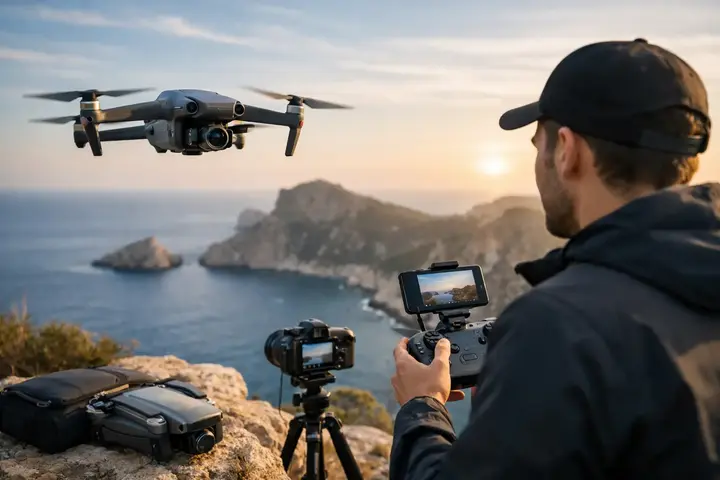
When a ground-level shot no longer provides the necessary scale, a drone becomes not a toy, but a full-fledged work tool. The best drones for content creators today are not just the ones that fly farther or faster. What matters most is how predictably they shoot, how safely they operate in real-world conditions, and how easily they fit into an everyday production workflow.
For a content creator, choosing a drone almost always starts with the wrong question - which model is the most powerful. In practice, it is much more useful to ask what kind of content it will be used for. Short vertical videos for social media, travel vlogs, real estate shoots, events, or advertising projects require different approaches. That is why there is no single universally best drone, but there are very clear best options for specific needs.
In brief
- Choose a drone based on the goal — short social media videos, travel vlogs, and commercial projects require different features.
- Priority: camera sensor (dynamic range), stabilization, and reliable positioning in wind — not just megapixels or flight time.
- If you need fast results, choose a compact model with simple operation and quick move from bag to shooting.
- For commercial projects, look for a larger sensor, 10-bit recording, and better codecs; for hybrid use, the kit (batteries, ND filters, bag) matters more than the “bare” price.
- Consider renting if you need a specific model for a short time — it lets you try a higher class without long-term commitments.
What to choose for different tasks
| Task | Solution | Why |
|---|---|---|
| Short social media videos (Instagram, TikTok, Shorts) | A compact, quickly foldable drone with good auto exposure and stabilization; easy transfer to a phone. | This workflow requires speed from bag to publish and predictable results without heavy post-production. Large files and complex color profiles can slow down quick publishing. |
| Travel vlogs and light mobile filming | A foldable mid-size drone with a better sensor and sufficient wind resistance. | Portability is essential, but better performance in low light and high-contrast scenes is also needed. A slightly larger model often delivers better visual quality, which pays off in editing. |
| Commercial projects, advertising, and real estate filming | A professional-grade drone with a larger sensor, 10-bit recording, wide codec support, and strong obstacle detection. | Client projects require color matching with other cameras, a high level of detail, and repeatable results across multiple flights. Better technical headroom provides flexibility in post-production and reduces the risk of the client rejecting the footage. |
| Hybrid use (hobby + work) | A mid-range or upper-mid-range drone plus a full accessory kit (extra batteries, ND filters, bag). | This approach provides enough headroom for commercial work without overpaying for rarely used features. A full kit improves work efficiency in the field. |
| Multiple flying sessions or a one-time high-end project | Consider renting from a trusted dealer to try a higher class or use more expensive equipment for a single project. | Rental gives access to better technology without a large purchase cost and helps you practically assess whether a specific model suits you. It is especially useful when moving from hobby to commercial work. |
How to evaluate which drones are the best for content creators
The first filter is camera quality, but megapixels alone are not enough. For a content creator, sensor size, dynamic range, color profile, and video codecs matter much more. If the material is intended for editing with color correction, 10-bit recording and D-Log or a similar profile provide a noticeable reserve. If the main goal is quick publishing without complex post-production, good auto exposure and reliable color straight out of the camera matter more.
The second critical point is flight stability. Many people look at maximum flight time in the technical specs, but in real projects it is often more important how the drone behaves in the wind. In Latvia, this is not a minor detail. On the open coast, near water, or in urban environments with air currents, a drone with good stabilization and solid positioning will deliver more usable footage than a model with theoretically longer battery life.
The third is size and workflow. The more compact the drone, the more likely it is to come with you. At the same time, smaller models usually mean a smaller sensor, weaker low-light performance, and more limited wind resistance. There is no single right answer for everyone here. For a travel content creator, saving space in the bag may be more important, while for a commercial videographer the priority will be image headroom in editing.
The best drones for content creators for different tasks
For everyday video and social media content
If content regularly ends up on Instagram, TikTok, YouTube Shorts, or in fast campaigns, the most practical are compact drones with simple setup and predictable automation. In this class, it is often not absolute image quality that wins, but the speed from bag to finished shot. It is important that the drone quickly locks onto GPS, holds position steadily, and offers intelligent flight modes that allow one person to get dynamic shots without an additional operator.
For this kind of use, a model that records 4K, provides good electronic and mechanical stabilization, and allows convenient transfer of material to a phone is often enough. If the content is published almost the same day, overly complex profiles and heavy files can even get in the way. A fast and simple result is often more valuable here than maximum technical headroom.
For travel vlogs and lightweight mobile filming
For travel content creators, the ideal drone is usually small, foldable, and light enough that it is not annoying to carry all day. In this segment, the balance between portability and image quality is crucial. Very compact models are great for spontaneous shots, especially on hikes, in cities, and on routes with lots of movement.
However, travel content often has to be shot in difficult lighting - at sunrise, sunset, or in high-contrast landscapes. That is why it is worth looking at models with a larger sensor, even if they cost more and take up a bit more space. If the priority is high-quality landscape video, this trade-off usually pays off in the first serious edit.
For commercial video, real estate, and advertising
If the drone is used in client projects, the demands rise sharply. It is no longer enough for the image to look good on a phone. Color matching with other cameras, detail, strong backlight performance, and the ability to achieve a stable, repeatable result across multiple flights become important. Here, models with larger sensors are clearly ahead.
In real estate shooting, accurate obstacle detection, smooth movements, and the ability to maneuver safely between buildings are useful. In advertising work, higher-quality codecs and broader color grading options often also matter. If projects combine a ground camera, gimbal, and drone, post-production flexibility becomes a real time saver rather than a theoretical bonus.
For hybrid use - hobby plus work
For many content creators, a drone is not just one tool for one niche. It is used both in personal projects and in client work. In this case, you should look for a model that does not overpay for features that will be used rarely, but at the same time does not limit growth after six months. Usually this means a mid-range or upper-mid-range drone with good camera headroom, a reliable obstacle sensor system, and enough flight time for multiple takes.
This is a segment where the decision is often influenced not only by the drone itself, but by the whole kit - extra batteries, charging solution, ND filters, spare propellers, and a carrying bag. Buying only the “bare” drone makes the initial price look attractive, but in working reality the full kit is almost always the more rational choice.
What not to miss when comparing models
In camera specifications, it makes sense to look not only at resolution, but also at frame rates and crop limitations. Some drones at 4K 60p mode keep a full sensor readout, while others introduce additional cropping. That can change the feel of the shot more than it seems in a table. If you shoot wide landscape shots or architecture, such a difference is very noticeable.
Vertical content is also important. Some models handle it in software, others with a sensor or gimbal adjustment. If most of the work happens on social media, it is worth looking for a solution that does not require unnecessary reframing and does not lose quality. This is especially relevant for short-form video producers and brand content teams.
You also should not ignore the controller quality. A bright screen, stable connection, and clear controls directly affect work in the field. If the screen is hard to see on a sunny day, the risk of mistakes increases and the ability to precisely control composition decreases. This is one of those factors that you only appreciate after the first long filming evening.
When buying is not the only right move
Not every project requires buying a drone right away. If you need a specific model for a single advertising job, real estate shoot, or trip, rental may be more economically justified. It allows you to use a higher class without the full purchase cost and at the same time understand whether the specific model really matches your workflow.
This is especially useful for content creators who are only transitioning from hobby work to regular commercial jobs. At this stage, it is not always clear whether the priority will be a compact drone for everyday video, or a more serious model with better image headroom. Practical testing says more than any specification table. For exactly this reason, a specialized retailer with consultation and rental options, such as Master Foto, is for many the safest path to the right choice.
Realistic expectations about drone work
Even the best drones for content creators do not solve everything automatically. They do not compensate for weak framing, poorly planned lighting, or a chaotic filming plan. A good drone gives more options, but a good result still starts with a clear idea - what exactly you want to show, what kind of movement is needed, and how the drone shot will complement the rest of the material.
The regulatory and practical context must also be taken into account. Flight restrictions, weather conditions, people’s safety, and insurance issues are not secondary in commercial work. In a professional approach, a drone is not just a camera in the air, but a tool that must be used responsibly and technically correctly.
The right model is usually not the one with the most impressive numbers in the ad. It is the drone you will take with you, trust on the job, and be able to use without fighting settings. If the choice is based on your real filming scenarios rather than just a specification comparison, the drone becomes an investment that starts working from the very first project.
Frequently asked questions
How do I determine which drone is right for me?
Start with the type of content you plan to shoot — short social videos, travel vlogs, or commercial work require different features. Also evaluate the workflow: is the priority fast publishing or a wide post-production margin?
Is it better to choose a drone with longer flight time or better stability in wind?
In real-world work, stability and positioning in wind are often more practical than theoretically longer flight time. If you film often near the coast or in urban environments, choose a model with good stabilization and positioning systems.
When is renting a drone a better solution than buying?
Rental is useful when you need a specific model for one project or when you want to try a higher class before buying. It lets you use professional equipment without long-term commitments and practically assess fit for your workflow.
How important are the sensor and 10-bit recording?
The sensor and dynamic range definitely affect image quality, especially in high-contrast scenes and backlight. 10-bit recording and log profiles provide a significant margin for color correction and professional post-production.
How do I choose a drone for social media content?
Look for a compact, quickly foldable model with simple setup, good auto exposure, and stabilization. Vertical framing options and easy transfer to a phone are a big time saver for everyday publishing.
What should I do if the screen is hard to see in sunlight?
Use a bright controller or an additional external monitor with a sun hood, or carefully plan your compositions before longer flying sessions. Knowing the controller functions and using alternative information (histogram, levels) reduces the risk of mistakes in the field.
Useful links
- Drones and Action Cameras - A category with drone and action camera assortment, useful for browsing the compact and professional models mentioned in the article.
- RENTAL — drone rental - The article recommends a rental option for testing or one-time projects; this page leads to the rental offer.
- Video filming equipment - Related content about accessories and equipment that is often combined with drone use in the field.
- DJI DRONE MINI 5 PRO — product - An example of a compact, travel-segment drone that matches the article section on portability and video quality.