
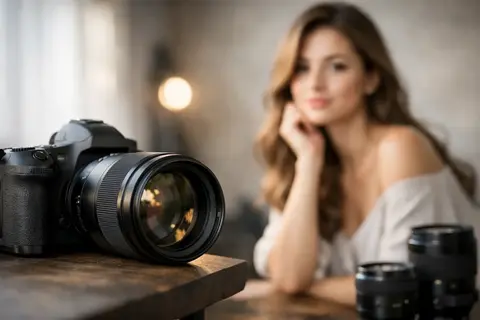
Portrait quality is often determined not by the camera body, but by the distance to the subject, the light, and the chosen lens. The best lenses for portrait photography are not one universal model - the most suitable solution changes depending on whether you are photographing family sessions outdoors, business portraits in offices, studio work, or weddings with changing light. The right lens helps achieve natural facial proportions, control the background, and reliably focus on the eyes.
In brief
- Choose the focal length based on the space and framing — 50 mm for a comfortable environmental/half-body composition, 85 mm for a classic portrait look, 105–200 mm if you want more background blur.
- A prime lens offers a larger aperture and optical character; a zoom is more practical for changing workflows or reportage.
- Pay attention to the combination of aperture, focal length, and autofocus accuracy — f/1.2–f/1.8 gives bokeh, but requires precise focusing.
- Before buying, try the lens with your camera and consider renting — this reduces the risk of mistakes and shows real compatibility with the mount.
- For video work, check the focus motor noise and focus breathing — lenses that are ideal for photo are not always suitable for silent video focusing.
What to choose for different tasks
| Task | Solution | Why |
|---|---|---|
| Hobby portraits and content creation | 50 mm f/1.8 or 35–50 mm zoom with a large maximum aperture | Compact, inexpensive compared with large wide-aperture lenses, and versatile enough for small spaces and environmental portraits. |
| Corporate and business headshot portraits | 85 mm f/1.8–f/1.4 or 70–135 mm prime lens | Maintains natural proportions and separates the subject from the background without distortion. |
| Wedding and event photography | 70-200 mm f/2.8 zoom lens together with one fast prime (e.g., 50/85 mm) | The zoom provides flexibility for changing shots and distance, while the prime adds strength in low-light situations. |
| Studio portraits and reproduction quality | Fixed 85 mm or 105 mm with high optical quality and reliable autofocus | In controlled lighting, consistent sharpness, color rendering, and focusing accuracy matter more than maximum aperture. |
| Small spaces and environmental portraits | 35–50 mm primes or 24-70 mm f/2.8 zoom | A wider angle of view makes it easier to work in limited space without losing contact with the model. |
| Photo + video content creators | Quiet AF motor lenses with minimal focus breathing, such as modern mirrorless portrait lenses or cine versions | For video, silent focusing and smooth transitions are important; in photo mode, sharpness and aperture still matter. |
What a portrait lens should be able to provide
A portrait lens is usually expected to have three qualities: an appropriate angle of view, a sufficiently large maximum aperture, and reliable autofocus. These parameters work together. The focal length determines perspective and working distance, the aperture affects the amount of light and background blur, while autofocus determines how consistently the most important point - the eyes - will be sharp.
A large aperture, such as f/1.2, f/1.4, or f/1.8, allows shooting in lower light and visually separating the person from the background. However, with a very shallow depth of field, focusing must be precise. If the subject turns their head or the photographer shifts focus after recomposing the frame, the eyes can fall out of the sharp zone. That is why eye-detection autofocus is useful for portraits shot wide open, as well as a lens with a fast and quiet focusing drive.
The optical behavior of the lens at wide aperture is also important. Some models will have less sharpness in the corners or visible vignetting, but in portraiture that is not necessarily a drawback. If the face is in the central part of the frame, soft corners and a darker background can even help direct attention to the person. For corporate group portraits or reproduction-quality printing, however, a lens with uniform sharpness across the frame is often preferable.
Best lenses for portrait photography by focal length
The focal length should be chosen not only based on background blur. You need to consider the available space, the type of portrait, and how comfortably the subject can communicate with the photographer.
50 mm - a flexible choice for everyday portraits
A 50 mm lens on a full-frame camera is a practical first prime lens. It is wide enough to create a waist-up portrait or an environmental portrait in a small space, yet still allows for pleasant background blur. Lenses with an f/1.8 aperture are usually compact and affordable, making them a logical choice for hobby photographers and content creators.
For close-ups with 50 mm, you should not get too close. At a very short distance, the nearest parts of the face, especially the nose, may appear larger in the frame. This is not a defect of the lens, but a result of perspective. To maintain natural proportions, 50 mm is better used for half-length, three-quarter, or environmental portraits.
On a APS-C camera, 50 mm provides an equivalent angle of view of approximately 75-80 mm, so it becomes a very classic portrait solution. In the Micro Four Thirds system, a similar view is provided by an approximately 42.5 mm lens.
85 mm - the classic portrait choice
85 mm on a full-frame camera is often considered the portrait standard. It allows shooting from a comfortable distance, preserves natural facial proportions, and effectively separates the subject from the background. This focal length works well for individual portraits, couple sessions, weddings, and business images, if the space allows you to step back a few paces.
An 85 mm f/1.8 lens offers most photographers a very good balance of quality, weight, and price. An f/1.4 or f/1.2 version provides even more light and more pronounced background blur, but it is usually larger, heavier, and significantly more expensive. Such an investment is justified if you regularly photograph paid portrait sessions, weddings, or work in available natural light.
It should be remembered that 85 mm is not ideal in a small apartment or a narrow studio. There may not be enough distance to capture a full-body portrait. In that situation, 50 mm or 35 mm will be more practical, even if the visual character of 85 mm seems more attractive.
105 mm, 135 mm, and 70-200 mm - for controlled backgrounds and working from a distance
Longer focal lengths, such as 105 mm or 135 mm, create a very clean background and allow expressive head-and-shoulders portraits. They are also useful at events, fashion shoots, and outdoor settings where the photographer can step back. This angle of view reduces the role of the surrounding environment and focuses attention on facial expression.
A 70-200 mm f/2.8 zoom lens is a professional, versatile working tool. With one lens, you can quickly move from a medium shot to a tight portrait without changing position or losing contact with the subject. This is especially valuable at weddings, events, and situations where the framing changes continuously. In return, you get greater weight, size, and price, so for small, calm portrait sessions, a prime lens is often more pleasant.
Prime lens or zoom
A prime lens usually offers a larger maximum aperture, less weight, and more pronounced background blur. A 50 mm f/1.8 or 85 mm f/1.8 often delivers more than enough results for a professional-level portrait if the photographer knows how to place the subject and control the light. A prime lens also imposes discipline - to change the frame, you have to move yourself.
A zoom lens is more suitable for changing work conditions. A 24-70 mm f/2.8 allows you to shoot both environmental portraits and closer frames in a single session, and it is a practical solution for small teams, reportage style, and corporate events. A 70-200 mm f/2.8 provides even greater separation from the background, but requires space and physical endurance during a long workday.
The choice should not be based only on the aperture number. If the main task is photographing active children or people at an event, fast framing changes may be more valuable than f/1.4. On the other hand, in a carefully crafted studio portrait with one subject and controlled light, a prime lens often provides greater creative flexibility.
Aperture and bokeh - not just a question of f/1.2
Bokeh, or the character of out-of-focus areas, is one of the reasons portrait lenses are so in demand. However, a blurred background is not created by a large aperture alone. It is also influenced by focal length, distance to the subject, and distance between the subject and the background. Even with f/2.8, you can achieve a very soft background if you use a 135 mm lens and place the background farther away.
f/1.2 and f/1.4 lenses give a distinctive image character, but they require more careful work. In a close portrait at f/1.2, one eye may be sharp while the other becomes slightly softer if the face is not parallel to the camera. Sometimes f/2 or f/2.8 is the more professional choice - both eyes are sharp, facial contours remain clear, but the background still does not distract.
In studio strobe use, maximum aperture is less decisive because light output can be controlled. There, lens choice is more often about sharpness, color transitions, focus accuracy, and a convenient working focal length. Outdoors or in dark event venues, the advantage of a large aperture becomes much more noticeable.
Before buying, check the system and the working scenario
The lens must match the specific camera mount. Canon RF, Nikon Z, Sony E, Fujifilm X, Micro Four Thirds, and lenses from other systems are not directly interchangeable. An adapter is sometimes a good solution, especially when moving to a mirrorless camera, but you should check autofocus performance, size, and feature compatibility.
If you photograph video and portrait sessions at the same time, pay attention to the focusing motor noise and focus breathing. A photo lens may be optically excellent, but in video footage, a visible loss of angle of view during focusing changes can be distracting. For content creators, this is a practical criterion alongside photo quality.
Before purchasing, it is worth trying the lens on your camera. Check how quickly it finds the eye indoors and against backlight, whether the weight is comfortable during a longer session, and whether the chosen focal length matches your usual locations. Renting is a rational way to compare, for example, 50 mm, 85 mm, and 70-200 mm lenses in a real assignment rather than only by specification tables. Master Foto consultation and rental option can help make the decision with a lower risk of error.
The best portrait lens is the one you can confidently use in a specific place, light, and working pace. Start with a focal length that matches your frames, and only then evaluate whether an extra aperture stop will really give you an advantage in your photography practice.
Frequently asked questions
How do you choose between a prime and a zoom lens for portraits?
A prime lens usually offers a larger maximum aperture, better optical quality, and lower weight, which are valuable for portraits. A zoom lens gives flexibility in changing workflows and makes composition changes easier without moving your position. The choice depends on whether you prioritize creative look or practical working efficiency.
Is f/1.2 or f/1.8 always better for portraits?
There is no single answer — a large aperture gives stronger bokeh and better low-light performance, but it requires more precise focusing. In many cases, f/2–f/2.8 provides better eye sharpness in both eyes and more practical studio use. Consider your working pace and how often you really need the maximum aperture.
What focal length is optimal for studio head-and-shoulders portraits?
Usually 85 mm or 105 mm primes are a classic choice for head-and-shoulders portraits because they preserve natural proportions and a pleasant perspective. 135 mm can give an even tighter composition and warmer background separation, but it requires more working distance. Choose based on the size of the studio and the distance you can maintain from the subject.
Does an adapter affect autofocus performance?
Yes — the adapter’s electronic compatibility and performance can affect autofocus speed and accuracy, especially in combinations of modern mirrorless cameras and older lenses. Before a long-term purchase, check whether the adapter fully supports your camera’s AF modes and eye detection. Renting the adapter or testing it with your equipment is recommended.
How can you practically achieve pleasant bokeh without an f/1.2 lens?
Bokeh quality is also affected by focal length and the distances between the camera, the model, and the background. By using a longer focal length (for example, 105–200 mm) and placing the background farther away, you can get a very soft background even at f/2.8. This means that proper composition can often replace the need for a very wide aperture.
What should you check before buying a lens for portrait photography?
Check the focal length relative to your usual locations, autofocus accuracy (especially eye detection), weight for longer sessions, and optical behavior at wide aperture. If possible, try the lens with your camera or rent it to assess real performance before making a large investment.
Useful links
- Objektīvi - A wider selection of lenses for portrait focal lengths and specifications.
- Objektīvu adapteri - Information about adapters if you are switching to another mount or want to use existing lenses on a mirrorless camera.
- Bezspoguļa kameras - Tips for choosing mirrorless systems and their impact on autofocus and lens compatibility.
- Kameras - General information about camera bodies that should be considered together with lens choice.
- Objektīvi un aksesuāri - Rental options to try different lenses before buying.
- Studijas zibspuldžu komplekti - Recommendations for studio lighting, where maximum aperture is not the only quality factor.
- NOMA - General rental section if you want to try lenses or equipment in the real session.