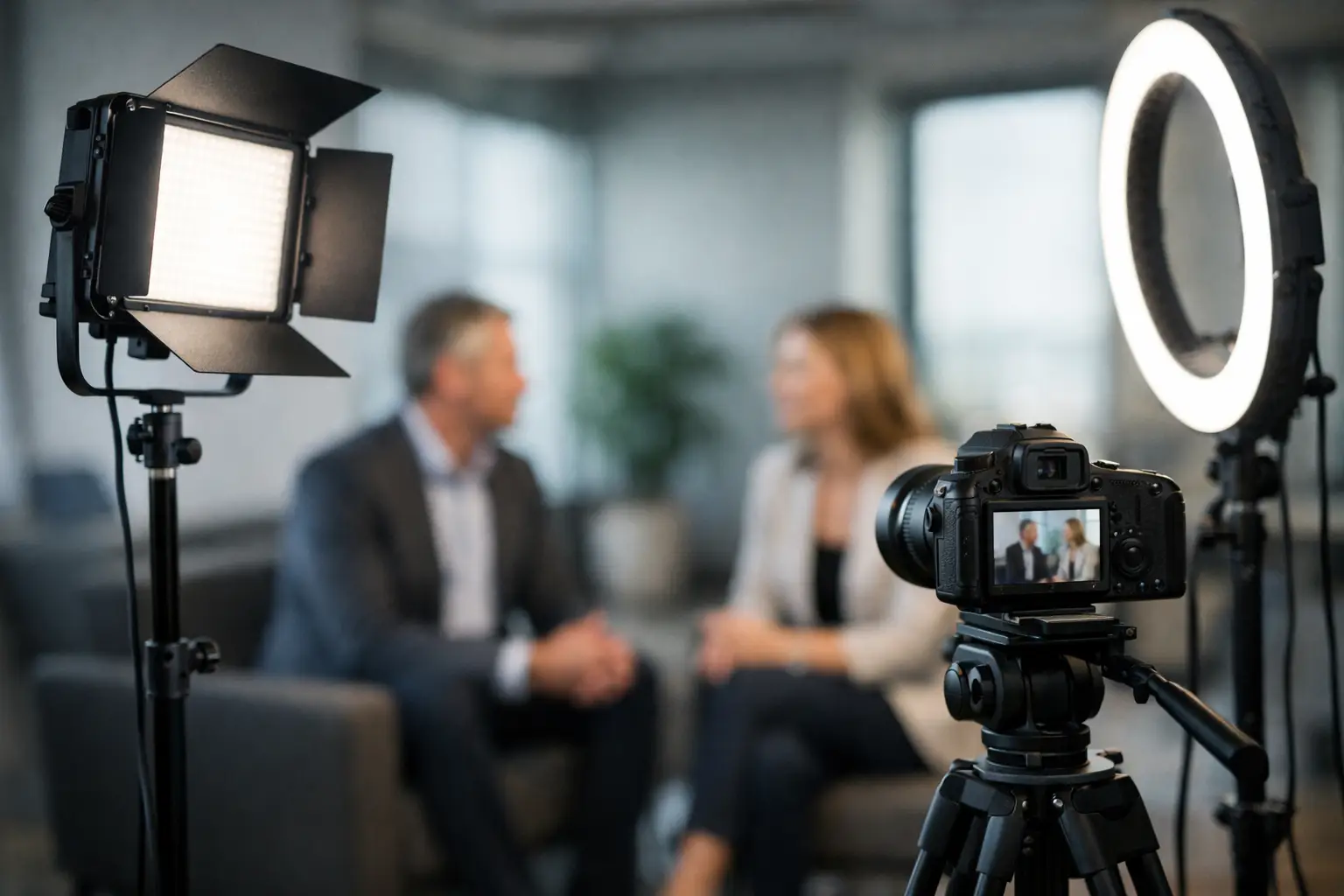
In an interview frame, the viewer notices one thing very quickly - whether the person looks trustworthy and clearly lit, or whether the face is sinking into shadows, the forehead is shining, and the background looks random. That is exactly why the best video lights for interviews are not just a technical purchase. They affect image quality, the pace of work on set, and how easy it will be to repeat the same result on the next shooting day.
In brief
- Choose the solution by use case — LED panels for regular, fast interviews; COB for commercial quality.
- Prioritize light quality (CRI/TLCI) and color temperature adjustability, not just watts.
- Think about diffusion and the character of the light — a softbox or diffuser significantly improves facial modeling.
- If you film on location, check power options, weight, and stand stability before choosing.
What to choose for different tasks
| Task | Solution | Why |
|---|---|---|
| Small office or home studio | Two adjustable LED panels with stands — one for the key light, the other for fill or background. | Easy to set up, with a quickly repeatable result and the ability to adjust brightness and color temperature. |
| Commercial interviews / multi-camera shooting | A powerful COB light as the main source together with a softbox and a separate background light or backlight. | Provides better headroom, control over modeling, and deeper separation from the background, which is important for professional projects. |
| On-location reports and fast setup situations | Compact battery-powered LED lights or smaller COB systems with portable modifiers. | Battery life, weight, and quick assembly are important — a compromise between light quality and mobility. |
| Shooting in a room with large windows or changing daylight | A bi-color solution or a more powerful daylight/bi-color panel so you can adjust color temperature and output. | To maintain consistent skin tone rendition and exposure when natural light changes. |
Frequently asked questions
How do I choose between LED panels and COB lights for interviews?
LED panels are more convenient and quicker to set up, good for smaller spaces and regular sessions. COB lights usually offer more power and better modeling with modifiers, so they are more often chosen for commercial projects.
How important are CRI and TLCI ratings for interview lighting?
High CRI/TLCI provides more accurate skin tone and color reproduction on camera. In practice, choose lights with clearly documented color indexes, because that reduces the time needed for color correction in post-production.
Can on-camera light replace a full lighting kit?
On-camera lights work well as fill or accent light and in highly mobile situations. However, they rarely can provide enough controlled key light for an aesthetic seated interview.
What should I do if I’m filming on location and need long-lasting light without mains power?
Choose lamps with a built-in battery or the option to run from external batteries, and check the real runtime at the intended brightness. Also consider extra chargers and spare batteries as part of the kit.
Is a softbox always necessary for interview lighting?
A softbox or other diffusion is not mandatory, but it significantly softens the light and creates more pleasant facial modeling. If the goal is a natural, soft look, diffusion is often the simplest path to a better result.
Is it better to buy lights or rent a kit?
If filming is regular and consistency is needed, buying usually pays off in the long term. Renting, on the other hand, is a logical solution for one-off projects, pre-purchase tests, or when a specific, powerful setup is needed.
Useful links
- LED gaismas paneļi - A wide selection of LED panels suitable for office and home studio interviews.
- LED lampas kamerai - Compact on-camera LED lights often used as fill or mobile lighting solutions.
- LED lampas barošana - Information about battery and power solutions, important for on-location filming.
- Foto studijas aksesuāri - Softboxes and other modifiers that significantly improve the character of interview lighting.
- Video gaismas (noma) - Rental options if you need a specific kit for a single project or test.
- Statīvi apgaismojumam - Durable stands and supports that reduce risk and improve work efficiency.
Interview lighting does not require an overly complicated setup, but it does require the right choice. Different scenarios call for different solutions - in one case two LED panels in a small office are enough, elsewhere a powerful COB light with a softbox is needed, while in a mobile reporting situation battery operation and quick setup become crucial. If a light is chosen only by price or wattage, the result often disappoints.
Which video lights work best for interviews
In practice, three types are most often used for interviews - LED panels, COB-type continuous lights, and compact on-camera lights. Each option has its own use case.
LED panels are convenient when a simple, fast, and predictable solution is needed. They provide a broad light area, often offer brightness and color temperature adjustment, and are easy to understand even for users without studio experience. For small interviews in an office, classroom, or home studio, they are a logical starting point. The downside - some panels are not powerful enough, especially when working at a greater distance or competing with daylight from windows.
COB lights are more flexible and more professional, especially together with light modifiers. They allow for more directed, controlled, and powerful lighting. If an interview is being filmed for commercial content, broadcasts, brand videos, or multi-camera production, a COB system usually provides a better margin. Keep in mind that such a solution often requires a stand, softbox or dome, as well as more transport space.
On-camera lights are rarely the main solution for interviews. They are useful as fill light, accent light, or in a very mobile situation where there is no time for a full setup. If the plan is to film a seated interview with an aesthetic image, relying only on a light mounted on the camera is usually not the best choice.
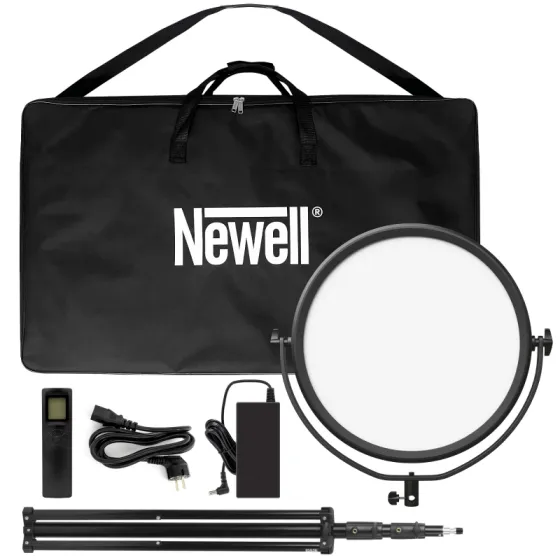 ProductNewell Air Artha XL 41cm LED Light and Talos Light Stand SetView product
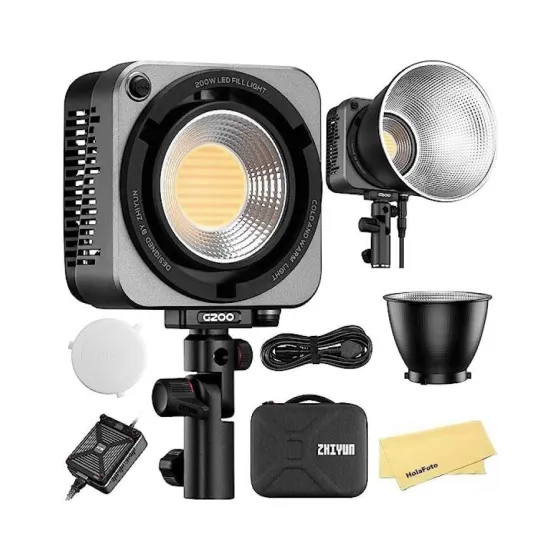 ProductZhiyun LED Molus G200 COB LightView product
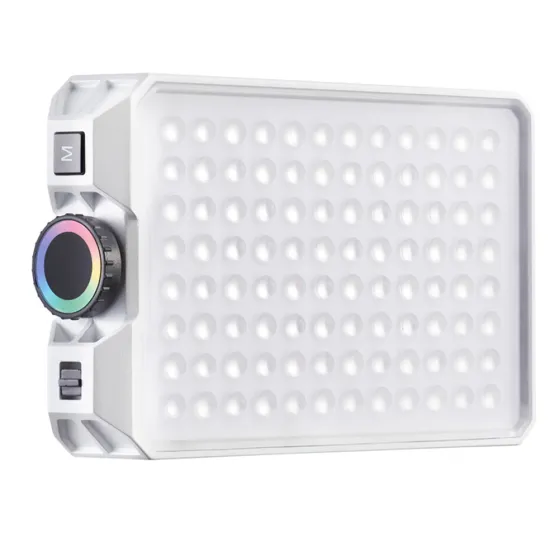 ProductGodox C30R LITEMONS RGB Pocket LEDPanel LightView product
What determines whether a light is really suitable for interviews
The first criterion is light quality, not just power. In interviews, natural skin tone reproduction is very important, so attention should be paid to the CRI and TLCI ratings. The higher they are, the more reliably the camera will reproduce skin tone. For practical work, it is advisable to look at models with high color accuracy rather than the cheapest options with unclear specifications.
The second important factor is color temperature. If filming takes place in different locations, bi-color lights are more convenient because they allow you to adapt to window light, warm room lamps, or a neutral studio setup. Daylight-type lights, on the other hand, are often more powerful and simpler, but less flexible. If you mostly film in one controlled environment, daylight can be a very good solution. If locations change, adjustable temperature saves time in everyday work.
The third is the character of the light. For interviews, you rarely want hard, sharp shadows on the face. That is why not only the lamp itself is important, but also diffusion. Even a good LED panel without softening can produce a flat or unpleasant result, while a COB lamp with a softbox can create volume and a pleasant transition in the shadows. This is where one of the main compromises appears - the prettier and softer the light, the larger and slower the setup becomes.
The best video lights for interviews in different scenarios
In a small office or home studio, the most practical solution is often two LED panels with stands. One is used as the key light, the other as the fill or background light. This configuration is compact, easy to understand, and does not require much space. If interviews are filmed regularly in one place, it is an effective starter kit.
If the task is to achieve a more visually expressive and commercial result, one powerful COB light with a softbox as the main source and a separate smaller light for the background or backlight works better. This allows you to more precisely separate the person from the background and create a deeper image. This solution is often chosen by videographers, producers, and company content teams that want consistent quality across different client projects.
When filming on location, priorities change. Battery power, quick assembly, and weight become important. Compact LED lights or smaller COB systems with portable modifiers work well here. If the team has to set everything up in a few minutes, an overly large softbox kit can become an obstacle, even if it would produce better light in a studio.
If the interview takes place in a room with large windows, you need to think not only about the type of lamp, but also about its reserve power. Natural light can change quickly, and weak light in such a situation can no longer hold exposure. That is why more powerful solutions often win near windows, especially if filming takes place during the day without full light control.
How to create a simple and professional interview lighting setup
The basic principle is simple - key light, fill, and background or backlight. But you do not necessarily have to use all three sources. In many situations, one well-positioned key light and the sensible use of the room environment are enough.
The key light is usually placed slightly to the side of the camera and slightly above eye level. This gives natural facial modeling. If the light is too central, the image becomes flat. If it is too far to the side, one side of the face can become too dark.
Fill light helps reduce contrast. It can be created with another lamp, a reflector, or even a light wall. If the goal is a corporate, clean, and easy-to-read frame, softer contrast usually works better. If a more dramatic aesthetic is desired, fill can be reduced.
Backlight or background light is not mandatory, but it often makes the image look more professional. A small accent on hair, shoulders, or the background helps separate the speaker from the room. This is especially useful in darker interiors or neutral offices, where the background might otherwise look too flat.
What is often underestimated when choosing interview lights
One of the most commonly ignored aspects is the quality of stands and mounts. The lamp itself may be good, but an unstable stand complicates work and increases the risk during filming. If the kit is moved regularly, durable equipment pays off very quickly.
Another aspect is noise level. Some powerful lights have active cooling with a fan. In an interview, where the microphone is relatively close, this can be significant. It will not always be a critical problem, but in quiet rooms it is definitely worth checking before making a choice.
Power supply is also important. A mains adapter is convenient in the studio, but on location a battery system is often needed. Sometimes users buy a good lamp, only to later realize that mobile filming requires additional batteries, chargers, and mounts. The total system cost should therefore be evaluated more broadly than the price of a single lamp.
Buy or rent
If interview filming is a regular part of the job, your own lighting system is usually a logical investment. It allows you to standardize the result, prepare the shoot faster, and know exactly how the lights behave in specific setups. This is especially true for agencies, content teams, studios, and videographers with a stable project flow.
By contrast, a rental solution makes sense if a specific kit is needed for a separate project, a larger interview, or a test before purchase. It is also practical if you usually film smaller jobs, but occasionally need a more powerful light, larger modifiers, or a full multi-light configuration. In such situations, flexibility is often more valuable than ownership.
That is why the choice between an LED panel and a COB system is not only about the image. It is also about the work model, transport, locations, and how quickly the team needs to be able to start filming. For Master Foto clients, this is often the decisive question - not which lamp is theoretically better, but which system will actually work in specific projects in Latvia.
If you need a short practical direction, then for small and regular interviews a safe start is a quality LED kit with adjustable color temperature. If the goal is a higher visual level and greater control, a COB light with a good softbox is often the preferred choice. But the best solution is always the one that allows you to quickly build stable, repeatable light suited to the specific location - without fighting the equipment on filming day.