
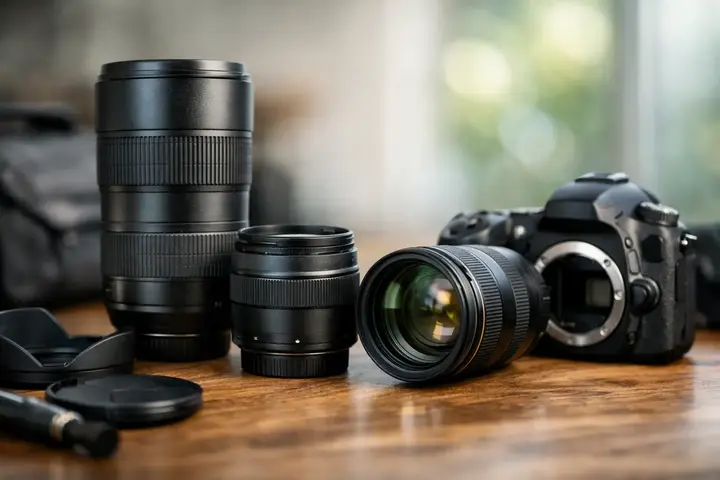
If a camera starts to feel limiting, the problem is often not the body but the lens. That’s why a camera lens buying guide is a good starting point for anyone who wants a sharper image, better low-light performance, or a more suitable frame for a specific genre. A properly chosen lens affects not only image quality, but also how comfortably and quickly you can work.
Choosing a lens is not about the most expensive model on the shelf. What matters more is understanding what you photograph or film most often, the environment you work in, and how much flexibility you actually need. Portraits, sports, events, and product photography all have different requirements, and one universal solution is rarely the best in the long run.
In brief
- Choose a lens based on the real use case first — portrait, landscape, sports, or product photography.
- Check compatibility with the camera mount and sensor size before choosing optics.
- Aperture, autofocus, and stabilization are critical for work efficiency, not just specifications.
- Consider renting or testing in real work if you need a specialized lens that you use less often.
- Ergonomics, weight, and working distance affect the choice just as strongly as optical quality.
What to choose for different tasks
| Task | Solution | Why |
|---|---|---|
| Portrait photography | A prime 50 mm or 85 mm with a large aperture (e.g., f/1.4–f/1.8) | This focal length provides a natural perspective and pleasant background blur, which helps highlight the subject. The large aperture allows work in available light and control over depth of field. |
| Reportage and wedding photography | A versatile 24–70 mm zoom lens with good autofocus and stabilization | The 24–70 mm class provides flexibility in different situations without frequent lens changes, while stabilization and fast AF help capture important moments. It is a practical solution for a mobile working environment. |
| Sports and nature / telephoto photography | A 70–200 mm telephoto lens or longer with fast autofocus and, if possible, optical stabilization | Telephoto lenses let you bring distant events closer and compress perspective, while stabilization and accurate AF reduce the number of missed shots in dynamic situations. |
| Interiors and real estate / vlogs in tight spaces | A 16–35 mm wide-angle lens or an ultra-wide solution with minimal distortion | A wider field of view lets you include more of the space in the frame; it is important to choose optics with controlled distortion and good detail reproduction so the image looks professional. |
| Product photography and macro | A macro or dedicated product lens with high optical quality and stable focusing | Product photos require good detail reproduction, minimal aberrations, and the ability to work with a shallow depth of field; specialized optics provide precision and consistency. |
Camera lens buying guide by use case
The most practical way to choose a lens is to start with the task, not the technical specifications. If you mainly photograph people, a pleasing perspective and the ability to achieve strong background blur will matter. If you film interiors or real estate, a wide field of view will be the priority. In sports and nature photography, reachable distance and autofocus speed will be decisive.
For everyday use, a standard zoom lens is a good starting point for many people. It lets you cover the most commonly used focal lengths and understand which ones are actually used most. This approach makes sense if you’re still building your system and don’t want to buy several prime lenses right away.
If you already know your genre, the choice becomes more specific. Portrait photographers often value 50 mm, 85 mm, or similar focal lengths. In reportage and weddings, the 24-70 mm class often wins. For travel, a lighter all-purpose zoom lens is useful, while in video work you should consider not only the image, but also focusing behavior, breathing, and stabilization.
Camera compatibility is the first filter
Before looking at sharpness, bokeh, or price, you should check mount compatibility. The lens must match your camera mount, and that is not a minor detail you can solve later. Even within one manufacturer’s ecosystem, there can be several systems with different compatibility.
It’s also important to consider sensor size. A full-frame lens will usually also fit a APS-C body, but the field of view will become narrower. Conversely, a APS-C lens will not always be suitable for a full-frame camera without compromises. This is one of the most common points where buyers either overpay for specifications they don’t use in practice, or, on the contrary, buy a solution that later limits system growth.
If you plan to change camera bodies soon, it’s worth thinking one step ahead. Sometimes it makes more sense to invest immediately in a lens that will remain in the system longer than the camera itself. Lenses often last longer than bodies, and that is precisely why the purchase decision has a greater impact on the overall quality of the kit.
Focal length - what it means in practice
Focal length determines the field of view and strongly affects how the subject appears in the frame. Wide-angle lenses are suitable for landscapes, architecture, interiors, and vlogs where you need more space in one shot. The standard range is more universal for everyday use, events, and documentary work. Telephoto lenses help you reach subjects from a distance and compress perspective.
In theory that sounds simple, but in practice the working distance matters. With too wide a lens in portrait photography, the face can look distorted if you get too close. With too long a telephoto lens in a small room, there simply may be nowhere to step back. So a good question is not only “what am I photographing?” but also “from what distance will I do it?”
Prime lenses usually offer better light transmission, a more compact body, and often higher optical quality for a comparable price. Zoom lenses, on the other hand, save time and let you react faster in changing situations. Neither option is automatically better - it depends on your working style.
Popular focal lengths for different tasks
The roughly 16-35 mm range is often chosen for landscapes, architecture, interiors, and video work in tight spaces. The 24-70 mm class is one of the most versatile options for events, reportage, and commercial tasks. 70-200 mm is a classic solution for sports, stage work, and portraits at a greater distance.
If you prefer a prime focal length, 35 mm is often useful for documentary style and everyday use, 50 mm is a universal option for portraits and video, and 85 mm gives a classic portrait perspective. Of course, sensor size changes this perception, so equivalence should always be considered together with the camera type.
Aperture - not just for low-light work
The aperture affects much more than the ability to photograph in the evening. A larger aperture, such as f/1.8 or f/2.8, allows for shallower depth of field, helps isolate the subject from the background, and reduces the need to raise ISO. This is important in portrait work, event photography, and video work in available light.
However, a larger aperture almost always means a higher price, larger size, and more weight. If you mostly shoot in a studio, in daylight, or use flash, a very bright lens may not be a priority. But for weddings, concerts, or interior photography without a tripod, it becomes much more significant.
Here too, usage habits matter. Many people buy a very bright lens but use it at f/4 or f/5.6 in everyday work because they need a greater depth of field. That doesn’t mean the purchase was wrong, but it clearly shows that a specification alone does not guarantee a better choice.
Autofocus, stabilization, and optical quality
A modern lens is not valuable only because of the glass. If you photograph movement, children, sports, or events, autofocus speed and accuracy are critical. In video work, focus smoothness and motor noise also matter. Some lenses produce excellent images but are not pleasant to use with continuous autofocus.
Image stabilization helps you shoot at slower shutter speeds and makes handheld video smoother. But its importance depends on the camera body. If the body already has effective stabilization, lens stabilization is not always the deciding factor. If it doesn’t, especially in the telephoto range, this feature becomes very valuable.
In optical quality, you should look beyond center sharpness. In real work, contrast, chromatic aberration, vignetting, distortion, and behavior against backlight are also important. In product photography and architecture, these factors are much more noticeable than in social media content or everyday reportage. So you need to assess how technically demanding the final use case is.
How much to pay and when rental is the better choice
In lens selection, budget is not just a limitation - it helps narrow down the options. In practice, it is often smarter to buy one very suitable lens than two mediocre ones you use only occasionally. If you know a certain focal length will be a working tool every week, investing in quality optics pays off faster than it seems.
For projects with rarer use, an immediate purchase is not always necessary. An expensive telephoto lens, macro optics, or a model specific to cinema work may only be needed for certain jobs. In such cases, renting is a rational way to test the lens in real work and understand whether it is truly needed long term. That is precisely why a specialized approach, where you can compare options, get advice, and assess rental possibilities in one place, often reduces the risk of a mistaken purchase.
The most common mistakes when choosing a lens
One of the most typical mistakes is focusing too much on the specification table instead of your actual work. The buyer sees an impressive aperture or a professional series name but does not assess whether the lens’s weight, size, and focal range match everyday tasks. As a result, a good lens stays on the shelf.
Another common mistake is trying to find one lens for everything. Theoretically that sounds economical, but in practice a universal lens usually means compromises in light transmission, size, or image quality. For some users that will be completely acceptable; for others, it will quickly become a bottleneck.
The third mistake is ignoring ergonomics. A lens may be optically excellent, but if the kit becomes too heavy for long filming days, gimbal work, or travel, it affects the result more than lab tests. Equipment should be evaluated not only by the image, but also by the workflow.
How to make the right decision faster
If the choice feels too broad, narrow it down to three questions. What do you photograph or film most often? What kind of light do you work in? Is flexibility more important to you, or maximum image quality in a specific genre? With these answers, it is usually enough to determine whether you need a universal zoom lens, a bright prime, or specialized optics.
Another practical approach is to analyze your existing frames. If you often find yourself lacking width, you need a wider solution. If portrait perspective is regularly distorted, you may want to look at a longer focal length. If light is always insufficient, the priority will be aperture or stabilization.
A good lens is not always the one people talk about most on forums. A good lens is the one that helps you get the needed result quickly and predictably in your work. If you base your choice on real tasks rather than only on the most popular models, the purchase will serve you longer and work in your favor from day one.
Frequently asked questions
How do I check whether a lens fits my camera?
Make sure the lens mount type and the camera mount are compatible. Also take the sensor size into account (full-frame or APS-C), because it affects the effective field of view and suitability.
Is it better to buy a prime or a zoom lens?
Prime lenses usually offer better aperture and optical quality for a similar price, but they require you to move your position more often. Zoom lenses provide greater flexibility in everyday and reportage situations if you want one multifunctional solution.
How important is optical stabilization if the camera already provides it?
If the body has effective sensor stabilization, lens stabilization may not be mandatory, but the combination often improves framing at longer focal lengths. In telephoto lenses and in low-light situations, lens stabilization can still be very valuable.
What mistakes are most commonly made when buying a lens?
The most common mistakes are focusing only on specifications without considering the real working style, and the desire to find one lens for everything. Ignoring ergonomics and weight can also make a good optical solution unsuitable for long-term work.
When is a rental solution more cost-effective than buying?
Rental is sensible if the lens is needed only for occasional projects or if you want to try optics before purchasing. It lets you test the lens in real work without a large initial investment.
How do you choose the right focal length in practice?
Think about working distance — how far you want to work most of the time — not only about what you are photographing. Analyze your existing frames and determine whether you most often lack width, reach, or flexibility in order to choose the appropriate range.
Useful links
- Objektīvi - A broad category where you can find both prime and zoom lenses for the different genres mentioned in the guide.
- Objektīvu adapteri - Important to check adapters if you plan to use lenses with another mount or switch systems.
- MIRRORLESS Objektīvi - Many tips in the guide apply to mirrorless bodies, so this category helps find optimal solutions.
- Specefekti produktu fotografēšanai - The product photography section benefits from specialized solutions and accessories mentioned in the product photo section.
- Objektīvu filtri - Filters affect the final image quality and are important in product, landscape, and video work, where the guide discusses optical behavior.