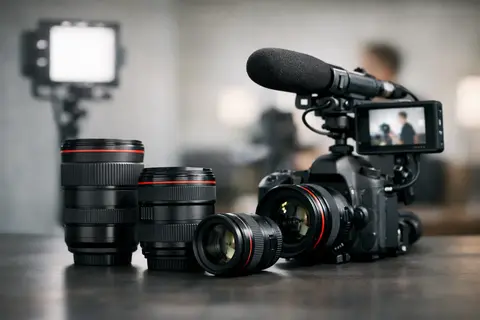
When everything looks right in the frame, but the video still doesn’t seem professional, the problem is often not the camera. Very often the decisive factor is the optics, so a Canon lens review for video needs should start not with a list of models, but with real use - what you are filming, in what environment, and how quickly you need to work.
In brief
- Choose a lens based on the shooting scenario — wide angle for vlogs/interiors, 24–70 mm for flexible everyday use, telephoto for interviews and details.
- Video evaluates lenses differently than photo: smooth autofocus transitions, focus breathing, a quiet motor, and optical stabilization matter.
- APS-C and full-frame systems require adapting focal length choice (35mm APS-C ≈ a universal solution); calculate the crop factor.
- Sometimes it is better to rent a specific, more expensive lens for one project rather than buy — testing in practice reveals behavior in motion.
- Video quality depends on the full setup: optics, lighting, sound, and stabilization — balancing the components gives the biggest effect.
What to choose for different tasks
| Task | Solution | Why |
|---|---|---|
| Vlogs and handheld filmmaking | Wide prime or wide-angle zoom lens (about 16–35mm full-frame equivalent) with good edge correction and quiet autofocus | A wide view includes the environment and lets you film close-ups without stepping back; a quiet motor does not interfere with audio and ensures seamless focus transitions |
| Interviews and talking head | 50mm prime on full frame or an equivalent on APS-C with stable autofocus and a medium aperture (f/1.8–f/2.8) | Classic perspective and pleasant background separation without excessive distortion; it is easier to maintain consistent focus in long recordings |
| Weddings and events | A standard 24–70mm zoom plus a telephoto option (70–200mm) or a dedicated fast prime lens | Flexibility in fast-changing situations and the ability to reframe quickly without changing lenses; telephoto helps isolate details and moments from a distance |
| Real estate / interiors | A high-quality wide-angle lens with minimal edge distortion or a tilt-shift solution for professional architectural correction | Spaces should be shown broadly, but proportions must remain realistic; good optics reduce the need for correction in post-production |
| Product video and advertising | A fast prime lens with precise close focus and predictable focusing behavior | Sharpness, repeatability, and ergonomics for manual focus movements are more important than versatility; prime lenses often provide a better optical character |
| Fast documentary scenes and reporting | A versatile zoom lens with quiet and smooth autofocus, with the option to rent a fast prime if needed | Fast situations require flexibility and quick reaction; a rental option allows access to more expensive solutions only for the duration of the project |
Frequently asked questions
How do I choose between a prime and a zoom lens for video filming?
The choice depends on the pace of work and the aesthetics. If you need flexibility and quick reframing — choose a zoom; if optical quality, bokeh, and a compact size are the priority — choose a prime lens.
Is autofocus more important than aperture in video shooting?
Both elements are important, but the priority changes by scenario. In dynamic filming, autofocus stability and a quiet motor often provide greater practical benefit; in studio conditions, aperture and sharpness may be more important.
When is it worth renting a lens instead of buying one?
Rental is justified if the lens is needed less often or for a specific project that requires a particular focal range or higher-end class. It allows you to test the optics in practice before purchasing and reduces initial costs.
How does the crop factor affect lens choice on APS-C versus full frame?
The crop factor increases the effective focal length, so 35mm on APS-C can deliver a result equivalent to 50mm on full frame. When planning a frame, take this conversion into account to achieve the desired composition.
How important is optical stabilization in video work?
Optical stabilization helps a lot when shooting handheld, in documentary work, and in situations without a tripod or gimbal. However, it does not replace proper technique and often needs to be combined with stabilizers or monopods in specific scenarios.
Does a more expensive Canon lens always mean better video quality?
Not necessarily — more expensive lenses usually provide better optics and durability, but the final result depends on the whole setup. If lighting, sound, or stabilization is lacking, even a high-quality lens will not deliver the expected improvement.
Useful links
- Video filmēšanas tehnika - Category page with an overview of equipment for video filming, a good link to find tripods, sliders, and other accessories.
- Objektīvi - Direct access to the lens section to compare Canon and other brands' solutions for different focal lengths.
- Objektīvi un aksesuāri - Rental section that is useful when you need a specific lens for a project or want to test the optics in practice.
- Audio tehnika - Sound equipment has a major impact on final video quality; this page helps you find microphones and accessories.
- NOMA - General rental page with access to various categories if you need a short-term equipment expansion.
- Canon RF 24mm F1.4L VCM - An example of a fast wide-angle Canon lens often considered for video work with high optical quality requirements.
In the Canon ecosystem, the choice of lenses for video work is broad, and that is both an advantage and a challenge. On the one hand, compact and affordable solutions are available for everyday content creation; on the other, there is professional-grade glass with high sharpness, smoother focusing, and better performance in challenging light. The right choice is usually not the “best lens,” but the most suitable one for the specific task.
Canon lens review for video tasks
For video, lenses are evaluated differently than in photography. A photographer can accept slower autofocus or more pronounced focus breathing if the final frame is a single photo. For a videographer, these same factors become immediately visible - focus transitions, a breathing frame, stabilization behavior, and motor noise can directly affect the final material.
There are four main criteria. The first is focal length and its suitability for the shot. The second is maximum aperture, which determines not only the amount of light but also background separation. The third is autofocus character, especially if you film with face or eye tracking. The fourth is optical stabilization, which in many scenarios makes it possible to get a steadier frame without extra equipment.
That is exactly why one user’s best solution will be a 24-70 mm zoom, while another’s will be a 35 mm or 50 mm prime lens. If you are filming interviews in a controlled environment, your priorities will be different than when shooting weddings, events, or real estate videos.
What type of Canon lens to choose for video
In practice, the choice usually comes down to zoom versus prime lenses. A zoom lens is more flexible because it lets you reframe quickly without changing position. This is especially useful in documentary work, events, reporting, and teams where shooting pace is high. A typical example is a standard range from a wider angle to portrait framing.
Prime lenses, on the other hand, often provide greater light-gathering ability, a more compact size, and a more distinct aesthetic. When filming a speaking person, product close-ups, or more artistic shots, 24 mm, 35 mm, 50 mm, or 85 mm primes often provide a more predictable image character. Keep in mind that this approach requires more time and more deliberate work with positioning.
APS-C and full-frame cameras also introduce adjustments here. A 35 mm lens on an APS-C sensor becomes a very versatile everyday video option, while on full frame it gives a natural, slightly wider perspective. Meanwhile, a 50 mm on full frame is a classic for interviews, but on APS-C it already becomes closer to a short telephoto range.
Wide-angle lenses for vlogging and interiors
If you film vlogs, real estate, travel content, or tight spaces, the main benefit is a wide field of view. It helps you include more of the surroundings in the frame and shoot handheld without moving too far away from the subject. Here, edge geometry and the cooperation between stabilization and the camera become especially important.
However, wide angle is not a universal answer to everything. An overly wide lens can distort a face in close-up, and the room in the frame can look larger than it really is. If you mainly film people in a conversational format, a moderately wide lens is sometimes safer than an extremely wide angle.
Standard zooms for everyday work
If you have to choose one lens for a wide variety of video tasks, a standard zoom is usually the most practical starting point. A range around 24-70 mm for full-frame cameras or a similar equivalent in the APS-C system gives enough flexibility for both wider framing and tighter portrait shots.
This solution is especially suitable for event filming, commercial tasks, and corporate content creation, where there is no time to change lenses often. The trade-off is usually greater weight and a higher price, especially in brighter versions.
Telephoto lenses for interviews and details
A longer focal length is useful for interviews, stage events, ceremonies, and isolating details. It helps separate the background, make the frame feel more “compressed,” and achieve a visually cleaner composition. Subjectively, the image also often looks calmer and more professional.
Keep in mind that telephoto ranges are more demanding in terms of stabilization, tripod use, and focusing. If you work handheld or in a small room, a telephoto lens may be technically good but practically inconvenient.
What autofocus, stabilization, and aperture mean in video work
In video use, autofocus quality is not just about speed. It is important that focusing happens smoothly, without jerky transitions and without unnecessary “hunting.” A strength of the Canon system in many modern lenses is exactly the predictable cooperation with Dual Pixel autofocus, which significantly reduces the risk of refocusing in everyday work.
If you film with a gimbal, from a tripod, or in a controlled studio environment, you can do without optical stabilization. But in documentary, event, or fast content-production environments, stabilization is a very practical advantage. It will not save poor technique, but it will help you get usable material in situations where a tripod is not a real option.
Aperture, in turn, affects more than just exposure. A wide aperture helps you work in lower light and get more pronounced background blur, but focusing becomes more demanding. In commercial video this is not always a plus. Sometimes a safer and more effective result is a slightly stopped-down aperture with more sharpness reserve, especially if the person in the frame is moving.
Canon lens review for video formats by scenario
To make the choice rational, the lens should be tied to the type of filming, not just the specification table. For vlogging, a wide angle, low weight, and quiet autofocus will matter. For interviews, the face perspective, pleasant background separation, and stable focus over a longer recording become more important.
In wedding and event video filming, flexibility usually wins. A standard zoom and a second body with a telephoto lens or a bright prime are justified here. If filming takes place in changing light and decision time is measured in seconds, the theoretically most beautiful lens is not always the most productive one.
In product video or advertising content, priorities change. Sharpness, close focus, the feel of manual control, and how predictably the lens behaves in repeated movements are valued more. In some cases, even a compact prime lens will provide a better workflow than a universal zoom.
In real estate filming and architectural framing, wide angle is almost mandatory, but you have to be careful not to overdo the effect. The space should look spacious, not unrealistic. This is exactly where quality optics pay off, because line correction and edge performance are visible immediately.
Is a more expensive Canon lens always better for video
Not always. More expensive models usually offer better optical quality, a more durable build, smoother focus, and greater light-gathering ability. But that does not mean every user will get a proportionally larger benefit.
If the content is published on social media, filmed in controlled light, and the main format is talking head or simple B-roll shots, a mid-range lens may be completely sufficient. On the other hand, in professional commissioned work, where you have to work in different conditions and the cost of mistakes is high, higher-end optics become a work tool rather than a luxury choice.
Another important factor is balance with the rest of the kit. There is not much benefit in investing almost the entire budget in a lens if you simultaneously lack light, sound equipment, a tripod, or storage media. Video quality is always created by the system, not by one component.
When to buy and when it is better to rent
If a lens is needed for regular work, buying it is usually more justified. It allows you to build a consistent workflow, get used to the character of a specific optic, and achieve a predictable result more quickly. This especially applies to standard work lenses that you use in almost every project.
Rental, on the other hand, is logical if you need a specific focal range, a higher-end model for one project, or simply want to test a lens in practice before buying. This is especially valuable in video work because the feel of a lens cannot be fully judged from specifications alone. What matters is not only how sharp the image is, but also how the lens behaves in motion, during focus transitions, and over a longer filming day.
If you need to compare several options or choose optics for a specific filming scenario, a specialized approach such as that offered by industry retailers like Master Foto is useful - with the opportunity not only to look at the equipment, but also to assess whether a particular solution is suitable for purchase or rental.
The most practical decision usually is not to look for one “right” Canon lens for all cases. A better result comes when the lens matches your frame, your working pace, and how filming actually happens. If you manage to find that match, the equipment starts working for you instead of demanding compromises in every project.