
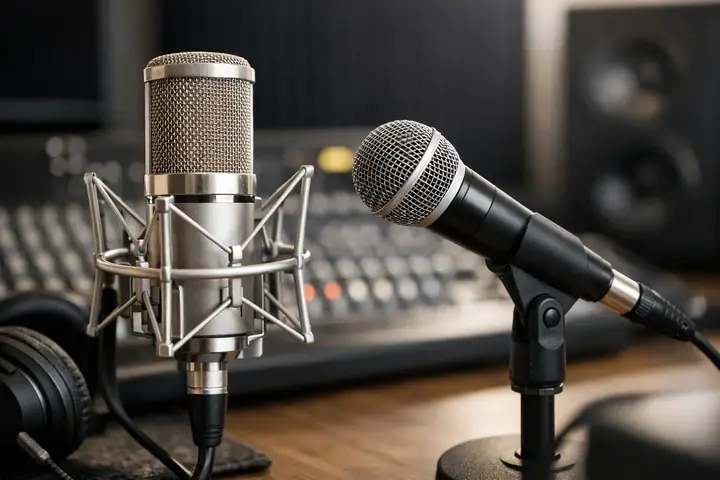
A microphone can be technically high quality, yet in a specific room and workflow it can create more problems than benefits. That is why the question - condenser or dynamic microphone - is not only about sound quality or price. The choice is determined by the recording source, the room’s acoustics, the distance to the microphone, the interface used, and how quickly a repeatable result needs to be achieved.
For a content creator speaking in an untreated home office, one solution is often more suitable. For a studio recording vocals or instruments in a treated room, another. Meanwhile, in reportage, event filming, or outdoor interviews, the priority may be durability, isolation from the surroundings, and reliable operation while moving.
In brief
- Choosing between a condenser and a dynamic microphone starts with the room and the recording scenario, not just price or brand.
- Dynamic microphones better reject room and background noise at close range — often a good choice for podcasts and streams in a home office.
- Condenser microphones reveal more detail and high end, making them suitable for studio vocals and acoustic instruments in a quiet environment.
- An XLR setup provides flexibility and better preamps; USB is convenient for getting started, but limits expansion.
- Accessories (pop filter, shock mount, stand) and room acoustics often affect the result more than small differences between microphone models.
What to choose for different tasks
| Task | Solution | Why |
|---|---|---|
| Podcast in a home office (two people at a table) | A dynamic cardioid XLR microphone with close placement (~5–10 cm) and a shock mount or boom stand. | Reduces room echo and background noise, while keeping levels stable without excessive preamp self-noise. |
| Studio vocals and acoustic instruments | A condenser XLR microphone with a suitable polar pattern and a quality preamp. | Provides more detail and nuance, which is important for vocals and acoustic sound sources when the room is acoustically controlled. |
| Interviews and reporting outdoors | A durable dynamic handheld microphone (XLR) or a lavalier/clip-on solution with wind protection. | A dynamic element isolates the speaker’s voice better from ambient noise and is more practical on the move. |
| Live streaming or video at a desk (one speaker) | A dynamic XLR microphone with a stand or a quality USB microphone if you want simplicity without an interface. | Dynamic XLR offers better noise rejection and expansion options; USB is more convenient for a quick start. |
| One-off recording or a new project | Consider renting a microphone to try a condenser or dynamic model in the real space before buying. | Rental lets you test the model in your recording environment and avoid a mismatched purchase. |
Condenser or dynamic microphone: the main difference
A condenser microphone capsule picks up very subtle changes in air pressure. That is why these microphones are usually sensitive, detailed, and able to accurately convey vocal nuances, breathing, room reflections, and high-frequency information. This level of detail is valuable for studio vocals, acoustic guitar, instruments, voice-over work, and controlled video recording.
A dynamic microphone works on a different principle - diaphragm movement is converted into an electrical signal with the help of a moving coil and magnet. Its construction is generally more resistant to very loud sources and less sensitive to distant ambient noise. That does not mean a dynamic microphone automatically sounds worse. A properly chosen model can deliver a dense, intelligible, and professional voice, especially when the speaker is close to the capsule.
A simplified view is this: a condenser microphone captures more, while a dynamic microphone often captures more selectively. But the final result depends not only on the capsule type. Equally important are the microphone’s polar pattern, preamp quality, recording level, placement, and room acoustics.
The room is often more important than the microphone
A condenser microphone in a home office can clearly pick up not only the voice, but also the computer, ventilation, street traffic, and sound reflecting off bare walls. If the room has many hard surfaces, the recording can become boxy or overly harsh. Such problems cannot be fully fixed in editing - noise reduction tends to affect vocal naturalness.
A dynamic microphone, used 5-10 centimeters from the mouth, often helps achieve a more focused speech recording even in a less-than-ideal room. It is not a solution for all noise, but it reduces the relative amount of room sound. For this reason, dynamic models are a common choice for podcasts, streams, remote interviews, and video recordings in an office.
If the room is acoustically treated or the recording takes place in a very quiet environment, a condenser microphone reveals its advantages. It can convey more vocal texture and a more natural openness, provided the microphone is placed correctly and the speaker maintains a consistent distance.
Distance and microphone technique
A dynamic microphone usually requires closer working distance. If you speak too far away, the voice level will be low, and increasing the gain will make the preamp’s self-noise audible. Close placement also creates the proximity effect - low frequencies become more pronounced. For some voices, this adds pleasant fullness; in other cases, it is better to reduce the bass a bit in post or move back a few centimeters.
A condenser microphone often works well at a greater distance, for example 15-25 centimeters. This is convenient if freer movement in frame is needed or an instrument must be recorded. However, the microphone will also capture more of the room. A pop filter is a practical accessory in both cases, as it reduces plosive “p”, “b”, and “t” sounds.
Connection, power, and gain requirements
Most microphones intended for professional audio work use an XLR connection. This requires an audio interface, recorder, or mixer input with a quality preamp. Such a system is flexible - you can choose the right cable, recording device, and later replace only one part of the chain.
Condenser microphones usually need 48 V phantom power. Many audio interfaces and recorders provide this, but before purchasing you should check the specific device’s specifications. Phantom power should not be turned on without reason, especially if unsuitable connections or older equipment are in the chain.
Dynamic microphones usually do not require phantom power. Their output signal can be significantly quieter, especially with broadcast and vocal models. Therefore, it is important to check whether the interface offers enough clean gain. If the gain is insufficient, the solution may be an active signal booster or a microphone with an integrated preamp. There is no point evaluating only the microphone’s price - a weak audio chain can also limit a good model’s results.
A USB microphone combines the capsule, preamp, and analog-to-digital converter in one body. It is a convenient starting point for solo podcasts, live streams, and work calls. However, an XLR solution generally offers broader opportunities to develop the system, connect multiple microphones, and use the same equipment for filming or mobile recordings.
Which microphone is suitable for what?
For studio vocal recording, a condenser microphone is often a logical first choice because it can capture the dynamics and articulation of singing in detail. The same applies to acoustic instruments, piano, string instruments, and foley recording. However, for loud rock vocals or stage use, a dynamic model can be not only safer but also more appropriate in character.
There is no universal answer for podcasts. For two people at a table in an untreated room, dynamic cardioid microphones often help achieve a cleaner result with less room echo. Meanwhile, a single host in a quiet, controlled room can successfully use a condenser microphone, especially if the goal is an open and nuanced vocal aesthetic.
In video production, studio setups should be distinguished from documentary situations. For a speaking person at a table, a good solution may be a microphone placed outside the frame on a desk stand or boom arm. For on-location interviews, a handheld dynamic microphone, lavalier microphone, or shotgun microphone on a boom is often chosen. The condenser or dynamic capsule is only one part of the choice - the format and workflow are also important.
The polar pattern and accessories determine the result
A cardioid polar pattern picks up sound mostly from the front of the microphone and reduces signal from the rear. It is common in voice recording solutions, but it does not eliminate side reflections or loud noises in the room. A supercardioid can be even more focused, but it requires more careful placement because it has a small pickup area at the rear.
An omnidirectional microphone picks up sound from all directions. It can be a very natural solution in a room with good acoustics or for a conversation among several people, but in a home workspace it will usually pick up too much ambient sound. Therefore, before buying, you should look not only at the words “condenser” or “dynamic”, but also at the specific model’s polar pattern.
A shock mount reduces desk vibrations, a pop filter improves speech recording, and a stable stand helps maintain the correct distance. If a shotgun microphone is used or recording takes place outdoors, wind protection is not an optional accessory - it is a necessity. These elements often affect everyday recording quality more than a small price difference between two similar microphones.
How to make a practical decision
Start with the recording location, not the most popular model. If the room is lively, noisy, or recording must be done at a work desk, consider a dynamic XLR microphone and an interface with enough gain headroom. If you work in a quiet studio, record vocals or instruments, or want a broader range of detail, a condenser microphone is a justified choice.
Before buying, determine whether the microphone will be needed for a single project or for regular work. For a one-time shoot or a specific recording task, a rental solution lets you test the model in a real environment without making a hasty purchase. Master Foto consultation can help match the microphone with your existing camera, audio interface, recorder, stand, and recording scenario.
A good microphone is not the one that picks up the most sound. It is the microphone that, in your specific room, captures the needed sound clearly, repeatably, and with a workable process.
Frequently asked questions
Can phantom power damage a dynamic microphone?
Usually not — phantom power is needed to power condenser microphones, but basic dynamic microphones do not use this power. However, avoid phantom power if there is a ribbon microphone element in the chain or unsuitable cable construction, as it can create risk. Check the manufacturer’s instructions for the specific microphone before turning on phantom power.
How close should the microphone be when speaking?
A dynamic microphone usually works well at a distance of 5–10 cm, which gives a focused voice and emphasizes the proximity effect. For condenser microphones, 15–25 cm is often enough, especially if you want less plosive sound and a more natural sense of the room. A pop filter and angle help reduce plosive consonant issues regardless of microphone type.
How do you choose between a USB and XLR microphone?
USB microphones are convenient and quick to use because they include a preamp and converter in one body, so they are suitable for streams and solo podcasts without extra devices. An XLR system requires an audio interface or mixer, but it provides more flexibility, better preamping, and the ability to connect multiple microphones in a professional recording chain. If you plan to expand your recording setup, XLR has a long-term advantage.
What affects recording quality more — the microphone or the room?
Room acoustics often determine the final recording quality more than the microphone model, because echoes, reflections, and background noise are captured regardless of capsule type. In a good room, a condenser reveals detail, but in a poor room it will also capture unwanted noise. Therefore, first evaluate the room and then choose the microphone that best fits that environment.
How can you reduce "p" and "b" plosives in recordings?
Use a pop filter or air filter between the voice and the microphone, place the microphone slightly to the left or right of the speaker’s mouth, and keep a stable distance. Reducing direct movement toward the capsule and slightly reducing bass after the proximity effect can produce a clearer voice signal. A shock mount also helps avoid desk vibrations that amplify unpleasant transients.
What should you do if the interface provides insufficient gain?
First check the microphone and cable connections and make sure the gain is set correctly without excessive compression or noise amplification. If the signal is still weak, consider an external preamp, an active microphone solution, or another interface with stronger preamps. A rental option can help you try different equipment in the real recording environment before buying.
Useful links
- Microphones - A category with various condenser and dynamic models to evaluate the right microphone.
- Audio equipment - Audio interfaces and preamps are necessary for XLR systems and professional recording.
- Microphone accessories - Pop filters, shock mounts, and stands that practically improve everyday recording quality.
- Rode XLR Cable 3m Blue - Quality XLR cables reduce signal loss and interference between the microphone and interface.
- RENTAL - A rental option lets you try different microphone types in the real recording environment before buying.