
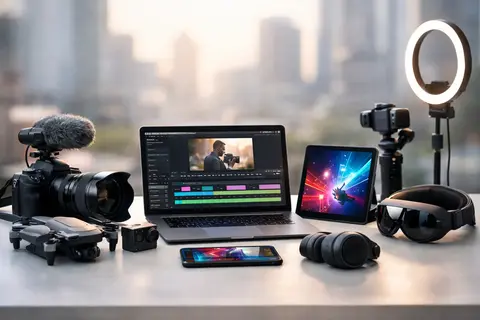
If a few years ago a camera and one universal lens were enough, today content creator gear trends clearly point in a different direction - setups are becoming more compact, smarter, and more tailored to a specific format. Not everyone is buying one “one-size-fits-all” solution anymore. Much more often, gear is chosen based on whether the content is intended for YouTube, TikTok, a podcast, live streaming, advertising materials, or a client project.
That is exactly why the main question is no longer just about the brand or sensor size. It is more important to understand what the gear will need to do every day. For one person, autofocus and vertical shooting will be decisive; for another - clean audio, long studio operation, or the ability to quickly assemble a rental solution for a specific project.
In brief
- Equipment is chosen based on the work scenario — mobility, audio quality, and fast setup matter more than a single “one size fits all” solution.
- Audio and lighting often affect the final result more than the camera; wireless microphones and portable LED lights are a priority.
- Creators build systems (compatibility, batteries, quick release) rather than buying individual devices; rental solutions increase flexibility.
What to choose for different tasks
| Task | Solution | Why |
|---|---|---|
| Solo creator — short social media videos (TikTok/Reels) | Compact phone or mirrorless camera kit with a gimbal, one quality wireless microphone, and LED vlog light. | Mobility, fast setup, and reliable focus matter most; good audio instantly improves watchability. |
| Two-person interviews and street reporting | Dual-channel wireless audio system or two lavalier microphones, a lightweight tripod or monopod, compact shotgun mic for the camera. | Separate channel recording for each speaker and a stable mount for quick operation are needed. |
| Podcasts and studio conversations | USB or XLR microphones with an audio interface, acoustic panels, and stable desk or stand mounting. | Clear, controlled sound and convenient connections for multiple participants are important in podcasts. |
| Product videos and e-commerce | LED panels or COB lights with softboxes/grids, a stable photo/video tripod, and teleprompter option. | Even, controllable lighting and stable camera placement ensure a professional, repeatable result. |
| Events and moving content | Gimbals or a handheld stabilizer, extra batteries, and quick-to-set-up video tripods. | Movement requires stability and long runtime without interruptions. |
| Small studio or in-house company production | A background kit with light, a teleprompter, monitor, and audio interface together with a reliable base camera. | Repeatability, fast preparation, and the ability to work regularly without technical surprises. |
How content creator gear trends are changing
At the moment, the market is dominated not by a single universal trend, but by several clear usage scenarios. The camera is no longer the only central purchase. Equally important are microphones, LED lights, wireless audio systems, stabilizers, teleprompters, and quick-to-set-up accessories.
That makes sense. Today’s audience notices bad sound much faster than a small difference in image sharpness. Lighting also often affects the result more than switching from one camera model to the next. That is why technical priorities have become more pragmatic.
Another trend is also visible - content creators are increasingly building a system rather than buying separate devices. That means thinking about compatibility, battery type, mounts, audio inputs, file flow, and workflow speed. Gear is evaluated not only by specifications, but by how quickly it can be used.
The camera is no longer the whole story
Cameras are still the core tool, but the selection criteria have changed. In the past, attention often focused on megapixels or maximum video resolution. Now much more important is how reliably the camera works in real conditions - in motion, in lower light, with solo shooting, and during longer sessions.
Content creators are increasingly choosing mirrorless cameras with good eye autofocus, 4K recording without major limitations, and a flip screen. This especially applies to solo creators who film themselves. If the camera loses focus or overheats during a live stream, theoretically impressive specs no longer help.
At the same time, the smartphone has not disappeared from the workflow. For some formats, it has become a fully-fledged primary tool, especially in short-form content. But even then, demand for accessories increases - a gimbal, external microphone, compact light, and tripod. In other words, even if the camera is in your pocket, the rest of the system becomes more professional.
Compactness versus image headroom
Here a clear compromise is visible. A smaller body and lighter kit are convenient for everyday work, on the road, and at events. A larger sensor, better cooling, and more extensive connectivity provide greater security in commercial projects.
That is why there is no single right answer. A creator who films social media content every day may value mobility more. A studio or company team producing product videos, interviews, and advertising materials often benefits more from a more stable and technically complete setup.
Audio gear is becoming a priority
One of the strongest changes in recent years is the growing importance of audio. Wireless microphone systems, compact receivers, USB microphones for podcasts, and shotgun microphones for cameras are no longer niche equipment. They are becoming the standard.
This is especially visible in interviews, vlogs, course recordings, and internal company communication. A built-in camera microphone is only enough in very limited cases. If content is meant to be published regularly, an external audio solution is usually one of the first upgrades that has a real effect.
Demand for easy setup is also increasing. Content creators are looking for solutions that do not require complex sound processing or multiple adapters. In practice, that means a preference for wireless systems with a charging case, direct connection to a camera or phone, and a stable recording level.
When one microphone is enough and when it is not
For solo content, one quality wireless microphone or a shotgun microphone for the camera is often enough. Two-person interviews already require a two-channel system. For podcasts and studio conversations, the decision depends on the room acoustics, the number of inputs, and whether mobility or maximum control is the priority.
This is exactly where gear should be chosen according to the work scenario, not just the price. A cheaper option may be sufficient for social media clips, but not for client shoots or a paid program.
Lighting is getting smaller, but more powerful
The development of LED lighting is one of the most practically significant content creator gear trends. Portable lights are becoming more powerful, more precisely adjustable, and easier to integrate into small studios or mobile kits. This significantly simplifies work both in home recordings and on location.
In the past, small projects often used a simple continuous-light setup without much control. Now interest is growing in LED panels, COB lights, RGB solutions, and battery operation. This allows the same gear to cover talking-head videos, product shoots, and content recordings outside the studio.
It is also important that lighting is bought together with accessories. A softbox, stand, grid, mounts, and power options often determine practical value more than the fixture’s maximum output. If setup is inconvenient, the gear quickly starts collecting dust on a shelf.
Stabilization and workflow speed
Gimbals, video tripods, monopods, and desk mounts have become everyday equipment rather than an added luxury. The reason is simple - viewers will forgive an imperfect background, but not a chaotic, hard-to-watch frame.
However, the choice here also depends on the format. Gimbals are useful for moving content, events, and dynamic advertising shots. For studio recordings or review videos, a high-quality tripod with a reliable video head is often the better investment. For many creators, both solutions have their place, but they do not always need to be bought at the same time.
Demand for quick-mount solutions is also growing. Quick release systems, multifunctional rig accessories, and compact mounts save time in everyday work. This seems minor until the day you need to switch from phone to camera, from vertical to horizontal framing, and from tripod to handheld shooting in a single day.
Studio equipment is becoming more accessible to small teams
Small studios, company marketing teams, and individual creators are increasingly building their own permanent recording environments. That means not only a camera, but also background systems, teleprompters, desk mounts, monitors, audio interfaces, and printers for preparing final materials.
This trend shows the market maturing. Content is no longer created only for campaigns. It is produced regularly, so repeatability becomes more important than a one-time “impressive” setup. If gear can be prepared for work quickly and the result is predictable every time, the team works more efficiently.
This is where the balance between rental and purchase becomes especially clear. It makes sense to keep basic everyday equipment on site, while more specific needs - a more powerful light, an additional camera, a teleprompter, or a drone - are often more cost-effective to source for a specific project. This approach helps keep the budget under control without sacrificing quality.
What these trends mean for buyers in Latvia
In the Latvian market, not only the gear itself matters, but also availability, service, and consultation before making a decision. A content creator often does not want to wait several weeks to find out whether the chosen equipment will even fit their workflow. That is why the ability to compare categories, understand compatibility, and, if necessary, choose rental before purchase is so important.
In practice, this allows for a more accurate decision. If a creator is just starting to work with podcasts, there is no need to build a full studio right away. If a company is filming a product video series for the first time, initially a rented light and stabilization kit may be enough. And if content is produced every week, investing in reliable core equipment becomes justified.
That is why a specialized equipment center like Master Foto becomes more valuable in this segment than a simple retailer. A content creator often needs not just a product, but a clear answer - what will be good enough for the specific job, what will be too weak, and what is not worth overpaying for.
Where content creator gear trends are heading next
In the near future, demand will increase for even more flexible systems. That means more hybrid cameras, better wireless audio solutions, more portable lighting, and equipment that can be equally convenient to use with both a phone and a camera. At the same time, in the professional segment, reliability in long-term operation, data security, and consistent results across multiple projects will become more important.
The main trend is clear - gear is chosen based on how well it fits into the real workflow. Not because of the loudest marketing promise, but because it allows you to film, record, light, and deliver finished material without unnecessary complications. If you can think in exactly this way at the time of purchase, the equipment lasts longer and works for you, not against you.
Frequently asked questions
How do you choose between a compact kit and a larger studio solution?
The choice should be based on how often you work and the format. If you mostly film on the street or make short social media clips, mobility is the priority; if you produce regular commercial videos, reliability and better cooling matter more.
Can a smartphone replace a camera today?
For some short-form projects, a smartphone is a fully capable tool, especially with a gimbal, external microphone, and light. However, in commercial projects or long sessions, cameras with better cooling, ports, and more professional autofocus are often preferred.
How important is audio compared to video?
Audio quality often affects the viewer experience more than small differences in image quality. Bad audio quickly reduces credibility, so an external microphone or wireless system is one of the first upgrades creators recommend.
How do you choose a wireless microphone system?
Assess the number of channels, battery management (for example, a charging case), connectivity with the camera or phone, and recording quality. A practical criterion is also setup speed and the required combination of adapters.
When is it better to choose a gimbal instead of a tripod?
A gimbal is suitable when dynamic, moving framing or event filming is needed. A tripod with a reliable video head is often much better for interviews, product filming, or static reviews where precision and repeatability matter.
Is it better to rent or buy equipment?
If the need is for rare or specific projects (for example, more powerful lighting or a teleprompter), rental can be more economical. If content is produced regularly, investing in reliable base equipment usually pays off through efficiency and fewer maintenance problems.
Useful links
- Cameras - A place for information about mirrorless and other camera categories mentioned in the article.
- Wireless audio systems - A resource for choosing wireless microphones and dual-channel solutions, which the article highlights as a priority.
- LED VLOG light - Quick access to the portable LED solutions category, useful for mobile lighting and vlogs.
- Video tripods - Information about tripods and video heads — a category the article recommends evaluating according to the format.
- Background kits with light - A resource for building studio solutions and repeatable video production mentioned in the article.