
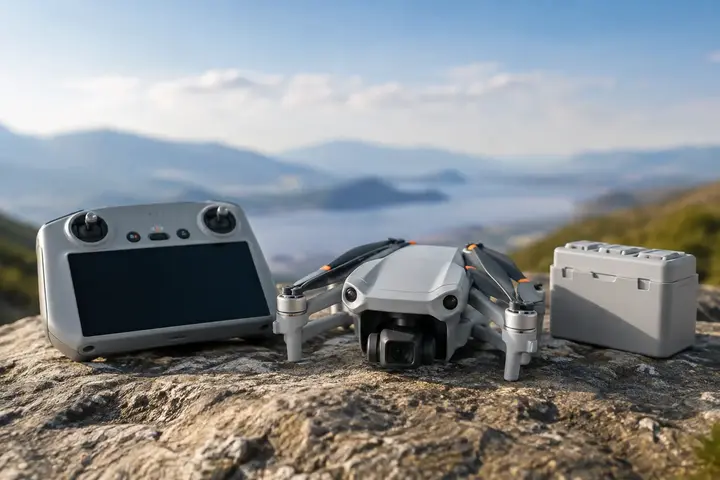
A compact drone is often chosen not because the smallest possible body is needed, but because filming has to be fast and mobile. A review of DJI compact drones helps understand when a lightweight model is enough for travel videos and social media content, and when it is worth choosing a drone with broader control, camera, and safety capabilities.
In DJI’s compact class there are several different solutions. These are not just variants of the same drone with different prices. The Mini series is mainly focused on low weight, stable image quality, and versatile use, while DJI Flip offers foldable propeller guards and is especially interesting for individual content creators. The choice is determined not only by 4K or flight time, but also by the environment in which the drone will be used and the requirements for the final material.
In brief
- Choose a compact drone based on use — for travel, weight and portability matter more than just 4K specs.
- Plan flights with battery reserve; manufacturer flight times apply only in ideal conditions.
- For content creators, evaluate vertical shooting and tracking modes; for professional work, look for 10-bit recording and flat profile support.
- Safety: check local flight requirements, understand the limitations of obstacle sensors, and use propeller guards if filming near people.
What to choose for different tasks
| Task | Solution | Why |
|---|---|---|
| Travel vlogs and quick social media clips | A lightweight Mini series device with extra batteries and a compact bag | Low weight and portability let you carry the drone without extra logistics; more batteries provide enough time for recording. |
| Solo content creators and filming indoors with obstacles | A Flip-style drone with integrated propeller guards and a reliable tracking mode | Protection reduces accident risk in close shots, while tracking helps capture dynamic footage without an additional operator. |
| Commercial filming and color grading | A model with a larger sensor, 10-bit recording, and a flat color profile (e.g., Mini 4 Pro-level capabilities) | Higher color bit depth and flat profiles give more flexibility in post-production and better compatibility with the rest of the project footage. |
| Many flight sessions or projects outside the studio | A kit with multiple batteries, a Fly More/kit solution, and fast charging | More batteries reduce time pressure on location and let you repeat shots without rushing. |
| Reels / TikTok / Shorts — primarily vertical content | A drone with a physical camera rotation option for portrait orientation or good crop quality from width to height | Physical rotation uses the sensor area better and provides higher-quality vertical framing than simple cropping. |
| Getting started and training flights in a safe environment | A model with easy automation, stability, and good obstacle sensors; plus spare propellers | Simple control and safety features help you learn drone piloting faster, while spare parts reduce interruptions. |
DJI compact drone review by use case
For travel and everyday shots
The main advantage of the DJI Mini series is the balance between size and functionality. Such drones take up little space in a bag alongside a camera, lenses, or a stabilizer, so they can be taken on a hike, a city trip, or a client shoot without planning separate transport. The low weight is a practical advantage, but it does not mean the drone can be used without preparation. In wind, a lightweight platform requires more careful flight planning, especially by the sea, in open fields, and at higher elevations.
For travel content, maximum video resolution is not the only important factor. More useful is often the ability to quickly capture vertical material, safely follow a subject, or get both a wide environmental shot and a closer motion sequence in one flight. If the video is intended for short-form platforms, vertical shooting may be more important than an additional telephoto equivalent or a rarely used professional codec.
For content creators and solo teams
DJI Flip is an example of how, in a compact drone choice, the safety design can be just as important as the sensor. Integrated propeller guards provide extra confidence when filming yourself, people at closer distances, or working in places with more obstacles. It does not make flight risk-free and does not replace piloting skills, but it reduces the chance that a minor contact with a branch or other obstacle will immediately end the flight.
This approach is convenient for trainers, real estate content creators, small businesses, and travelers working alone. If you only need one stable aerial shot with a person in motion, a complex professional platform may be unnecessary. On the other hand, for regular commercial filming, where repeatable trajectories, precise exposure control, and work in challenging lighting are needed, a compact drone should be assessed more rigorously.
For higher-quality video and photography
DJI Mini 4 Pro class models are generally the more logical choice when active subject tracking, more effective obstacle sensing, and broader video control options are important. They are useful when filming cyclists, runners, boats, or cars, provided the flight is carried out in a safe and permitted environment. Automated modes speed up work, but they do not assess the legal or safety conditions of a specific filming location on behalf of the pilot.
In photography, you should look at more than megapixels. RAW format, dynamic range, the ability to manually set exposure, and reliable gimbal performance will matter more if the files are intended to be processed in Lightroom, Photoshop, or another program. Meanwhile, JPEG and automatic video modes are perfectly sufficient for a quick company social media post or a personal travel archive.
Camera: what the specifications mean in practice
4K resolution by itself no longer says much. Two drones can film 4K, but differ in sensor size, frame rates, color profiles, and image quality in low light. A larger sensor usually provides a cleaner image at dusk and more flexibility when correcting shadows or highlights in post-production. However, in daylight even a drone with a smaller sensor can produce very convincing material if the shot is properly exposed.
In a more professional workflow, check whether the specific model offers 10-bit recording, D-Log M, or another flat color profile. These options are useful if the drone footage needs to be matched with a mirrorless camera, cinema camera, or a multi-operator project. If color correction is not planned, the standard profile is often a faster solution — the file looks more finished immediately after recording.
Vertical video is also important. On some compact DJI models, the camera can physically rotate into portrait orientation, while on others the vertical frame is created by cropping. Physical rotation makes better use of the sensor area and gives more freedom in framing. This is essential if Reels, TikTok, or Shorts is the project’s primary format rather than an extra version of horizontal video.
Flight time, batteries, and the real work rhythm
The manufacturer’s stated flight time is measured under controlled conditions. In practice it is affected by wind, temperature, flight style, distance, and the reserve needed for a safe return. In Latvia’s colder season, battery performance must be monitored especially carefully. A flight should not be planned down to the last percent, because a safe landing is more important than one more shot.
One battery is enough to get familiar with the drone, but rarely enough for a deliberate filming session. A multi-battery kit not only allows you to fly longer, but also to avoid rushing the framing and to repeat a movement if the first attempt did not work. For commercial work, it is also worth planning for memory cards with an appropriate speed class, spare propellers, a charging solution, and neutral density filters for working in bright sunlight.
A controller with an integrated screen can be more convenient for regular work, since you do not need to use a phone, worry about its battery, or deal with notifications. On the other hand, a controller that uses a smartphone is usually more compact and economical. There is no universally correct choice: a traveler may be satisfied with a simpler kit, while an operator working on a client assignment will often find a screen controller easier to use.
Safety and rules are not accessories
Drone weight and category can affect requirements, but a lightweight device does not exempt you from the duty to familiarize yourself with current flight rules. Before takeoff, assess the airspace, distance to airfields, local restrictions, privacy, the presence of people, and weather conditions. Rules can change, so for any specific flight you should always use current official information.
Obstacle sensors are a valuable aid, but they have limitations. They may not see thin branches, power lines, transparent surfaces, or objects in poor lighting. The automatic return function must also be set thoughtfully, choosing a safe altitude for the specific location. Quality drone footage starts with a well-planned route, not with the “Record” button.
How to choose a kit without overpaying
If the drone is intended for occasional travel and family videos, priority should be given to low weight, simple operation, and extra batteries. If regular social media content is being created, vertical filming options, tracking modes, and propeller guards should be evaluated. Meanwhile, for video producers and photographers who include aerial shots in paid projects, more important factors will be 10-bit recording, manual control, sensors, and easy integration into the existing workflow.
Before buying, it is useful to compare not only the drone body, but the entire kit. Battery count, controller type, charging hub, bag size, and filter availability often affect everyday use more than a small difference in maximum flight time. If the requirements of a specific project are not yet clear, a Master Foto consultation or rental option allows you to test how the chosen solution fits into your filming process.
A good compact DJI drone is not necessarily the model with the longest specification list. It is the model you will take with you, safely launch into the air, and whose footage you can use in your next project without unnecessary compromises.
Frequently asked questions
What is the main difference between the DJI Mini and Flip series?
The Mini series focuses on lower weight and portability, making it more convenient for travel. The Flip series offers an additional safety design (such as propeller guards), which is useful for close shots and filming more complex environments.
Does 4K always mean better video quality?
Not necessarily — 4K indicates resolution, but quality is affected by sensor size, frame rate, color profiles, and log modes. In practice, a larger sensor and better dynamic range often produce better results in low light than 4K resolution alone.
How many batteries should I bring for commercial filming?
It depends on session length and safety requirements, but usually one battery is not enough for professional sessions. It is recommended to plan for at least two spare batteries on top of one test battery, plus an on-site charging solution.
Do obstacle sensors guarantee complete safety?
No — sensors are valuable, but they have limitations, such as not seeing thin branches, power lines, or transparent objects. Full safety requires good flight planning and pilot attention, not just automatic aids.
What should I do if my project requires vertical video?
Check whether the drone camera can physically rotate into portrait orientation or whether its sensor provides a good crop for a vertical frame. Physical rotation usually gives better sensor utilization and more composition freedom than a simple crop.
Is a controller with an integrated screen mandatory for professional work?
It is not mandatory, but it can make regular professional work easier because you do not have to rely on a smartphone battery or notifications. For some operators, a more compact smartphone-based solution is preferable, especially when traveling and bag size and weight matter.
Useful links
- DJI DRONE MINI 5 PRO — product page - A direct example of a compact Mini-class drone that can be considered for travel and professional framing.
- Droni un Sporta kameras — category - A category where different compact drone models and accessories can be compared.
- Video filmēšanas tehnika — broader selection - A resource for equipment and accessories useful for drone filming and post-production.
- DJI RS 4 Mini gimbals — stabilization for camera work - To compare gimbal solutions in a lower-weight category and understand stabilization options for ground-based devices as well.