
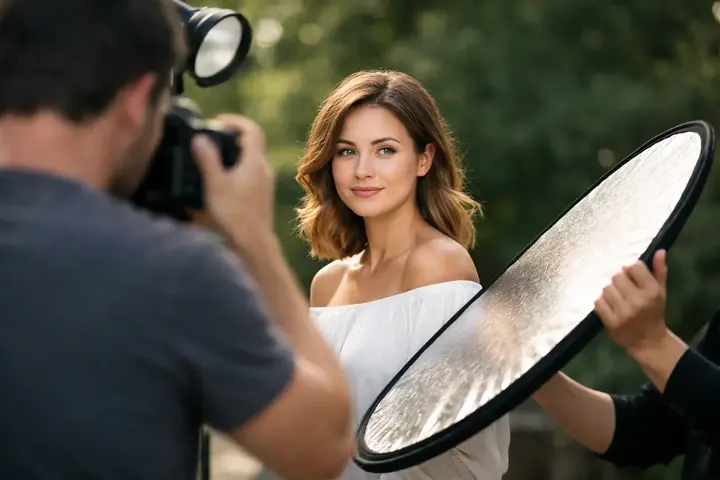
Window light can be beautiful, but in portraits there is often one problem - the shadows in the eye sockets, under the chin, or on the shadow side of the face are too dark. The question, do you need a reflector for photography, usually arises at exactly this moment. The answer is not always a categorical «yes», but a reflector is one of the most accessible accessories with which you can significantly improve light quality without an additional flash or studio light.
A reflector does not create a new light source. It redirects the already available light onto the subject being photographed. That is why its result is natural, predictable, and especially useful in portraits, product photography, video interviews, and small studio situations.
In brief
- A reflector does not create a light source — it redirects existing light, softening shadows and preserving a natural look.
- A white surface is the most universal option for portraits; silver increases contrast, gold warms the tone, and black absorbs light.
- Size matters more than color: 80–110 cm works for one person; full-body shots need 120 cm or more.
- In video and product photography, a reflector is a fast, battery-free solution, but in dark or distant scenes it is better to use an active light source.
What to choose for different tasks
| Task | Solution | Why |
|---|---|---|
| Window portrait photography | A white or silver surface 80–110 cm, placed on the shadow side near the lower part of the face | Helps brighten eye sockets and soften shadows without an extra lamp, while preserving the character of window light |
| Outdoor portraits in backlight or shade | A silver reflector or white one depending on the desired effect; use a stand or assistant help | Silver adds a stronger accent, while white gives softer fill; changing outdoor light requires quick positioning |
| Product photography (shiny surfaces) | Use a white reflector with precise angle adjustment; sometimes a black surface to deepen shadows | Reduces overly bright reflections and opens detail in dark areas; small angle changes alter the reflection shape |
| Video interviews — static shots | A white reflective surface slightly below the shadow side of the face, mounted on a holder | Provides more even fill light without an extra lamp and without noise or a power connection |
| Full-body portrait or group shot | A large rectangular reflector (120 cm+), or multiple surfaces, a secure stand or holder | A larger area provides more even fill for the whole body; a smaller model will be insufficient |
| Short studio or travel photoshoot | A foldable 5-in-1 reflector 80–110 cm with diffuser and holder option | A universal kit lets you quickly adjust tone, contrast, and diffusion without sacrificing mobility |
When a reflector for photography gives the greatest benefit
It helps most in situations where the main light source is already good enough, but the contrast is too strong. When photographing a person by a window, the light usually falls from one side. If you place a white or silver reflector on the opposite side, the shadows become brighter without losing the volume of the face.
Outdoors, a reflector is useful for portraits in the shade, on cloudy days, and in backlight. For example, at sunset the sun can create attractive rim light in the hair, but the face remains dark. A reflector allows you to preserve the background and mood while giving the face the necessary exposure.
In product photography, it helps control reflections and the visibility of details. A white surface can open up shadows on dark packaging, a metal object, or a cosmetic product. A black surface, on the other hand, is not intended to add light - it reduces unwanted reflections and helps create a more pronounced edge on a shiny object.
Do you need a reflector for photography if you have a flash?
A flash and a reflector are not interchangeable accessories. A flash provides independence from ambient light, power, and more precise exposure control. A reflector, on the other hand, is a quick solution if you want to soften shadows and preserve the character of the existing light.
In the studio, a reflector is often used together with a flash or continuous light source. The main light defines the direction of the image, while the reflector acts as fill light. Instead of setting up a second lamp, adjusting its power and modifier, it is enough to change the reflector’s angle or distance.
It also has limitations. If the room is dark or the light source is far away, there is simply nothing for the reflector to reflect. In such conditions, a flash, LED panel, or other active light will be more effective. In windy environments, a large reflector also requires a holder, weights, or an assistant.
The surface choice determines the result
Multifunction models often offer five surfaces: white, silver, gold, black, and a translucent diffuser. This does not mean that each one will be needed in every shoot. For practical use, it is worth understanding what each one does.
The white reflector creates a soft, neutral fill. It is the safest option for portraits, corporate communications images, and product photography because it affects skin tone and color accuracy the least.
The silver surface reflects more light and produces a more contrasty result. It is useful outdoors if the subject is in shade, as well as when a more pronounced light accent is needed. Keep in mind that at close range the silver surface can be too intense, especially for a person with sensitive eyes.
The gold surface adds a warmer tone. It can complement evening sunlight or create a warmer mood in a portrait, but it should be used in moderation. In neutral e-commerce product images and situations where accurate color rendering is important, the gold surface is often not the best choice.
The black surface works opposite to the white and silver ones: it absorbs light. It is used to deepen shadows or reduce uncontrolled reflections. The translucent diffuser, in turn, is placed between the light source and the subject to soften direct sun or harsh lamp light.
Size is more important than color choice
A reflector should be large enough relative to the subject being photographed. A small 30-40 cm model is convenient for head portraits, details, and small objects, but it will be too small for a full-body portrait. In that situation, the light on the legs and lower part of the clothing will become significantly weaker.
An approximately 80-110 cm reflector is a universal choice for one person. It is effective enough for portraits and small product setups while still being relatively easy to transport. For full-body portraits, two people, or video interviews, a 120 cm or larger model is often useful.
The shape affects convenience. Round and oval reflectors are compact and suitable for individual work. Rectangular models are often more practical for full-body shots, because their long side covers the subject more evenly. A foldable model is convenient for on-location work, while rigid reflectors better preserve a precise shape in the studio.
Proper placement without complicated technique
First, determine the main light. It can be window light, sunlight, a softbox, or an LED lamp. Place the reflector on the shadow side and observe how the face or product changes. Start with a larger distance, then gradually move it closer to the subject.
The closer the reflector is, the more visible the effect will be. However, a silver surface that is too close can create a flatter image or very bright skin reflections. In portraits, a good starting point is to place a white reflector slightly below the face, angled toward the light source. This helps brighten the eye sockets and soften the shadow under the chin.
In product photography, very small angle corrections often matter. By moving the reflector only a few centimeters, the shape of the reflection on glass, polished metal, or glossy packaging can change. Here it is worth using a stand with a holder, because it allows you to maintain a repeatable position for several product units.
The reflector in video work
In video production, a reflector is especially useful for interviews and shots of a speaking person. If the main light comes from a window or an LED panel, a white reflector makes the shadow side softer without a second lamp. It is a quiet solution, requires no power, and does not change the room’s acoustics.
However, in video you must take continuity into account. If the person moves or the camera changes angle, the reflector’s effect can become uneven. Outdoors, clouds and the sun can also change it. In dynamic shooting, active fill light is often more stable, but for a static shot a reflector is very effective.
What to choose for the first purchase or replacement
If you need one universal solution, a practical choice is a foldable 5-in-1 reflector with white, silver, gold, black surfaces and a diffuser. For portraits and small projects, an 80-110 cm model is usually suitable. It is recommended to add a holder and a sturdy light stand if you are working alone.
For a large project, it is not necessary to buy all the equipment at once. If you need to photograph full-body portraits, larger products, or set up a temporary filming area, a rental solution allows you to test the most suitable size and configuration. Master Foto specialists can help assess whether a reflector alone is enough for the task or whether additional light and a mounting system are also needed.
For your next shoot, try making one frame without a reflector and another with a white surface on the shadow side. This comparison quickly shows how much control over light you can gain with one simple accessory.
Frequently asked questions
Will a reflector replace a flash?
No, a reflector does not replace a light source; it only redirects existing light. If the room is dark or the main light source is far away, a flash or LED panel will be more effective.
Which surface is best for portraits?
A white surface is usually the safest and most neutral option for portraits because it does not change skin tone or color rendering. If you need more contrast or emphasis, you can try silver, but it may be too intense in close shots.
How close should the reflector be placed?
Start at a greater distance and gradually move it closer — the closer it is, the stronger the effect. However, be careful with a silver surface, because if it is too close it can create a flatter image or bright reflections on the skin.
Which reflector shape is better — round or rectangular?
Round and oval reflectors are compact and convenient for individual work, while rectangular models provide more even coverage for full-body shots. The choice depends on the frame size and shooting convenience.
Can a reflector be used for products with shiny surfaces?
Yes, a reflector can be used to control the shape of reflections and reveal detail in dark areas. Small changes in angle can be decisive — in product photography, a stand is often used to keep the position repeatable.
How do I choose my first reflector?
A practical start is a foldable 5-in-1 reflector 80–110 cm, because it offers white, silver, gold, black, and a diffuser in one. If you need larger shots or full-body portraits, consider a larger model or renting before buying.
Useful links
- Foni, Turētāji, Atstarotāji - Rent a holder or try different reflector sizes before buying.
- Video filmēšanas tehnika - Related to video interview equipment and static shots, where a reflector works well as fill light.
- LED gaismas paneļi - If a reflector is not effective enough in dark areas, LED panels serve as a stable additional light source.