
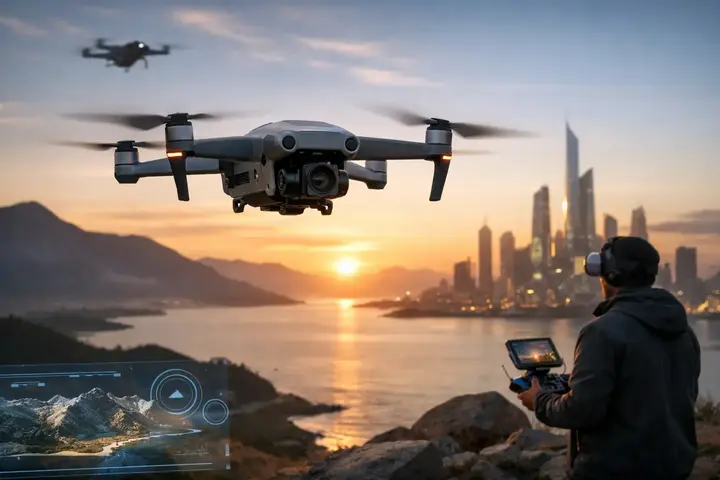
In some projects, a drone is no longer a “supplementary shot.” It is the main tool used to build the entire rhythm of the video - from the opening flight to the precise tracking frame. That is exactly why drone filming trends 2026 are not just about new models, but about how the requirements for image quality, safety, workflow speed, and final result quality are changing.
In brief
- In 2026, sensor, dynamic range, and video codecs matter more than resolution in drone filming.
- Vertical video should be planned during filming, not just cropped in post-production.
- Automated tracking modes and route repetition speed up work, but do not eliminate the need for an experienced operator.
- Safety, regulations, and platform stability (wind resistance) often determine equipment choice more than the camera.
- FPV remains a specialized tool — a good addition for dynamic shots, not a full replacement for classic drones.
What to choose for different tasks
| Task | Solution | Why |
|---|---|---|
| Daily social media content creation | A compact, quick-to-set-up folding drone with good stabilization and simple file handling. | The priority is mobility, battery life, and fast publishing ability, not the maximum codec set. |
| Real estate and tourism video | A stable platform with good wind resistance, wide dynamic range, and high resolution headroom. | Location and lighting variability require a clean image in low light and precise composition across multiple shots. |
| Advertising and film production work | A larger sensor, 10-bit recording or higher-quality codecs, and the ability to work with log profiles. | Matching material with cinema cameras and intensive color grading requires more detailed color and dynamic information. |
| Repeatable time-based documentation projects | Drones with precise route repetition and a stable GPS/positioning system. | Consistency across multiple shooting days ensures comparable shots and makes automation easier. |
| Dynamic, aggressive framing and accents | An FPV drone or a combination — FPV moments together with a classic stable platform. | FPV provides a kinetic effect that is usually impossible to achieve with a traditional drone, but it requires specialized piloting. |
| Short-term projects or rare need for a high-end platform | Consider renting equipment instead of buying it. | Rental gives access to professional equipment without long-term costs and ensures compliance with the specific project requirements. |
- year the market is moving away from the simple “higher, farther, faster” principle. Clients and teams are increasingly demanding a stable, predictable result with less post-production load. This means that sensors, dynamic range, color profile, automated flight modes, and integration into the overall filming workflow are becoming more important.
Drone Filming Trends 2026 in Practice
If previously the choice of a drone was often determined only by the 4K specification, that is no longer enough. More and more often, the evaluation is about how well the drone performs in difficult lighting, how safely it holds position in wind, and how precisely it repeats the route in multiple takes. This is especially important in real estate, tourism, event, advertising, and industrial projects.
There is also a visible trend toward specialization. One drone is no longer always a universal solution for all tasks. A compact foldable model is suitable for quick content creation and travel, while a larger professional drone with a more powerful camera is more justified in advertising or television work. As a result, the choice is increasingly based not on the “best drone,” but on the one most suitable for a specific scenario.
Larger Sensors and More Flexible Post-Production
One of the most significant changes is the demand for larger sensors. This is not just a technical parameter on a spec sheet. In practice, it means a cleaner image in low light, smoother transitions between bright and dark areas, and more freedom in color correction.
For professional users, filming in 10-bit or higher-quality codecs, as well as log profiles, is becoming increasingly important. If the material has to be matched with mirrorless cameras, cinema cameras, or multi-camera shooting, a limited drone file quickly becomes a problem. In 2026, a drone is increasingly evaluated as a full-fledged camera in the air, not a separate device with its own set of compromises.
There is one nuance here, though. The higher the quality and data volume, the more serious the demands on memory cards, archiving, and editing power become. For a content creator publishing on social media the same day, maximum codecs will not always be necessary. In advertising or corporate projects, however, this reserve often pays off.
Vertical video is no longer a side format
Another clearly visible trend is thinking about the final format already during filming. Vertical video is no longer just a crop from a horizontal frame. Many creators plan the composition so that the material can be used in both 16:9 and 9:16 formats.
This affects flight altitude, the placement of the subject in frame, and the direction of movement. Drones with more flexible framing options and high-resolution headroom provide a real advantage here. If the material is intended for multiple platforms, this factor is becoming the norm in 2026 rather than the exception.
Automation is getting smarter, but it does not replace the operator
Automated tracking modes, object recognition, and pre-programmed routes are becoming more accurate. This is useful when filming cars, sports activities, construction progress, or repeatable routes in the same location. It is especially important for projects that require consistency across multiple filming days.
However, the reality of 2026 is not that automation solves everything. Complex terrain, trees, power lines, people flow, and changing wind still require operator experience. Automation works well as an assistant, but not as the decision-maker for creative and safety matters.
This is also where a significant workflow speed benefit appears. An experienced team with a reliable drone and precise flight modes can obtain repeatable shots faster, saving time on location. In commercial projects, this is often just as important as image quality itself.
Safety and regulation affect equipment choice
Drone filming trends 2026 cannot be assessed separately from flight regulations and safety requirements. In Latvia and the European market, it is not only the camera that matters, but also the drone class, identification functions, geospatial restrictions, and the use case. This is especially relevant for companies filming in urban environments, at public events, or near infrastructure objects.
As a result, the purchase or rental decision often starts not with the question of megapixels, but with where and how the drone will be used. A lighter model with fewer restrictions is sometimes more practical than a technically more powerful alternative. In professional teams, on the other hand, a larger drone with broader capabilities is justified when the workflow, permits, and safety procedures support it.
That is why in 2026, a good decision is one where the technical capabilities match the real application. Overpaying for functions that cannot be fully used in a specific workflow is not efficient.
Wind resistance and stability still make a big difference
In spec tables, the camera often dominates, but in practice flight stability affects the result just as strongly. In Latvian conditions, wind is everyday reality, not an exception. On the coast, in open landscapes, and over water, it becomes the main quality factor.
A more stable platform means not only safer flight, but also calmer footage, more predictable trajectory, and a better work pace. If the drone struggles with every gust, the operator loses precision and has to rescue the material more often in post-production. That is why in 2026, more and more buyers are looking at the overall maturity of the platform, not just the camera parameters.
FPV is developing, but remains a niche tool
FPV drones continue to be in demand in dynamic advertising, automotive, sports, and indoor fly-through projects. They provide movement that is difficult or impossible to achieve with a classic camera drone. The result can be impressive, especially when a more aggressive trajectory and kinetic energy are needed.
However, FPV is not a universal solution. It requires a different piloting skill, more preparation, and often a greater tolerance for risk. Moreover, not every client needs such a dynamic language. In 2026, FPV is most often an addition rather than a replacement for classic drone filming.
In a professional approach, the best result often comes from combining both directions - stable, clean atmospheric shots from a classic drone and a few precisely planned FPV moments for emphasis. This requires a clear concept, not a desire to use effect for effect’s sake.
What this means for buyers and rental clients
If you need to choose a drone for work in 2026, the most important thing is to define the task. For a content creator who needs a fast, lightweight, and reliable solution for everyday video, the priorities will be mobility, battery life, and simple file handling. In real estate, tourism, or social media content projects, this is often the optimal direction.
For agencies, videographers, and company teams filming ads, brand stories, or corporate content, a sensor, color information, a reliable flight platform, and precise integration into the overall production will bring more value. In such cases, it is worth considering rental as well, especially if a certain level of equipment is needed periodically rather than every day.
Practically, this means that before purchasing or booking, a few clear questions need to be answered. In what weather conditions is filming planned, whether the material will need intensive color grading, whether vertical format is important, whether filming in urban environments will be required, and whether the team has experience with a platform of the given class. These are the questions that help avoid an unsuitable solution.
That is why consulting is also becoming increasingly valuable in the market, not just the equipment itself. If you need to compare buying versus renting, understand the difference between a compact travel drone and a professional filming platform, or determine what package is needed for a specific project, a specialized approach saves both budget and time. In such a situation, a full-cycle photo and video equipment center, such as Master Foto, is a practical support point.
- year the winner is not the one with the most complicated drone, but the one who chooses equipment according to the task and knows how to use it predictably. A good aerial shot starts not with takeoff, but with the right choice on the ground.
Frequently asked questions
Why is the sensor more important than 4K resolution in 2026?
A larger sensor improves image quality in low light, provides better transitions between bright and dark areas, and gives more room for color correction. In practical terms, this reduces post-production problems and allows the footage to be used alongside other cameras.
Does vertical video really need to be filmed specifically?
Yes — vertical video is no longer just a crop from a horizontal frame if the material is intended for social platforms. Planning composition and movement during filming provides a better frame structure and less work in post-production.
How does automation change the drone operator's job?
Automation speeds up repeatable tasks, such as route repetition and subject tracking, which reduces time on location. However, in complex, safety-sensitive, or creative scenarios, operator oversight and decision-making remain essential.
When is FPV more suitable than a classic drone?
FPV is optimal when aggressive trajectories, interior fly-throughs, or dynamic advertising sequences are needed that a classic platform cannot safely or aesthetically perform. However, FPV requires specialized piloting skills, preparation, and risk management.
How do flight safety and regulations affect equipment choice in Latvia?
Regulations, drone class, and identification requirements determine where and what kind of drone can be used in public places, urban environments, or near infrastructure. Often, purchase or rental starts with the use scenario and permissions rather than technical parameters.
Is it better to buy a drone or rent one for a project?
If the need for a high-end platform is rare and projects are periodic, a rental solution is often more financially efficient. For regular professional work, purchase and investment in consultation can pay off in the long term.
Useful links
- Droni un Sporta kameras - Related to choosing drone models and sports cameras, useful when planning different filming scenarios.
- Video filmēšanas tehnika - This section helps compare the basic equipment and accessories needed for professional drone filming.
- Pro video cameras - Useful when footage needs to be synchronized with cinema or professional cameras, as mentioned in the article about sensors and codecs.
- Video sliedes - Alternative motion framing and combinations with aerial filming to achieve greater dynamics.
- Sporta kameras - FPV solutions and dynamic framing often use sports cameras and their accessories.
- NOMA - The article recommends considering rental if a professional platform is needed only periodically.