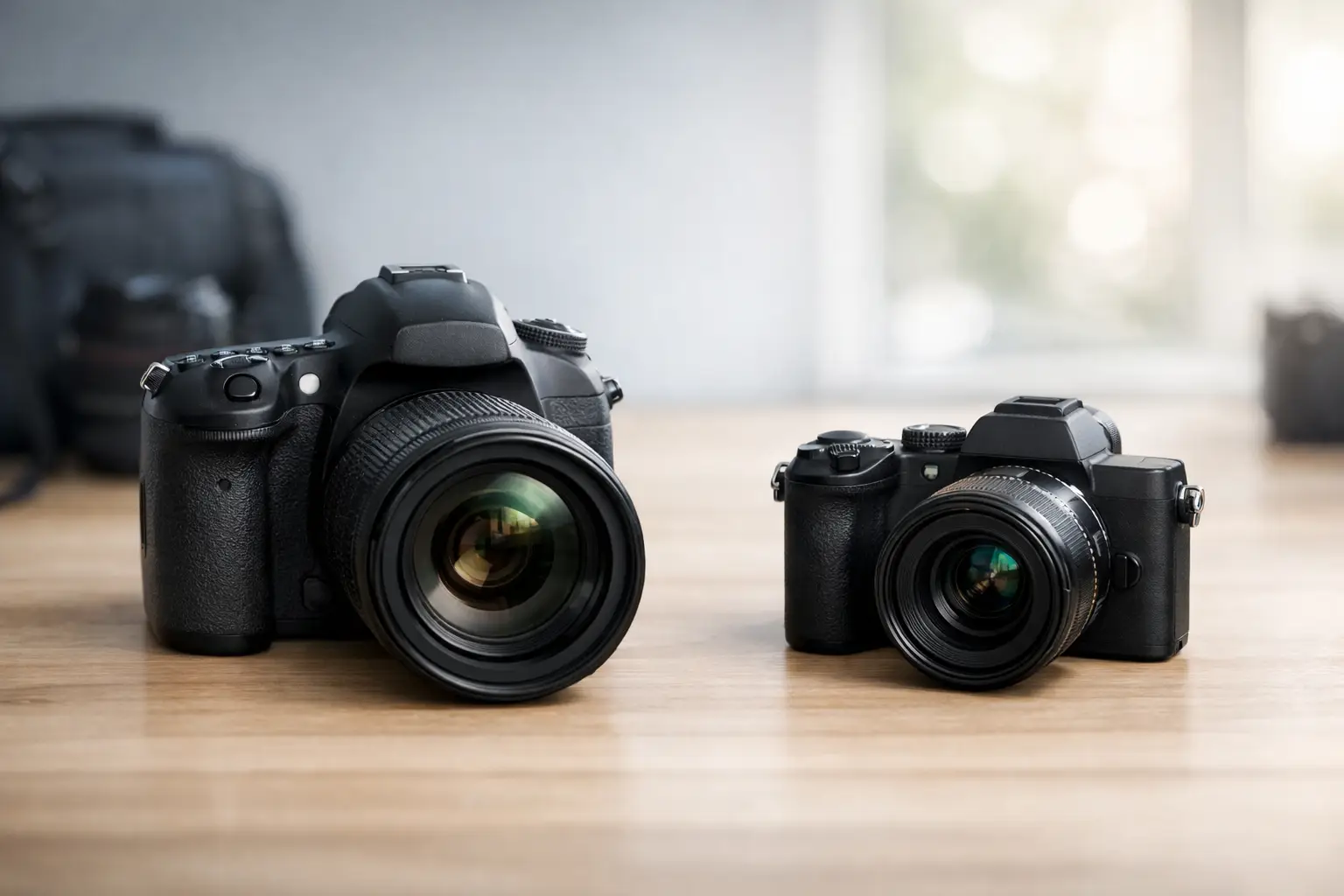
If you are planning to buy a new camera, the question of whether a DSLR or mirrorless camera will be more suitable usually comes up right at the beginning. And for good reason - the body type affects not only size and weight, but also autofocus performance, burst shooting, video capabilities, battery life, and the selection of available lenses. That is why there is no universal right answer. It depends on what you photograph, how often you film, and how long you plan to build your system for.
In brief
- The choice between a DSLR and a mirrorless camera depends on the type of work: photo only or photo+video (hybrid).
- DSLRs often offer better battery life and a broad used lens market; mirrorless offers more modern autofocus, better video capabilities, and compactness.
- Before buying, check the system (available lenses) and how comfortable it feels in your hand — specifications do not reveal this fully.
- If you're not sure, consider trying or renting the device before making the final decision.
What to choose for different tasks
| Task | Solution | Why |
|---|---|---|
| Portrait and studio work | DSLR or mirrorless with a quality portrait lens | Image quality is mainly determined by the sensor and lens; DSLR can be cost-effective, while mirrorless offers more modern focusing options. |
| Events, weddings, reportage | DSLR or mirrorless with fast autofocus and a comfortable grip | An optical viewfinder and long battery life are advantages of DSLR, but mirrorless autofocus systems and burst shooting often help with dynamic scenes. |
| Sports and dynamic situations | Mirrorless camera with fast burst mode and improved autofocus | Mirrorless systems often provide faster burst shooting and modern face/eye recognition, which improve the chances of getting sharp shots. |
| Hybrid — photo and video (content creators) | Mirrorless camera with good video features and stabilization | Mirrorless models usually offer better video support (log profiles, focusing during filming), which is essential for hybrid users. |
| Travel and everyday photography | Compact mirrorless body or a lightweight DSLR kit | Compactness and modern autofocus in mirrorless cameras often make everyday use easier; however, under budget constraints, a DSLR kit may be more practical. |
Frequently asked questions
Does a mirrorless camera battery always run down faster than a DSLR battery?
Usually the electronic viewfinder and screen consume more power, so mirrorless cameras can have higher battery consumption. However, this can vary between models, and in practice the difference depends on usage habits. It is worth checking the manufacturer's guidance and considering a spare battery or an external charger.
Does switching from DSLR to mirrorless mean I have to change all my lenses?
Not necessarily — many users use adapters to mount existing DSLR lenses on a mirrorless body. However, using an adapter can affect ergonomics and autofocus performance, so it is worth checking before making a final decision. In the long term, there are also new lenses available for mirrorless platforms, optimized for modern features.
Which system is better for a beginner?
For a beginner, the overall kit is more often important — comfort, available lenses, and camera logic — rather than just the body type. If you also plan to film, a mirrorless camera is usually more flexible, but on a tight budget a DSLR kit can provide good image quality at a lower cost. It is recommended to hold the cameras in your hands and, if possible, try several options.
Are mirrorless cameras always smaller and lighter than DSLR cameras?
Many mirrorless systems really are more compact because they do not have a mirror mechanism, but professional-grade mirrorless bodies with large lenses can be similar to DSLR in size and weight. The choice should be based not only on body size, but also on how comfortable the camera is to use and which lenses you plan to use. In practice, the full kit with lenses is more important than the manufacturer's classification.
How do I determine whether I need a camera with good video features?
Assess how much of your content creation is video versus photo — if video is a regular part, it is better to choose a camera with reliable focusing during filming, stabilization, and audio inputs. Also consider overheating risk and the need for log profiles or specific codecs. If you're not sure, a rental option lets you test video performance in real situations.
Useful links
- multiple lenses - On the linked resource, you can view lens and accessory rental options, which helps choose lenses suitable for the system.
- external charger - The link leads to power sources — useful if you need spare batteries or external chargers for battery longevity.
- try on rent - Rental options allow you to practically test the camera or kit in real working conditions before buying.
DSLR or mirrorless camera - the main difference
A DSLR camera uses a mirror mechanism and an optical viewfinder. This means that when looking through the viewfinder, you see the scene directly through the lens with an optical image, not an interpretation on a screen. A mirrorless camera, as the name suggests, does not use this mechanism. The image is read from the sensor and displayed in the electronic viewfinder or on the rear screen.
In practice, this design difference creates several very concrete consequences. DSLR cameras often offer longer battery life and ergonomics familiar to many users. Mirrorless systems, on the other hand, are usually more compact, develop faster in autofocus and video, and more often receive the latest manufacturer technologies.
If you previously photographed with a DSLR, switching to a mirrorless model may at first feel unusual precisely because of the electronic viewfinder. But many users quickly appreciate the ability to see exposure, white balance correction, and other settings before the shot is taken.
When a DSLR is still a logical choice
Despite the market shift toward mirrorless, a DSLR has not become obsolete. In some scenarios, it is still a very sensible purchase, especially if the priority is photography rather than hybrid photo and video work.
First, DSLR systems often have an attractive price-to-performance ratio on the second-hand market and also in some new or end-of-stock models. If you need a reliable body for portraits, events, or studio work, a DSLR can deliver high image quality without overpaying for modern video functions that will not be used every day.
Second, the optical viewfinder is still a key advantage for some photographers. It does not show a digital image, has no refresh lag, and works naturally even during long shooting sessions. For sports, reportage, or wedding photography, it is still the most comfortable way of working for some users.
Third, battery life in DSLR cameras is usually very good. If you photograph long events, travel, or work in places where charging is not conveniently available, this factor can be more practically important than a more modern autofocus algorithm.
Of course, limitations must also be taken into account. Development of newer models in the DSLR segment is slower, video functions are often more modest, and future system expansion may be less flexible than on mirrorless platforms.
When a mirrorless camera is the best solution
Mirrorless cameras currently dominate the new market not because of fashion, but because they fit modern workflow demands very well. This is especially evident in hybrid use, where one camera is used for both photo and video content creation.
Autofocus is one of the areas where mirrorless models often take the lead. Face, eye, animal, and vehicle detection work very accurately with many manufacturers, speeding up work in events, portraits, and content creation alike. If you film alone, reliable continuous autofocus may be not just a nice bonus, but a necessity.
Burst shooting is also often faster in mirrorless systems. This is important for sports, dance, children’s photography, and other dynamic scenarios. Some cameras offer a silent electronic shutter, which helps in ceremonies, theater, or interview filming without unnecessary noise.
In the video segment, mirrorless models are usually ahead. 4K, 6K or even higher recording modes, better focusing during filming, log profiles, more effective stabilization, and more flexible codecs - these are the arguments that make many buyers choose a mirrorless system.
There are also downsides. The electronic viewfinder consumes more power, so batteries need to be changed or charged more often. And not all mirrorless cameras are small. Professional-grade bodies with large lenses can be very close in weight to DSLR kits.
DSLR or mirrorless camera for a beginner
For a beginner, the right choice rarely starts with the question of the mirror. More important is the overall package - what lens will be used, how easy the camera is to operate, how convenient it will be to carry, and whether the system will be easy to expand in a year or two.
If you plan mainly to photograph family, travel, everyday life, and occasionally make videos, a mirrorless camera will often be the more flexible choice. It offers more modern autofocus, simpler video work, and often a more compact kit. Here it is especially important to look not only at the body, but also at the available entry-level lenses.
If the budget is tight and the priority is photo quality, a DSLR kit can still be a very good starting point. Especially if you do not need highly modern video functions or fast subject recognition. In many cases, a beginner will benefit more from a good lens and an easy-to-understand camera than from the latest body.
The lens system is just as important as the body
When choosing a camera, it is easy to get stuck comparing specifications. However, in the long term the key question is the system - what lenses will be available to you now and later. A broad, reliable lens range is often more important than a few extra frames per second or one video feature.
DSLR platforms have accumulated a large lens selection, including on the used market. This can be very advantageous for photographers who want to build a versatile kit at reasonable cost. The choice of portrait, macro, telephoto, and standard zoom lenses is still broad in many systems.
Mirrorless systems, in turn, receive the latest lenses, which are often optimized for faster autofocus, video work, and higher optical performance. Keep in mind that some of these lenses are more expensive. That is why it is important to evaluate not only the first purchase, but also the kit you will want in time.
If you already use lenses from a particular manufacturer’s DSLR system, switching to a mirrorless body can also be sensible with an adapter. But using an adapter does not always provide identical ergonomics or autofocus performance. It is worth checking this before making a decision.
Photo versus video - which direction matters more to you
If 90 percent of your work is photography, a DSLR may still be a logical and financially justified choice. Especially for portraits, studio work, real estate, or classic reportage, where the main thing is a reliable body and good optics. Image quality itself does not depend on whether the camera has a mirror. It is determined more by the sensor, the lens, and the photographer’s work.
If you regularly film, a mirrorless camera is usually more suitable. Here it is important not only to consider resolution, but also overheating control, audio ports, image stabilization, screen articulation, and focusing reliability during recording. For content creators, company marketing teams, and videographers, these factors usually outweigh the battery drawbacks.
It is precisely hybrid users who often get the most out of mirrorless systems today. One camera can cover product photography, social media video, interviews, events, and everyday content needs without major compromises.
What to check before buying
Before choosing a specific model, it is worth asking yourself a few practical questions. Will the camera be used mainly indoors or outdoors? Is mobility more important, or ergonomics with a larger grip? Do you plan to buy several lenses? Will you film regularly, and do you need a microphone input? Will you need a second battery, an external charger, a tripod, or a stabilizer?
It is also worth holding the camera in your hands. A specification table does not tell you how comfortable the grip will be, how logical the menu is, or how quickly the main settings can be changed. A technically good model is not always the best for your working style. That is why a consultation with a specialist or the opportunity to compare several options in one place often helps avoid an inaccurate purchase.
If you are not sure whether the system will meet real tasks, in some cases a sensible step is to try the equipment in rental first. This is especially relevant for video projects, event season, or a transition from one system to another. For Master Foto clients, this approach often helps make a much more accurate decision.
The choice between a DSLR and a mirrorless camera is not a test of who follows trends better. A good decision is the one that matches your tasks, budget, and working pace. If the camera does not get in the way of working, but helps you quickly get the expected result, it is the right camera - regardless of whether it has a mirror or not.