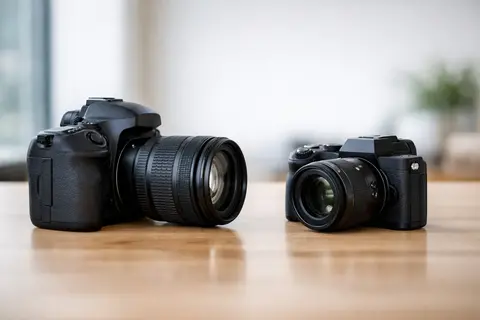
If you are planning to buy a camera for more serious photography or video work, the question DSLR or mirrorless camera usually comes up right from the start. And for good reason - this choice affects not only the body, but also autofocus performance, lens availability, size, battery life, and how comfortably the system will serve you in everyday use or on specific projects.
In brief
- DSLR cameras still offer an advantage in battery life, a wide range of used lenses, and an optical viewfinder.
- Mirrorless cameras usually offer more modern autofocus, better video capabilities, and a more compact body; they are a good fit for hybrid work (photo + video).
- The choice should be based on the real use case: for sports and fast-paced action, mirrorless; for long photo sessions and budget-conscious users, DSLR may be more practical.
- Before making a final choice, it is recommended to review the system ecosystem (lenses, batteries, accessories) and, if possible, try or rent the gear before buying.
What to choose for different tasks
| Task | Solution | Why |
|---|---|---|
| A beginner who mainly shoots portraits and is learning the basics | Mirrorless camera or a compact mirrorless kit | The electronic viewfinder and automatic eye/face detection make learning easier, and video capabilities are available right away. |
| A photographer with a limited budget and existing used optics | DSLR with used lenses | DSLR systems have a broad used lens market and value-oriented kits that make it possible to get quality optics at a lower price. |
| A wedding, sports, or event photographer who needs fast and reliable tracking | Modern mirrorless body with excellent tracking autofocus | Modern mirrorless systems offer accurate eye, face, and subject recognition in dynamic conditions. |
| Long photo sessions or events without frequent opportunities to charge gear | DSLR or additional power resources (spare batteries, battery grip) | The optical viewfinder and lower electronics usage usually provide longer shooting time on a single charge. |
| Travel photography and vlogging, where weight and video features matter | Compact mirrorless system with stabilization and lightweight lenses | A smaller body and modern video/AF functionality make long work sessions and moving around with minimal weight easier. |
Frequently asked questions
How do I know which system is better for me — DSLR or mirrorless?
Start with what you will mainly photograph or film over the next 12–36 months. If your work is dominated by video or fast-paced genres (weddings, sports), a mirrorless camera is usually more convenient; if your priorities are long photo sessions, budget, and used optics, a DSLR may be more practical.
Is mirrorless autofocus always better than DSLR autofocus?
Modern mirrorless models often outperform DSLRs in live view and video mode, especially in eye and face detection. However, some professional DSLRs are still very fast in phase autofocus when shooting through the optical viewfinder.
How important is battery life in the choice?
Battery life is especially important for long sessions, events, and travel without access to charging. If you choose a mirrorless camera, include spare batteries, a battery grip, or external power in the budget.
Should I worry about lens availability when choosing a mirrorless system?
The range of high-quality lenses for mirrorless systems is steadily growing, but professional optics in some segments can still cost more. If you already own DSLR lenses, adapters can help, but when planning long-term expansion, evaluate the lens selection of the target platform.
Do video modes make mirrorless cameras the only logical choice for content creators?
Mirrorless cameras often offer better video features — 4K, in-body stabilization, better tracking AF, and easier compatibility with gimbals and monitors. However, if video is secondary or simple clips are enough, a DSLR can still be an acceptable option.
Is it worth buying a used DSLR system?
Yes, if your budget is limited, used DSLR systems can provide a lot of valuable lenses and accessories at a good price. Make sure to check the condition of the optics, the operation of mechanical parts, and service availability before buying.
Useful links
- Power sources - Tips on batteries, external power, and other energy sources that are important for predicting battery life.
- Lenses - Guidance on lens selection, mounts, and a wider range of optics that affects the long-term system choice.
- Mirrorless cameras - A catalog of the latest mirrorless gear, useful when autofocus and video features are the priority.
- Cameras - A broader overview of the camera category for comparing different platforms and model ranges.
There is no single universally correct answer here. For some users, a DSLR is still a logical and economically justified solution, while for others a mirrorless system has long since become the most practical choice. The most important thing is to understand exactly what you will be photographing or filming, at what pace you work, and whether you plan to develop the system in the long term.
DSLR or mirrorless camera - the main difference
The main technical difference is in the design. In a DSLR, light passes through the lens to a mirror and an optical viewfinder. When you press the shutter, the mirror flips up and the image is recorded on the sensor. In a mirrorless camera, this mechanical assembly is absent - the image goes directly to the sensor, and you see the composition in the electronic viewfinder or on the screen.
In practice, this means several things. Mirrorless cameras are usually more compact, have more modern autofocus systems, and often stronger video features. DSLR cameras, on the other hand, are still appreciated by many users for their optical viewfinder, longer battery life, and the wide used-lens market.
If the choice is between your first camera and a long-term system, it is important to look not only at one body, but at the whole ecosystem - lenses, flashes, adapters, batteries, and service availability.
When a DSLR is still a good choice
Although the market is clearly moving toward mirrorless systems, a DSLR has not become obsolete simply because the technological direction has changed. In many scenarios, it still performs very convincingly.
For photography with an emphasis on a classic workflow - portraits, studio work, events, reportage with a traditional optical viewfinder - a DSLR is still comfortable. The optical viewfinder does not show a digitally processed image, so for some photographers it feels more natural and less tiring during long sessions.
Price is also an important argument. The range of used and previous-generation DSLR bodies and lenses is still broad. If the budget is limited, you can put together a very capable system for a relatively affordable sum. This is especially useful for beginners, students, or businesses that need a quality photo solution without overpaying for the latest video features.
A DSLR’s advantage is often its battery life as well. Because the optical viewfinder does not require continuous operation of the electronics and display, you can shoot more frames on a single charge. In long photo sessions, trips, or events, this is still a practical benefit.
When a mirrorless camera is the more logical choice
If your priority is a modern autofocus system, flexible video work, and lower equipment weight, a mirrorless camera will usually be ahead. This is the segment where the fastest development has taken place in recent years.
Modern mirrorless models offer very accurate eye, face, animal, and subject recognition. This is especially useful for wedding photographers, sports and event operators, content creators, and solo filmmakers. If a person moves unpredictably or there is a lot happening in the frame, a good mirrorless autofocus system can save both time and failed footage.
The difference is even more pronounced on the video side. Many mirrorless models offer 4K and higher resolution, better tracking autofocus during filming, log profiles, in-body stabilization, and more convenient work with external monitors, gimbals, and streaming solutions. If the camera will be a work tool not only for photography but also for video projects, a mirrorless system is often the safer investment.
Another benefit is the electronic viewfinder. It lets you immediately see exposure, white balance, image profile, and other parameters before shooting. For beginners, this reduces the number of mistakes, while for experienced users it speeds up work in challenging lighting conditions.
Autofocus, speed, and accuracy
If we compare it purely in practical terms, mirrorless cameras often offer superior autofocus right now, especially in live view and video mode. The sensor-plane focusing principle makes it possible to determine sharpness very precisely exactly where the image is being recorded.
DSLR cameras have long been very strong in phase-detect autofocus for shooting through the viewfinder, and many professional DSLR models are still very fast. However, as soon as work shifts more toward the screen, video, or dynamic face recognition, the mirrorless advantage becomes more visible.
There are nuances here, though. If you photograph in a studio, architecture, products, or calm portraits, the absolute complexity of autofocus may not be the deciding factor. For sports, events, and documentary filming, however, it is often very important.
Lens system and long-term choice
A camera is not just a body. When choosing between a DSLR and a mirrorless system, the lens question is often decisive.
DSLR systems have a large historical legacy. Canon EF, Nikon F, and other mounts offer a wide range of lenses across different price categories. If you already have such a collection or plan to buy used optics, the DSLR path can still be very economically sensible.
In mirrorless systems, the advantage is the development of newer optical designs. Many new-generation lenses are sharper, faster, and better optimized for both photo and video. At the same time, it should be noted that in some segments professional mirrorless optics can be more expensive.
It is also important to think ahead. If you plan to expand the system over the next three to five years with several lenses, external lights, video accessories, and possibly move to a full-frame camera, a mirrorless platform often offers a clearer development path.
Size, weight, and working ergonomics
It is often said that a mirrorless camera is always much smaller. That is only partly true. The body is usually indeed more compact, but with fast lenses the total system size can be very similar to a DSLR.
Still, the weight reduction during travel, everyday carrying, and gimbal work is noticeable. If you move around a lot, film handheld, or create content alone, a smaller body can be a significant advantage.
On the other hand, a larger DSLR body is more comfortable for many users with heavier telephoto lenses or during longer workdays. Ergonomics is not just size - it is button placement, grip, menu logic, and how quickly you can react in a real situation.
That is exactly why it is worth not only comparing cameras by specification, but also holding them in your hands if possible. What looks ideal on paper is not always the most comfortable in practice.
Battery, reliability, and everyday work
DSLRs traditionally win in battery life. That is still relevant. If you photograph long events without frequent opportunities to charge your equipment, a DSLR may be more convenient.
Mirrorless cameras, in turn, have to work with the electronic viewfinder, display, and often more complex data processing. As a result, batteries drain faster, especially in video work. The practical solution is extra batteries, a battery grip, or external power, but this should be included in the budget from the start.
In terms of reliability, both systems in the professional segment can be very strong. Here it is more important to look at the specific model, body protection against dust and moisture, card slots, overheating behavior in video mode, and service availability.
DSLR or mirrorless camera for a beginner
For a beginner, the choice is often not about the philosophy of the technology, but about how quickly you can start working with the camera and develop your skills. If ease of learning, automatic face and eye focusing, visible exposure before the shot, and video options matter, a mirrorless camera is usually more forgiving.
If the budget is strictly defined and the main goal is to learn the basics of photography with quality optics, a good DSLR can give you a lot for a relatively smaller investment. Here, what matters is not the technology’s status on the market, but the overall value of the kit.
For those who are still unsure, equipment rental or a practical consultation before purchase can be useful. This is especially important if the camera will be needed for work rather than just a hobby. In the case of Master Foto, this approach makes sense, because you can both compare the equipment in one place and assess whether buying or renting is more suitable for a specific project.
Which one to choose for your scenario
If you mainly photograph and want a stable, proven system with affordable used lenses, a DSLR is still a very sensible choice. If you work in hybrid mode - photo plus video -, want modern autofocus, and plan to develop the system long term, a mirrorless camera will in most cases be more suitable.
You do not have to choose what is currently more modern on the market. The right choice is the one that matches your shooting style, budget, and working environment. A camera is a tool, and a good tool is one that helps you work precisely, quickly, and predictably. If before deciding you clearly define what you will be photographing in the coming months, rather than just what looks good in the specifications, the choice will become much easier.