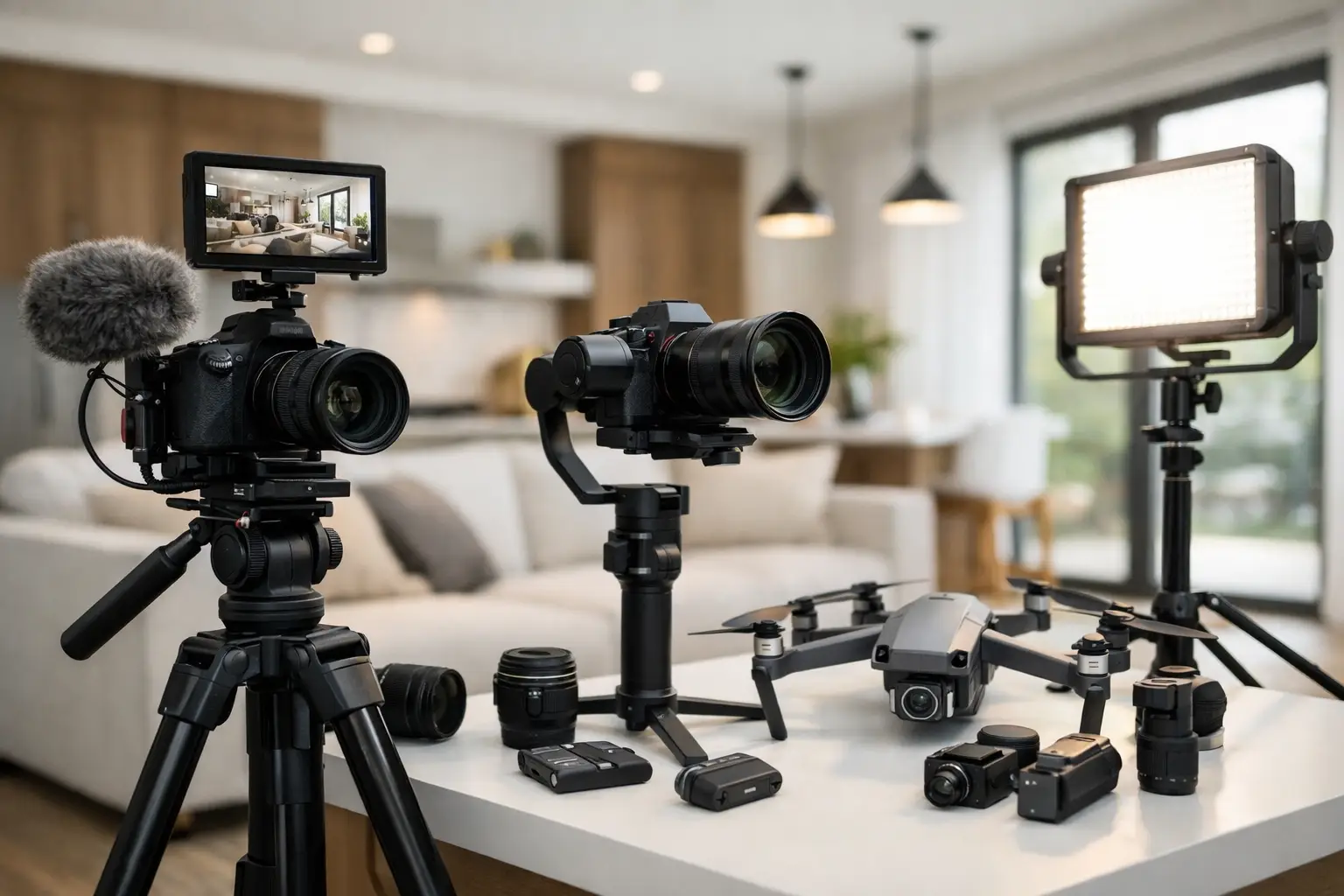
Mistakes in apartment or house filming usually start not with editing, but with an incorrectly assembled equipment kit. If the shot is unstable, the rooms are dark and the windows are overexposed, even a good property looks worse than it actually is. That is why a real estate filming kit example is not just a shopping list - it is a practical solution for a specific job.
In brief
- Build a kit around five elements: camera, wide lens, stabilization, light, and audio.
- Prioritize stabilization (gimbals or a video tripod) based on the movement planned in the shot.
- Choose a moderately wide lens to avoid strong perspective distortion indoors.
- For mobile work, use battery-powered LED lights with adjustable color temperature to balance window contrast.
- Capture audio with a lavalier or wireless microphone — the built-in mic usually does not meet requirements.
What to choose for different tasks
| Task | Solution | Why |
|---|---|---|
| Quick social media walkthroughs and small properties | Light mirrorless body or phone, moderately wide lens, compact gimbal, one LED panel, and a lavalier microphone. | The priority is quick movement and mobility — low weight and fast setup deliver good results in small-form content. |
| Sales videos for agencies (mid-level quality) | More stable gimbal, additional light panels with battery options, tripod for detail shots, high-quality wide lens, and wireless microphone. | This combination delivers both smooth walkthroughs and representative static shots that clients perceive as professional-level. |
| Premium segment property videos | Higher-end camera (full-frame or powerful APS-C), precise optics with good edge sharpness, multiple adjustable lights, tripods, and additional audio solutions. | Premium projects require stability, a wide dynamic range, and the ability to precisely control light and perspective. |
| Detailed static framing (kitchens, bathrooms) | Stable tripod with a video head, high-quality wide lens or prime lens, LED fill light, and spare batteries. | Static shots require precise composition and consistent exposure — a tripod provides clean, representative images. |
Frequently asked questions
Which wide-angle lens should I choose to avoid too much distortion indoors?
It is better to choose a moderately wide angle (around 16–20 mm full-frame equivalent), because it preserves the sense of space without aggressive perspective distortion. You should especially avoid extreme wide angles if correct verticals and furniture shapes matter.
When should I use a gimbal and when a tripod?
A gimbal is the priority when the video relies on transitions and smooth movement through rooms; a tripod is better for detail shots, fixed wide shots, and precise composition. Many operators use both so each can handle its own task.
Is a full-frame camera absolutely necessary for real estate filming?
No — the advantages of full frame are better low-light performance and dynamic range, but APS-C and Micro Four Thirds can be perfectly sufficient with the right optics and stabilization. The choice depends on workflow speed, weight requirements, and budget.
How do I deal with overly bright windows and dark corners?
Use LED lights with adjustable color temperature to add fill light and balance contrast; sometimes one accent light on a person or a dark corner is enough. With careful exposure planning and added lighting, you can preserve detail both inside and near the windows.
How important is audio in real estate video?
If the content includes speech or agent commentary, audio quality becomes critical — a lavalier or wireless microphone provides clear voice capture and reduces editing time. If the content will be published only with music, you can manage without an external microphone, but that is rarely the ideal approach for modern formats.
When is it better to buy, and when to rent additional gear?
For regular work, it makes sense to buy the basic kit (camera, lens, gimbal, basic light), because it lowers long-term costs. Specialized or rare equipment (large lights, complex stabilization systems, drone) is practical to rent for a specific project.
Useful links
- Tripods - Use of a tripod for fixed framing and precise composition, which is recommended in the description for detail shots and wide shots.
- Mirrorless cameras - Mirrorless bodies are mentioned as a practical option for beginners and mobile filming, so the link is useful for choosing equipment.
- Continuous lighting - The article emphasizes the importance of adjustable LED light to balance contrasts near windows and light dark corners.
- Audio equipment - It is explained that a lavalier or wireless microphone is essential equipment when the video includes a speaking person.
- Video stabilizer accessories - Gimbals and stabilization solutions are the central topic of the article — the link is useful for finding additional gear.
- LED light panels - The link to LED panels matches the recommendation for mobile adjustable lights for room filming.
Real estate video differs from an interview, a commercial clip, or event filming. Here, the feel of the space, smooth movement, correct perspective, and a consistent image throughout the route - from the entrance to the living room, bedroom, and bathroom - are important. The equipment should be chosen so that it helps achieve this result quickly and repeatably.
What makes a good real estate filming kit example
A good kit is usually based on five elements - camera, wide lens, stabilization, light, and audio. In some projects, audio will be secondary, especially if the final video is edited with music and without speech. However, if the agent records text on location or commentary is filmed, sound becomes just as important as the image.
It is also important to understand the boundary between a universal and an optimal kit. A universal kit will suit different tasks, but it will not always be the most convenient in tight spaces or when filming long, flowing movements. In turn, an optimal kit for real estate may be less suitable for other genres, but specifically in space filming it will deliver a more stable result.
Real estate filming kit example for beginners
If filming is done regularly, but the budget is controlled, a practical starter kit can consist of a mirrorless camera with good video autofocus, a wide-angle lens of around 16-20 mm full-frame equivalent, a lightweight gimbal, one LED panel or a compact COB light, and a wireless microphone system. Such a setup makes it possible to film both wide room shots and the agent’s introduction by the building or indoors.
At this level, the most expensive body is not necessarily required. Much greater impact on the final result is often made by the width of the lens, the quality of stabilization, and the ability to quickly balance the light in rooms with windows. If the camera shoots 4K, has reliable autofocus, and enough dynamic range reserve, that is often sufficient for professional day-to-day work.
When choosing a wide lens, you need to be careful. Too extreme a wide angle makes rooms look larger, but at the same time distorts walls, furniture, and door frames. Buyers and clients of real estate video quickly notice when the image seems artificially stretched. That is why a moderately wide lens often works better, preserving the feel of the space without aggressive perspective.
Camera and lens - where not to save in the wrong place
Real estate video is not a sports broadcast, but the camera must be able to work correctly in motion. If you film with a gimbal and move through rooms in one continuous motion, a camera with unpredictable autofocus or a strong rolling shutter effect will cause problems. This means crooked verticals, jittery transition shots, and longer post-production.
A full-frame camera has an advantage here, especially when working in lower light and with wide lenses. However, APS-C or Micro Four Thirds systems can also be completely sufficient if the priority is lower weight, lower costs, and good stabilization. The choice depends on whether you film alone, how quickly you need to work on site, and whether the equipment will also be used in other projects.
In terms of lenses, real estate filming is often won not by a universal zoom range, but by predictable optics with good sharpness at the edges. In room shots, walls and furniture are present across the entire frame, so the edges are not unimportant. If the lens blurs in the corners or distorts lines too strongly, it is immediately visible.
Stabilization - gimbal, tripod, or both
If one category has to be named that changes real estate video the most, it is usually stabilization. A gimbal allows you to create smooth entrance shots, movements through rooms, and gentle pans without jerks. It is this quality of movement that often creates a premium impression.
However, a gimbal is not the only solution. A tripod with a video head is still very useful for detail shots, fixed wide shots, and situations where precise composition is required. For example, when filming a kitchen, bathroom, or small room, a safer result is sometimes achieved from a tripod rather than from the hand or a gimbal.
A good practical principle is this - if the video is based on movement, the gimbal is a priority; if it is based on calm, representative shots, the tripod may be even more important. Many operators use both, because they solve different tasks.
Light for rooms with windows, white walls, and dark corners
In real estate filming, light is rarely fully controllable. One room has large windows and harsh daylight contrast, the next has warm ceiling lighting and dark corners. That is why a compact, powerful LED light with adjustable color temperature, or at least a quality LED panel, is useful in the kit.
Here you need to think not only about power, but also about mobility. If the operator moves between multiple properties in one day, a heavy studio light with large stands will be less practical. In turn, a small light with battery power will make it possible to quickly lift a dark part of the room, light the agent, or balance the contrast near the windows.
It should be taken into account that you do not always need to light the entire room. Often a focused fill light in one corner or a light fill for the person in the frame is enough. Excessive lighting can make the interior look flat and less believable.
Audio - not always first, but often decisive
If the video is published only with music, it may seem that a microphone is not needed. However, real estate content increasingly includes agent comments, short introductions, explanations of the property’s advantages, and social media formats with a speaking person in the frame. In such cases, a wireless microphone is basic equipment, not an addition.
The built-in camera microphone in rooms picks up too much echo and ambient sound. In contrast, a lavalier or compact wireless system provides clearer voice and saves time in editing. If the property is located near a busy street, audio quality becomes even more important.
Additional accessories that often save the shoot
A good real estate filming kit example is not complete without spare batteries, fast memory cards, ND filters, cleaning supplies, and a convenient bag. These are not glamorous purchases, but these small items often determine whether the shoot will go smoothly.
ND filters are especially important if you film during the day and want to maintain a cinema-style shutter speed. Without them, the image outdoors or near large windows may become too bright, and you will have to compromise the exposure or the look of motion. Spare batteries, on the other hand, are critical if several properties are scheduled in one day.
When to buy and when to rent
There is no single correct answer here. If real estate filming is a regular service, it usually makes sense to keep the camera, lens, and basic stabilization in your own arsenal. That reduces long-term costs and lets you work without a booking schedule.
More specific equipment, however, is worth renting. This can be a more powerful gimbal, additional lights, a drone, a teleprompter for agent narration, or a second camera for more complex projects. This approach is pragmatic - use the basic kit for everyday work, and add extra equipment for a specific project.
This is exactly where a specialized approach is useful, where it is possible both to evaluate suitable equipment and to buy or rent it in one place. If projects differ in scale, flexibility is often more valuable than the maximum full but rarely used inventory.
Practical setup for three scenarios
If you film for social media and small property tours, a light camera, a wide lens, a compact gimbal, and one microphone will be enough. The most important thing here is speed and mobility.
If you create high-quality sales videos for agencies, the kit should be supplemented with a more stable lighting system, a tripod, a backup audio solution, and possibly a drone for exterior shots. At this level, the client already notices nuances.
If you work with premium segment properties, a fuller kit is often needed with a higher-end camera, more precise optics, multiple lights, a more professional color grading reserve, and additional shots from different supports. Here the requirements grow not only technically, but also in terms of workflow stability.
The wrong kit in real estate filming rarely means complete failure. Much more often it means slower work, more compromises, and a result that is not as convincing as it could be. That is why it is worth starting not with the question of which camera is the most popular, but with what properties you film, at what pace you work, and what clients expect from the final video.
If the kit is assembled with a clear purpose, each filming day becomes easier - and in real estate work that is usually just as important as the final shot itself.