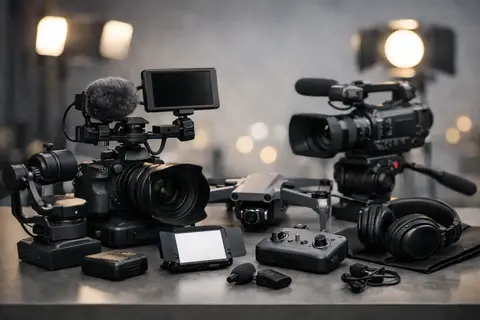
What is a good example of an event filming equipment kit in a situation where you need to film a conference, a corporate evening, or a stage event without the possibility of retaking shots? This is exactly where the logic of the kit matters more than the impressive specifications of individual devices. In an event environment, it is not the theoretically most powerful camera that wins, but the system that allows you to reliably record image and sound, quickly adapt to the light, and not lose momentum during the work.
In brief
- Prioritize reliability: a good setup means camera, audio, lighting, stabilization, memory, and backup power.
- Audio is more critical than an extra lens — use a lavalier or wireless system and always make a parallel backup recording.
- Choose a versatile zoom lens (e.g. 24–70 mm) as the first solution; a fast prime lens is an addition for specific needs.
- Plan backups: multiple SD cards, extra batteries, cables, and universal adapters reduce the risk of running out of work.
What to choose for different tasks
| Task | Solution | Why |
|---|---|---|
| Content creator / short video work | One hybrid camera with a versatile 24–70 mm lens, directional microphone, compact LED light, and monopod. | Move comfortably, prepare quickly, and provide sufficiently high-quality material for social networks and company content. |
| Corporate conference | Two-camera setup: one on a tripod for a fixed wide shot, the other mobile on a monopod or gimbal; a wireless microphone system and additional memory cards. | Simultaneous multi-angle filming reduces the risk of missing speakers and simplifies editing. |
| Stage event / concert | Several cameras (fixed and mobile), independent audio recording from the console, sturdier tripods, and on-site file management. | In large events, redundancy and coordinated audio/video synchronization are important to ensure usable final material. |
| Emergency interviews behind the scenes | Compact LED light with battery, lavalier microphone (wireless) and a fast camera with a single bright prime lens or a wide-angle zoom. | Fast setup and controlled close-up shots deliver good results without a large crew. |
Frequently asked questions
Do you always need two cameras for filming an event?
Two cameras are not mandatory, but they significantly reduce the risk of missing important moments and make editing easier. For smaller tasks, one camera is often enough if the task is clearly defined and does not require multiple angles.
Which audio solution should you choose for conferences?
The safest option is a wireless lavalier system for speakers plus a parallel backup recording in the camera or on a separate recorder. If possible, connect to the sound mixer and always check phases and levels before starting.
When is it better to use a gimbal instead of a monopod?
Gimbals provide smooth camera movement and a modern visual look, but they require time for balancing and more attention to batteries. A monopod or tripod is more practical for long sessions, in limited spaces, or in situations where quick movement is needed.
What memory cards and file practices are safe for event filming?
Use multiple fast SD/CFExpress cards and, if possible, record in parallel or use cameras with two card slots. On-site file management — regular copying to a portable drive — reduces the risk of data loss.
How important is it to bring spare batteries?
Very important — insufficient batteries can end the workday. It is recommended to have at least two spare batteries for each device and a solution for fast charging or portable power if filming lasts all day.
When is it better to rent equipment instead of buying it?
Renting is often more advantageous for niche or less frequently used equipment, such as an extra camera, telephoto zoom lenses, or specialized audio gear. If a particular equipment category is used regularly, purchasing usually pays off in the long run.
Useful links
- Wireless audio systems - A link to wireless microphones recommended in the article as a reliable audio solution for conferences and interviews.
- Cameras - A general category for choosing cameras, useful when looking for hybrid cameras and video cameras for event filming.
- Memory cards - Direct link to SD and other memory card categories, important for secure data recording and backup cards.
- Video lights - Small LED lights and lighting rental solutions are mentioned as an essential element for illuminating interviews and details.
- Stands - Links to tripods and video tripods recommended in the article for a stable group shot and long-duration filming.
- Video stabilizer accessories - Gimbal and stabilization accessories that are useful for more dynamic shooting and motion control.
- Audio equipment - Additional audio equipment and recorders needed for more professional event audio support.
- Video recording equipment - General category for video equipment that helps compare solutions for event filming.
This is not a story about one universal bag for all jobs. Event filming differs depending on the venue, number of people, lighting conditions, movement intensity, and final deliverable requirements. Therefore, it is more correct to think not about one ideal kit, but about a basic kit with clear priorities and a few extensions for a specific task.
Example of an event filming equipment kit in practice
If a rational starting point needs to be chosen, an example of an event filming equipment kit usually consists of a camera body, a versatile fast lens, a stabilization solution, an external microphone or wireless audio system, a small LED light, a set of memory cards, and backup power. These are not extras - this is the basic working configuration.
The camera here is only one part of the result. At events, what is often most important is reliable autofocus, good performance in low light, long recording time, and two memory card slots or at least safe file management. If filming takes place without an assistant, ergonomics also matter a lot - how quickly settings can be changed, how well the screen is visible, and whether the body works comfortably during long shifts.
When choosing a lens for events, two directions usually dominate. The first is a universal zoom lens, for example a 24-70 mm range, which allows quick switching from a wide shot to a close-up. The second is a bright prime lens for interviews, more portrait-like shots, or work in very poor light. If the budget allows only one lens, a good zoom model is often more practically safe than a prettier but less flexible prime lens.
Camera, lens, and stabilization
In event filming, a camera should be evaluated by the work scenario, not just by sensor resolution. 4K recording is currently standard for many projects, but it is not the only criterion. It is also important to consider overheating risks, file codecs, battery life, and the ability to connect external audio without an adapter chain.
If the event is dynamic - for example, an awards ceremony, an entertainment evening, or a reportage-type task - a gimbal or at least a camera with good internal stabilization is useful. However, a gimbal is not mandatory for every job. In conferences and panel discussions, a monopod or a tripod with a video head is often a much safer solution, because it reduces fatigue and allows the frame to be held steadily for longer.
This is exactly where one of the most common compromises appears. A gimbal provides movement and a modern visual feel, but it requires time for balancing, more attention to batteries, and is not always convenient in narrow or crowded spaces. A monopod, on the other hand, is less impressive, but very effective when the filmmaker has to work for several hours without breaks.
One body or two cameras
For smaller jobs, one camera is enough if the task is clearly defined and simultaneous multi-angle filming is not required. But for conferences, stage events, and corporate presentations, a second camera is often not a luxury but a safety tool.
One camera can remain on a fixed wide shot on a tripod, while the other handles close-ups, reactions, and details. This makes editing easier and reduces the risk of missing important moments. If a full second-camera kit is not needed regularly, a rental solution is often more economically justified than an immediate purchase.
Audio is more critical than another lens
Event video viewers will forgive a slightly darker image, but poor sound will make the material hard to use. That is why any example of an event filming equipment kit should be built with a serious approach to audio recording.
In the simplest version, a directional microphone is needed on the camera for ambience and backup sound. But that is not enough if you need to record a speaker on stage, a moderator, or an interview. In such cases, the safest solution is a wireless microphone system, while at larger events - a connection to the sound console and a parallel backup recording in the camera or a separate audio recorder.
The principle works here again - one audio source is not a plan. If the speaker has a lavalier microphone, the camera should still record the room ambience. If there is a console feed, it will not always be ideal for video use, because what is heard in the hall and what is mixed in the console may differ. A safe event operator thinks in layers, not in a single cable.
Light is not just for the studio in event work
Many people think that lighting equipment is not needed for events because the venue is already lit. In practice, this often only means that the venue is lit for guests, not for the camera. Dark walls, high-contrast spotlights, LED screens, and a mix of warm and cool colors create difficult conditions even for good cameras.
A small, adjustable LED light with a battery is useful for backstage interviews, short comments, and detail shots. It is not intended to light the entire hall, but specifically for controlled close work. If interviews are planned in a separate area, it is worth considering a two-light kit with stands and softening.
The practical side should also be considered. A larger lighting kit gives better results, but requires more setup time, transport space, and sometimes coordination with the organizer. If the filmmaker works alone and moves continuously, a compact LED light is often more productive than a technically superior but slower solution.
Accessories that save the project
In event filming, problems rarely arise only at the camera level. They start with a full memory card, a dead battery, the wrong cable, or a tripod plate that was left in another bag. That is why a good kit always includes spare elements.
The minimum reserve should include several fast memory cards, at least two to three batteries per device, a charger, headphones for audio monitoring, audio cables of different lengths, adapters, an extension cord, and a small tool kit. If filming is planned for a full day, portable power or the ability to charge several devices on site at the same time is also useful.
These accessories rarely appear in promotional photos, but they are often what determines whether the event will be filmed without stress. In professional practice, the basic idea is simple - everything that can be lost, discharged, or broken must be provided twice or have an alternative.
Three typical kit scenarios
For a content creator or a small team filming company events and social media material, one hybrid camera, a universal lens, a camera-mounted directional microphone, a compact LED light, a monopod, and spare batteries are enough. Such a kit is relatively light and allows quick location changes.
For corporate conference filming, a safer setup will be a two-camera solution, where one camera works on a tripod and the other creates close-ups. This should be supplemented with wireless audio or a console connection, headphones, extra memory cards, and at least one light for interviews. Here, the most important thing is not mobility, but a predictable result throughout the day.
For larger-scale stage events, the kit becomes even more structured - multiple cameras, a more serious tripod system, independent audio recording, clear file management, and backup equipment. If such work is not an everyday occurrence, in many cases the most sensible path is to combine your own basic gear with rentals. In exactly this model, a specialized equipment center, such as Master Foto, is often a more practical partner than a series of random purchases in different places.
When to buy and when to rent
If a particular category is used every week, buying is usually justified. This often applies to the camera, the main lens, the microphone, and everyday accessories. By contrast, niche equipment - a second camera for a large event, a teleprompter, additional lights, or specific audio solutions - in many cases works better in a rental model.
This is not just a budget issue. Rental allows you to choose equipment according to the specific project rather than adapting the project to what is already on the shelf. In event filming, this flexibility is often more valuable than the theoretical comfort of ownership.
A good kit is not the one with the most equipment in the bag. A good kit is the one with which you can arrive at the event safely, anticipate failures, and calmly do the job from the first frame to the last file on the card.