
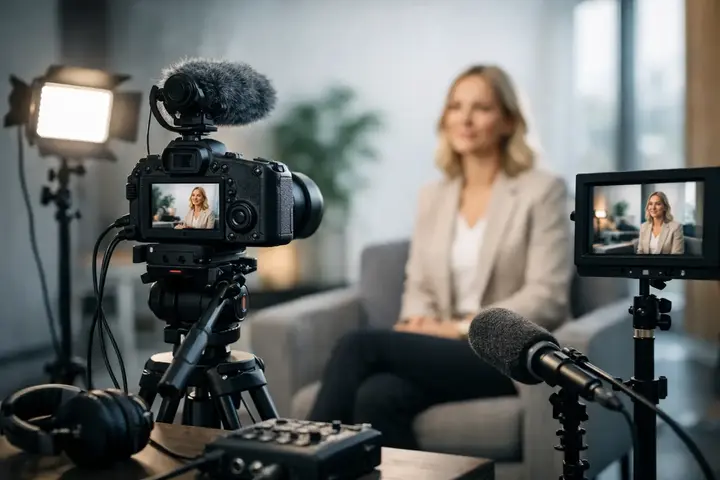
If a company needs to film an interview with a manager, specialist, or client, the result is most often determined not by one expensive camera, but by a balanced setup. That is precisely why an example of corporate interview video equipment should be built as a system - with a thoughtfully chosen camera, audio, lighting, and stabilization. If one link is weak, it is seen and heard immediately.
Interview videos are usually used in several situations: for a website, social media, employer branding, an advertising campaign, or internal communication. In each of these scenarios, the quality requirements differ slightly, but the basic principle remains the same. Viewers will forgive a simple shot, but they rarely forgive poor sound, unstable composition, or unpleasant lighting.
In brief
- A balanced kit (camera + audio + light + tripod) delivers better results than one expensive device.
- Sound is the priority — a lavalier or wireless clip-on microphone plus a backup recording.
- Three-point lighting with a softened key light gives office interviews a professional look.
- A single-camera basic kit is suitable for infrequent recordings; two cameras are needed for reputation or advertising projects.
- If equipment is needed rarely, consider renting; for regular filming, buying or a mixed model is more cost-effective.
What to choose for different tasks
| Task | Solution | Why |
|---|---|---|
| Interview for a website or company presentation | A single-camera mirrorless setup, a lavalier microphone, two lights (key + fill), and a tripod. | A simple, quick-to-set-up kit provides clean material for website needs without excessive costs. |
| Short social media clips and executive commentary | A compact 4K camera with good autofocus, an on-camera LED or portable light, and a lavalier microphone. | Fast setup and easy transport are more important than perfect studio lighting. |
| Reputation interviews or advertising material | A two-camera setup, a separate audio recorder, three-point lighting, and background control. | A second camera and better lighting make it possible to edit more dynamically and achieve higher quality. |
| Internal communication or internal training videos | A basic single-camera kit with a teleprompter option and reliable power supply (backup batteries). | Consistency and speed are required — a teleprompter reduces the number of takes, while backup power ensures continuity. |
| Rental of a lightweight portable interview kit | A rentable teleprompter or additional lights, a second camera if needed, and a high-quality lavalier microphone. | Rental lets you get specialized gear for a specific project without making a full purchase. |
What purpose is the example of corporate interview video equipment intended for
Before choosing gear, three practical questions need to be answered. Where the video will be published, how many people will be involved in the shoot, and whether the equipment is needed for a single project or regular work. This determines whether a compact one-operator setup is enough or whether a full solution with multiple lights, separate audio recording, and backup equipment is needed.
A simple one-person interview recording in company premises does not necessarily require a cinema camera. Often it is much more useful to choose a reliable hybrid camera with good autofocus, clean HDMI output, 4K recording, and long operating time. On the other hand, if interviews are filmed regularly, work speed, consistent color reproduction, and the ability to easily repeat settings in different locations become more important.
Practical example of corporate interview video equipment
The setup described below is a practical solution for most companies, marketing teams, and content creators who need professional but sensibly assembled interview filming equipment.
Camera and lens
As a basis, a mirrorless camera with 4K recording, reliable face and eye autofocus, good performance in low light, and a microphone input is recommended. For interview video, what is especially important is not the maximum frame rate, but stable and predictable performance during a longer recording.
The lens should be flexible enough to work both in a narrower office and in a larger room. In practice, a 24-70 mm range is often chosen for a full-frame camera or an equivalent option in the APS-C system. If the priority is a stronger background blur and a classic interview shot, a 50 mm or 85 mm prime lens is also a very good solution. Here, however, the space has to be taken into account - in a small office, 85 mm may simply be too tight.
Tripod
Interview video is not the place for chance. A sturdy tripod with a video head provides precise framing and eliminates small vibrations that are especially noticeable in a longer shot. If two cameras are being used, both need the same level of stability, otherwise the difference will be visible in editing.
A cheap tripod may seem sufficient until the moment when you need to level the frame correctly or perform a small pan. That is why for interviews it is worth choosing a model with a fluid head and sufficient payload for the specific camera and lens combination.
Microphone and audio recording
If one priority has to be chosen, it is sound. Good image with bad audio creates an amateur impression even if the lighting and camera are expensive. For company interviews, a wireless lavalier microphone or a classic lavalier solution with a receiver on the camera or in an external recorder is most often used.
In a quiet room, a shotgun microphone placed above the frame can produce a very natural and clean result. However, in practice, company premises often have air conditioners, echoes, and background noise, so a lavalier microphone is usually the safer choice. Ideally, both signals are recorded - the primary from the clip-on microphone and a backup from the directional microphone. This is not overkill, but work safety.
Lighting
The visual impression of an interview depends largely on lighting, not on the camera price. A typical corporate interview setup is sufficiently served by a three-point approach: key light, fill light or reflector, and backlight or a background accent. With this, a clean, professional image can be achieved even in a regular office.
For the key light, an LED monoblock or panel with a softbox is recommended so the face is evenly lit without harsh shadows. The second light can be weaker and softer to preserve volume. The third light is useful for separating the person from the background, especially in darker rooms or in a frame with a plain wall.
If the budget is limited, you can also start with two lights. But then you should expect the background to be simpler and less dimensional. That is not always a disadvantage - for a corporate interview, a restrained look is often even preferable.
Background and frame environment
An equipment example is not complete without background control. Sometimes companies focus on the camera and microphone, but forget about what is happening behind the speaker. A messy desk, an overly bright window, or random objects in the background reduce credibility more than a small difference in camera specifications.
If filming takes place in an office, it is worth choosing a deeper room, where the subject can be placed farther from the background. This helps create more pleasant depth and a softer background. If the room is not suitable, mobile backdrops or a simple, organized environment with a few brand elements are practical solutions.
Teleprompter, monitor, and power
A teleprompter is not necessary in all interviews, but for a company leader’s address, a precise expert comment, or a recording with multiple takes, it often saves time. A good teleprompter solution helps maintain eye contact with the camera and reduces the risk of re-shoots.
An external monitor makes it easier to control focus, exposure, and composition. Meanwhile, a continuous power solution or spare batteries are mandatory. In an interview, nothing looks less professional than a recording being interrupted because of battery issues at the best moment of the answer.
When a basic kit is enough and when more is needed
For a smaller company that produces one interview a month, a single-camera setup, one quality microphone, two lights, and a tripod are completely sufficient. Such a solution is quicker to set up, easier to transport, and cheaper to maintain. It is especially suitable for social media content, executive comments, and website videos.
If the interview is important for reputation communication, media use, or an advertising campaign, a two-camera setup is recommended. The second camera allows cuts to be hidden in editing, makes the pace more dynamic, and more reliably saves situations when the speaker makes a mistake or pauses need to be shortened. Here it is also worth thinking about a separate audio recorder, background light, and monitoring.
For regular content production, a standardized setup that can be replicated in different locations is useful. This saves time because the team does not have to think from scratch every time. The result becomes more consistent, and that is essential in company communication.
Buy or rent
This is one of the most practical questions. If the equipment is needed only for a specific project, renting is often more economically justified. It allows you to use higher-end gear without the full purchase cost and without the need to maintain the equipment between projects.
Buying makes sense if interviews are filmed regularly, the team has someone with sufficient technical skills, and there is a need to react quickly without a reservation process. For many companies, the mixed model works best - the basic kit is purchased, while specific solutions such as a teleprompter, additional lights, or a second camera body are used as needed. In exactly these situations, a partner who can both sell and rent suitable equipment is useful, for example Master Foto.
The most common mistakes when assembling interview equipment
The most common mistake is overspending on the camera and saving on lighting and audio. The second mistake is choosing a system that is too complicated for a team that does not use it daily. If the equipment is difficult to set up and understand, filming takes longer and the result does not improve.
The third typical problem is failing to prepare backups. In interview filming, you need extra memory cards, batteries, audio cables, mounts, and at least one alternative for the microphone. Backups are not a luxury - they reduce the risk of having to reschedule filming because of a person, room, or schedule.
A good example of corporate interview video equipment is not the one with the most expensive items, but the one where everything works together without unnecessary surprises. If the setup helps prepare the environment quickly, record the voice clearly, and achieve a stable, professional shot, it is doing its job correctly. And that is usually the most important thing in company video work.
Frequently asked questions
What camera is optimal for company interviews?
Usually a mirrorless camera with 4K recording, good face/eye autofocus, and reliable HDMI output is enough. The main things are stable operation during long recordings and a battery with sufficient runtime.
Why should audio be prioritized?
Poor sound ruins even high-quality video — viewers quickly lose trust. A lavalier or wireless clip-on microphone with a backup recording gives a reliable result in office conditions.
Are two lights enough, or do you need three?
Three-point lighting provides a more professional, dimensional look (key, fill, and back light). However, two lights can be enough if the budget is limited; the background and room characteristics should be taken into account.
When should you choose buying versus renting equipment?
Renting is more cost-effective for one-off or special projects because you can use higher-end devices without long-term costs. Buying pays off for regular recordings when quick availability and a standardized kit are needed.
Is a teleprompter necessary?
A teleprompter is not mandatory, but it is useful if the speaker must follow exact text or if you are filming a host who wants to maintain eye contact. It reduces the number of takes and speeds up the shoot.
What are the most common mistakes when assembling equipment?
Overspending on the camera and saving on audio or lighting, choosing a system that is too complex for a small team, and not planning for backups (batteries, cards, cables). These mistakes increase risk and time costs on the filming day.
Useful links
- Rode Wireless GO III lavalier kit - An example of a popular wireless clip-on microphone that matches the article's recommended priority — high-quality audio for interviews.
- Newell Air Artha LED light with stand - A compact LED solution for key light or fill light in office interviews, matching the article's recommended softened lighting.
- Photo umbrellas (softbox) category - Softbox and umbrella solutions are recommended for softened key light, as described in the article.
- Photo backgrounds — category - Mobile backgrounds are a practical solution if the filming space is not clean or suitable enough — they are mentioned in the article as a solution.
- Benro FS30 tripod head - A stable video head is important for interviews to ensure accurate framing and avoid vibrations, as recommended in the article.