
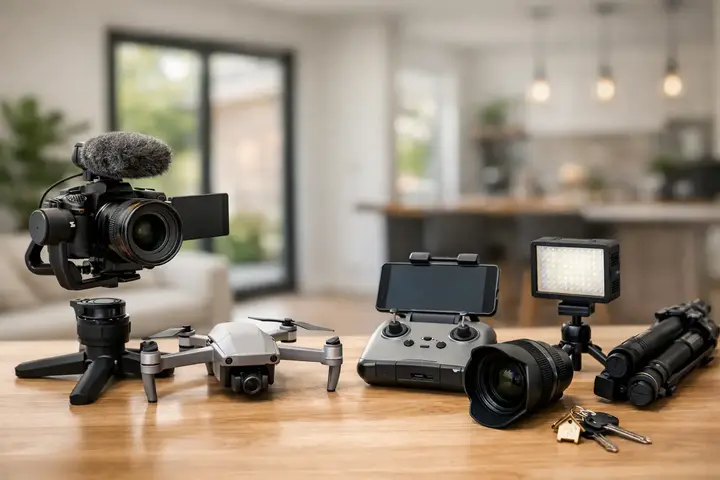
If a real estate video looks dark, shaky, or has unpleasant echoing sound, the problem is usually not just filming skills. Often, it simply lacks a properly assembled equipment kit. That is why a real estate video equipment example is a good starting point for an agent, a content creator, or a company marketing team that wants to film apartments, houses, or commercial spaces convincingly and technically correctly.
There is no single universal kit for everyone in this area. Room size, lighting, required workflow speed, and whether filming is for one property a month or several properties a week all differ. That is why, more important than loud model names, is understanding which piece of equipment solves what.
In brief
- The foundation of real estate video: wide framing, stabilization, controlled light, and clean audio.
- A wide-angle lens and optical quality often affect the final result more than the camera body itself.
- Gimbals provide smooth movement, but a tripod and easy-to-move LED lights are more practical for creative control.
- Choose a kit based on your workload—buy a basic set for regular filming and rent more specialized gear as needed.
What to choose for different tasks
| Task | Solution | Why |
|---|---|---|
| Quick apartment presentation for social media | A lightweight mirrorless body with a wide-angle zoom, a compact gimbal, one adjustable LED light, and a wireless microphone. | For fast filming, the key is balancing mobility and quick setup; a simple lighting and audio solution improves quality without unnecessary weight. |
| Detached house or exterior presentation with a drone | A full-frame camera or a high-quality APS-C body with a good wide-angle lens, a gimbal with higher load capacity, additional LED lights, and a drone for exterior shots. | Larger spaces and exterior views require greater dynamic range and stability; a drone adds value for showing outdoor scenes. |
| Regular filming of commercial spaces (multiple properties per week) | A stable mid-range setup — a reliable mirrorless camera, a better-quality wide-angle lens, a robust gimbal or tripod set with three LED lights and a wireless audio kit. | A higher workload requires quick setup, reliability, and the ability to work both handheld and in locked-off shots. |
| Advertising or premium segment video | A full-frame system with professional wide-angle optics, multi-source lighting, a high-quality gimbal, wireless audio, and, if needed, a drone. | Premium output requires precise light control, optical quality, and additional kits that enable more complex framing and lighting setups. |
Real estate video equipment example based on a real-world workflow
Typical real estate filming requires four things - a wide frame, stable movement, controlled light, and sufficiently clean sound. If any one of these parts is missing, the final result quickly starts to look amateurish even if the camera itself is good.
A practical base kit can consist of a mirrorless camera, a wide-angle lens, a gimbal, a lightweight tripod, an LED light, and a wireless microphone. In some projects, a drone is added for exterior shots, but it is not always necessary. If the focus is small apartments and quick publication on social media, a drone is often not a priority. For presentations of private houses, villages, or commercial properties, however, it can be very valuable.
Camera - important, but not the only priority
In real estate video, the camera must not be the bottleneck, but it should not be overestimated either. The most important qualities are good performance in low light, sufficient dynamic range to balance windows and interiors, reliable autofocus, and the ability to film in at least 4K resolution.
A full-frame camera offers an advantage in tight spaces because it is easier to get a wide view without an excessively extreme lens. However, an APS-C system can also be a very good solution, especially if budget or mobility is important. If the operator films many properties a day, a smaller and lighter body is sometimes more practical than a heavier professional system.
Heat management, battery life, and memory card reliability also need to be considered. Real estate filming is not sports or documentary reporting, but longer shoots across multiple properties require stable equipment performance without unpleasant surprises.
Lens - where quality becomes visible immediately
If one position had to be highlighted that affects results most visibly in this genre, it is often the lens. A wide-angle zoom is the most practical option because it allows quick adaptation to different rooms. A lens that is too narrow makes rooms look visually cramped, while one that is too extreme distorts lines and creates an unrealistic impression.
A good working range is often about 14 to 24 mm on full-frame systems or the equivalent in APS-C format. This makes it possible to film both a small bathroom and a larger living room without losing control over perspective. The lens also needs good sharpness retention at the edges of the frame, because in real estate video, wall lines and furniture edges quickly reveal optical shortcomings.
Stabilization - without it, real estate video rarely works
Most interior shots are captured in motion. The operator slowly moves through the space, follows the hallway, enters a room, or creates a smooth pan. Here, a gimbal is often more important than another expensive lens. Even a camera with good internal stabilization usually does not produce as smooth a result as a properly balanced gimbal.
However, a gimbal is not the only solution. A tripod remains useful when fixed shots, precise pans, or an on-camera introduction from a person are needed. In some projects, the most effective approach is to combine both - dynamic room shots with a gimbal and exteriors, details, and interviews with a tripod.
A compromise is important here. The lighter the kit, the faster the work on location. However, an overly light tripod can vibrate, and an overly small gimbal can limit camera and lens choice. That is why the kit should always be evaluated as a system, not as a list of separate products.
Light - not to make everything bright, but to keep control
A common mistake is relying only on the room’s existing lighting. In apartments and houses, it tends to be uneven, with different color temperatures and shadows that look dirty on video. A compact LED light or a two-light kit helps even out contrast and preserve a natural sense of space.
For interior filming, massive studio heads are usually not needed. Much more often, portable LED lights with adjustable color temperature and diffusion are enough. This is especially convenient when moving from room to room and there is no time to build a complex lighting setup.
If the goal of the shoot is a premium-segment presentation, the importance of lighting increases even more. Well-lit surfaces, properly balanced windows, and controlled reflections create the impression that the property itself is of a higher class. The viewer often does not consciously notice this in technical terms, but they immediately perceive the result.
Audio - needed even when the rooms speak for themselves
Not every real estate video needs spoken narration, but in many cases audio becomes an essential part of the quality. If an agent or presenter speaks on camera, the camera’s built-in microphone is not enough. There will be echo, a sense of distance, and surrounding noise in the rooms.
The safest solution here is usually a wireless microphone. It allows a clear voice even while moving through the rooms. If only room ambience or additional sound is needed, a compact directional microphone on the camera is also useful. Which option is better depends on the content format. A tour-style video requires one approach, while an edited commercial video requires another.
Real estate video equipment example in three budget levels
If you need a reference point, you can think in three levels. An entry-level kit is enough with a reliable mirrorless camera, a wide-angle lens, a gimbal, and one LED light. This is suitable for agents, small teams, and those who film on their own.
At the mid-level, a better lens, a higher-quality audio solution, a sturdier tripod, and an additional light are usually added. This is already a working kit for regular property filming, where not only the result but also the workflow speed matters.
A high-end kit includes a full-frame system, professional wide-angle optics, a reliable gimbal with higher payload capacity, multiple light sources, wireless audio, and often a drone. This is justified if video is part of a regular sales process or brand communication rather than just an occasional need.
The most important thing is not to overpay for features that are not used in the specific work. For example, very high frame rates are not a priority if almost all content is filmed with slow movement and standard delivery. However, reliable autofocus and fast on-location setup provide real benefits on every filming day.
Buy or rent
This question is completely practical in real estate video. If filming is regular, it makes sense to buy the base kit. A camera, the main lens, a tripod, and a basic audio solution pay off quickly in daily work.
More specialized equipment is often more economical to rent. This applies to drones, more powerful lighting kits, additional stabilization, or backup cameras for larger projects. This approach lowers initial costs and allows the right equipment to be used exactly when needed. In practice, this is often more effective than trying to buy everything at once.
For those who want to assemble equipment without unnecessary experimentation, a specialist consultation is useful. For example, in Master Foto practice, the most important question is often not which camera is more expensive, but which system will be faster to set up for the specific task, compatible with the chosen optics, and flexible enough for both purchase and rental.
Most common mistakes when choosing a kit
The first mistake is investing too much in the camera body and too little in optics and stabilization. The second is ignoring light, hoping to fix everything in post-production. The third is forgetting about audio, especially when the video is intended for an agent presentation or commentary.
Another common problem is an inconvenient workflow. A technically good kit can turn out to be impractical if it is too heavy, slow to assemble, or requires many accessories. In real estate filming, speed is often a business factor. If the operator loses 20 minutes at one property because of equipment, that becomes significant over the course of a month.
Good equipment in this field is not what looks impressive in a specification table. Good equipment is what lets you consistently film clean, stable, and convincing material in different interiors without stopping at every room because of technical limitations. It is with this approach that equipment choice becomes not an expense item, but a working tool that helps present a property in a way that makes the viewer want to see it in real life as well.
Frequently asked questions
Which camera is best for real estate video filming?
More important factors are good low-light performance, wide dynamic range, and reliable autofocus rather than the body name alone. A full-frame camera has advantages in tight spaces, but an APS-C system can be more practical because of budget and mobility priorities.
How important is the lens and which one should I choose?
The lens often affects the result most visibly—a wide-angle zoom around 14–24 mm (full-frame equivalent) is practical for most interiors. Look for good sharpness even at the edges of the frame so wall lines and furniture contours do not look distorted.
Is it better to film with a gimbal or a tripod?
Both have their uses: a gimbal provides smooth movement through rooms, while a tripod is indispensable for locked-off shots, precise pans, and interviews. In many projects, a combined approach works best—dynamic shots with a gimbal, static shots with a tripod.
What kind of light is suitable for interior filming?
Portable LED lights with adjustable color temperature and diffusion usually cover interior needs. They make it possible to balance contrasts, control window exposure, and move quickly between rooms without a large studio setup.
Is audio mandatory if the video shows only rooms?
Even when visuals dominate, audio affects the viewer experience—echo and background noise can lower perceived quality. If a presenter speaks on camera, a wireless microphone significantly improves voice clarity; a directional microphone on the camera is useful for recording the room atmosphere.
When should I buy instead of rent equipment?
If you film regularly, it makes sense to buy the core equipment (camera, main lens, tripod, basic audio) because it pays off over time. More specialized or rarely used gear—drone, large lighting kits, extra stabilization—is often more economical to rent per project.
Useful links
- Mirrorless cameras - Section about choosing mirrorless cameras and comparing them with full-frame and APS-C options.
- Video filming equipment - General category with equipment useful for real estate filming — tripods, gimbals, lights, and accessories.
- LED VLOG light - Recommendation for a portable LED light with adjustable color temperature, typical for interior filming.
- Video lights - A reference to the rental category if additional or more powerful lights are needed for a specific project.
- GoPro gimbal fluid PRO AI Premium Gimbal for Smartphone and Camera - An example of a gimbal option that can help achieve smooth movement indoors.
- Rode RØDE Wireless GO III RED lavalier wireless microphone kit 2xTX+RX 3.5mm USB Type-C 32bit - A specific wireless microphone example for clear voice recording while moving or during presentations.