
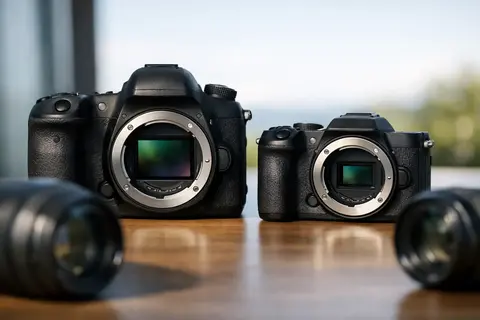
When choosing photography gear, the question of "full-frame or APS-C" usually comes up when an entry-level camera is no longer enough or when planning to buy a new system. Sensor format affects not only image quality, but also lens choice, kit weight, working speed, and budget. That is why there is no universal right answer - it depends on the type of photography or filming.
A full-frame camera does not automatically mean a more professional result, just as an APS-C camera is not only an option for beginners. In both formats, very capable mirrorless cameras, high-quality lenses, and features for photo, video, and social media content are available. The most important thing is to understand what each format offers in a specific situation.
In brief
- The choice between full frame and APS-C depends on real needs — the 80% job type is a good starting point.
- Full frame offers advantages in low light, dynamic range, and background blur; APS-C is a more compact and affordable setup.
- The APS-C crop factor (usually 1.5x–1.6x) makes telephoto more accessible, but getting a wider angle of view is harder.
- Compare complete kits at the same budget (camera + lenses + accessories), not just bodies.
- If possible, try the selected bodies/lenses in practice or use rental before making the final investment.
What to choose for different tasks
| Task | Solution | Why |
|---|---|---|
| Wedding photography and concerts | Full frame body with fast lenses | Better light sensitivity and a wider dynamic range help handle low light and high-contrast scenes. |
| Travel and everyday photography | APS-C compact body with a quality all-purpose zoom | Lower weight and size make the kit more convenient to carry and better for longer work with a gimbal. |
| Bird and wildlife photography | APS-C with a telephoto lens or full frame with a very long telephoto | The APS-C crop factor gives extra framing reach with more compact optics, making telephoto shooting cheaper and easier to transport. |
| Vlogging and solo filming | APS-C with good video features (4K, stabilization, mic/headphone ports) | A deeper depth of field makes focus control easier, and a more compact kit pairs better with stabilizers. |
| Commercial photography and architecture | Full frame system with specialized lenses (wide-angle, tilt-shift) | Full frame wide-angle and specialized optics provide the needed angle and optical control for professional production. |
Full-frame or APS-C: the main difference
A full-frame camera sensor is approximately 36 x 24 mm in size, which corresponds to the classic 35 mm film frame. An APS-C sensor is smaller, but its exact size varies by manufacturer. As a result, an APS-C camera has what is called a crop factor - most often 1.5x or 1.6x.
This does not change the lens's physical focal length, but it narrows the angle of view. For example, a 50 mm lens on an APS-C camera gives roughly the same framing as a 75 mm lens on a full-frame camera if the crop factor is 1.5x. Meanwhile, a 16 mm wide-angle lens in an APS-C system looks similar to a 24 mm lens on full frame.
A larger sensor usually captures more light when cameras of a similar generation and technology level are compared. This can provide an advantage in high ISO sensitivity, dynamic range, and background blur. However, in practice, results are also shaped by the lens's light-gathering ability, autofocus, in-camera image processing, lighting, and the photographer's work with the frame.
When a full-frame camera is a justified choice
A full-frame system is often suitable for professionals and enthusiasts who regularly shoot in difficult lighting. In wedding reportage, concerts, events, and interior photography, cleaner images at high ISO can be a very practical advantage. In video work too, a larger sensor often offers more flexibility with shadows and highlights, especially when shooting in window light or evening scenes.
Portrait photographers choose full frame not only because of light sensitivity. A wider field of view at the same focal length allows the familiar perspective, while a fast lens makes it easier to achieve pronounced background blur. This is useful for individual portraits, fashion photography, and commercial shots where the subject needs to be visually separated from the background.
Full frame also makes sense if you already own a full-frame lens lineup or have a clear plan to build one over time. Professional series lenses are often available specifically for this format, including especially fast wide-angles, standard zooms, and telephoto lenses. Keep in mind that the price and weight of such a kit usually increase faster than the camera body's capabilities.
However, a full-frame camera is not the best solution just because the sensor is larger. If you mostly shoot in daylight, publish images online, and need a lightweight kit, a more expensive body will not always provide a noticeable benefit.
Why the APS-C format is more practical in many jobs
The strength of the APS-C system is the balance between image quality, size, and cost. The camera and its lenses are often more compact, which makes this format convenient for travel, hiking, everyday content creation, and long filming days with a gimbal. Lower weight is not just a comfort issue - it can mean faster work and less fatigue at an event or outdoors.
The crop factor is especially useful for wildlife, sports, and bird photography. With a relatively compact telephoto lens, it is possible to achieve a narrower angle of view without buying a very long and heavy full-frame lens. For example, a 70-300 mm lens on an APS-C body can provide framing that would require significantly longer optics on full frame.
An APS-C camera is also a rational step for a hobby photographer who wants to invest budget in lenses, lighting, or audio equipment. A high-quality 16-55 mm or 17-70 mm zoom lens, a fast prime lens, and a small flash will in many cases improve results more than moving to a larger sensor with entry-level optics.
Modern APS-C cameras provide fast subject-detection autofocus, burst shooting, 4K video, and effective image stabilization. These features are essential for content creators, family photographers, and small businesses producing product videos or social media material without a large filming crew.
Lenses and system costs
The camera body is only one part of the system. When choosing between formats, you should calculate the kit for at least two or three years: camera, everyday zoom, portrait or fast prime lens, spare battery, memory cards, and necessary accessories.
Full-frame lenses are often more expensive because they have to cover a larger image circle. This is especially noticeable in the wide-angle and fast zoom categories. On the other hand, many full-frame lenses retain high value over the long term and can be used with several camera bodies.
In an APS-C system, it is important to check how broad the range of lenses designed specifically for this format is. If you need only a universal zoom, a portrait lens, and a telephoto lens, the selection is usually sufficient. If your work requires very specific optics, such as an especially fast wide-angle for architecture or a tilt-shift lens, a full-frame system may be more flexible.
You can also use full-frame lenses on an APS-C camera if the specific mount supports it. This is a good path if a future move to full frame is planned, but you should consider whether a larger and heavier lens will take away the main advantage of APS-C - compactness.
Photo and video needs should be evaluated separately
In photography, the advantages of a larger sensor are most often visible in low light and when working with a shallow depth of field. The video situation is more nuanced. A full-frame camera can provide more cinematic background blur and a wider dynamic range, but focus must be controlled more precisely because the area of sharpness is narrower at wide apertures.
An APS-C video kit can be more convenient for solo shooting. A deeper depth of field makes it easier to work with talking-head videos, product demonstrations, and event content. Smaller lenses also balance compact stabilizers better. If the final material is intended for 4K platforms or social networks, a well-lit APS-C frame will be a fully capable solution.
You should look not only at the sensor, but also at the specific body’s video capabilities: recording time, overheating risk, codecs, 10-bit recording, stabilization, microphone and headphone ports. Sometimes an APS-C camera with a more suitable set of video functions will be more useful than a full-frame model whose main strengths are in photography.
How to make a decision without overpaying
Start with the most common task, not the rarest situation. If 80 percent of your time is spent photographing travel, family, sports, or creating short videos, an APS-C system is often more efficient and easier to carry. If you regularly work in dark spaces, do paid portrait sessions, wedding reportage, or high-demand commercial material, full-frame advantages may justify the investment sooner.
It is useful to compare not just two camera bodies, but two complete kits within the same budget. One option may be a full-frame camera with a kit lens, while the other may be an APS-C body with higher-quality optics, a flash, or a microphone. Often the second kit will be better prepared for real work right after purchase.
If you are still unsure, it is worth trying a specific camera and lens on a project or via rental. This lets you test ergonomics, autofocus, lens angle, and file quality in real conditions rather than judging only from a specification table. A Master Foto consultation or rental solution in such a situation helps base the choice on practical experience.
The best camera is the one you can use regularly and confidently. Choose the format that leaves budget for important optics and lets you focus on the frame, light, and story rather than on compromises that appear after the purchase.
Frequently asked questions
Does a full frame camera always provide better image quality?
Not always — a larger sensor can offer advantages in low light and dynamic range, but the result also depends on lens quality, autofocus, and lighting. In some cases, APS-C with good optics and proper light will deliver a comparable result in everyday use.
How does crop factor affect lens choice?
Crop factor (usually 1.5x or 1.6x) narrows the field of view, so, for example, 50 mm on APS-C gives a framing similar to about 75–80 mm on full frame. This is useful for telephoto framing, but it is harder to get wide-angle coverage without short focal length lenses.
Is an APS-C camera sufficient for creating video content for social media?
Yes — modern APS-C bodies often provide 4K recording, stabilization, and fast autofocus, which is enough for social media content and product videos. It is more important to choose a camera with the right video features (codecs, recording length, ports) than sensor size alone.
How should costs be compared correctly between formats?
Compare complete kits at the same budget — body plus optics and necessary accessories, not just the body price. Often an APS-C kit with better optics or audio equipment will be more practical than a cheap full frame body with compromised lenses.
Can full frame lenses be used on an APS-C camera?
Yes — many full frame lenses can be used on APS-C crop-compatible mounts, but they will be larger and heavier. This can be a good path toward moving to full frame in the future, but you should consider whether such lenses will negate APS-C’s advantage — compactness.
How can I practically make sure which format is right for me?
Try the selected cameras and lenses in a real working situation or rent a kit for a project to test ergonomics and results. Consultation in a specialty store or testing helps avoid mistakes that can come from a decision based only on specifications.
Useful links
- Mirrorless cameras - As a pairing with what is described in the article — alternatives to full frame and APS-C mirrorless bodies.
- Lenses - Advice on lens choice is essential when evaluating wide-angle, portrait primes, and telephoto lenses.
- Video filming equipment - The video requirements discussed in the article — stabilization, audio, and recording parameters — are related to equipment in this category.
- Memory cards - For video and high-resolution RAW photo needs, the article recommends choosing suitable memory cards.
- Video stabilizer accessories - The APS-C advantage in filming is often linked to using lighter stabilizers and appropriate accessories.