
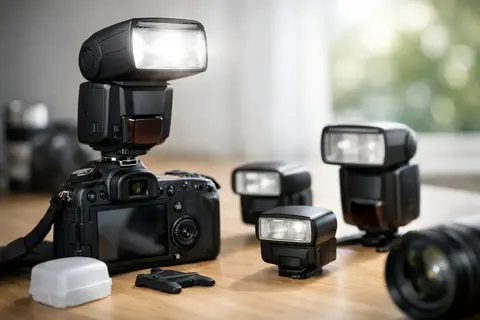
The first unsuccessful shot with the built-in flash usually looks the same - flat light, harsh shadows, and shiny skin. It is precisely at that moment that the question of how to choose a camera flash becomes relevant, one that really helps control the light instead of just making the image brighter. The right choice does not depend only on price or brand. Much more important is understanding what you are photographing, what camera you are working with, and whether you will use the flash on the camera, off the camera, or both.
In brief
- Start with the kind of work you do — choose a model by use case, not by the feature list.
- Make sure it is fully compatible with your camera system (TTL, control, transmitters) — physical fit on the hotshoe is not enough.
- Choose a flash with both TTL and manual mode; TTL for fast work, manual for stable studio light.
- HSS is only necessary if you often shoot outdoors with a wide aperture; HSS reduces effective power — plan for power reserve.
- Handle power based on workload: AA batteries are convenient, lithium batteries provide faster recycling and longer operation.
- Think about wireless radio control and system expansion — it makes it easier to add additional lights in the future.
What to choose for different tasks
| Task | Solution | Why |
|---|---|---|
| Wedding and event photography (fast on-camera work) | Mid-range speedlite with TTL, fast recycling, and a tilt/swivel head; if possible, a model with a built-in radio receiver. | In events, lighting and distances change, so TTL and fast recycling help you avoid missing moments. |
| Outdoor portraits with a blurred background | A flash with HSS, reliable radio control, and enough power reserve, or an external battery. | HSS lets you use shorter shutter speeds and a wide aperture, but it reduces effective power, so you need to plan for reserve. |
| Product photography and studio portraits | Models with a precise manual mode, repeatable power levels, and the ability to fit into a studio accessory ecosystem. | Stability and repeatability matter more than automation; manual mode provides consistent results. |
| Reportage and daytime work | A more powerful flash with fast recycling and TTL + HSS support; preferably with a lithium battery or external power connection. | Larger spaces and daylight require power and fast recycling, but HSS will be needed if you use a wide aperture. |
| Travel/everyday photography — compact solution | A compact speedlite with a tilt/swivel head, TTL, and good battery efficiency; choose a lightweight model without excessive professional features. | Weight and convenience are important for mobility; power limits are often an acceptable trade-off for convenience. |
How to choose a camera flash based on your use case
If you photograph family events, reportage, or indoor events, you need one type of flash. If you create portraits, product photos, or content projects with controlled light, the requirements will be different. That is why before technical specifications, you should start with the working scenario.
A flash mounted on the camera is practical when you need to move quickly and do not have time to set up complex lighting. It is a common choice in event photography, weddings, corporate events, and press work. Meanwhile, an off-camera flash gives much more control over shadows, facial modeling, and separating the subject from the background. This approach is more often useful for portraits, commercial projects, and small studio situations.
If you are not sure which direction to choose, the safest option is to look at a model that can be used both ways - on the camera and with wireless control. This lets you start simply and expand the system later.
Compatibility with the camera is the first filter
In practice, mistakes most often start right here. A flash is not enough just because it physically fits the camera hot shoe. Full electronic compatibility with the specific manufacturer and often with a specific camera generation is important.
TTL automation, exposure compensation, high-speed sync mode, and menu control can work differently depending on the system. Canon, Nikon, Sony, Fujifilm, OM System, or Panasonic users should look for a flash designed specifically for their system. A universal solution does not always mean full functionality.
If you plan to use transmitters, receivers, or multiple flashes in one system, compatibility becomes even more important. It is worth thinking not only about one purchase, but about the entire lighting ecosystem. This especially applies to those who plan to move in the future to a multi-light setup or combine portable flashes with studio lights.
Power - how much do you really need
Flash power is usually described by the guide number, but in practice it is much more important to understand in what situations the light will be used. In small rooms, when photographing with bounced light from the ceiling or wall, more power is needed than it may seem at first. Even more is needed if you use a softbox, dome, or other light modifiers that “eat up” some of the light.
If you photograph only at close distance and in small rooms, a more compact flash may be enough. But for reportage in larger rooms, dark interiors, or working in daylight with HSS mode, it is recommended to look at more powerful models. HSS is convenient, but it reduces effective light output, so here reserve power is essential.
Power also affects the recycle time between shots. The greater the load, the more important it is that the flash recovers quickly and can keep pace in burst shooting.
TTL or manual mode
TTL mode automatically calculates the required flash power for a specific shot. It is very useful in changing conditions where the distance to the subject and ambient light regularly change. At events, weddings, and for dynamic portraits, TTL is often the most convenient solution.
Manual mode, on the other hand, gives complete repeatability. If the lighting situation does not change, for example in product photography or studio portraiture, setting the power manually allows you to get very stable results frame after frame. It also helps you better understand how the flash itself works.
The optimal choice for most users is a model with both modes. Then you can use TTL where speed is needed and manual mode where precise control is important.
When HSS is really needed
High-speed sync mode, or HSS, allows you to use the flash at shutter speeds shorter than the standard sync limit. It is useful when photographing outdoors in bright daylight and you want a wide aperture, for example for a portrait with a blurred background.
If such a scenario is regular, HSS is not an extra bonus but practically a mandatory function. If you mostly work indoors or with controlled ambient light, you can do without HSS. This is a typical example where there is no point in overpaying for a function you will rarely use.
Flash head movement and light quality
One of the most important parameters in real work is the movement of the flash head. If the head can be raised, tilted, and rotated to both sides, it is much easier to use bounced light. It is bounced light that often creates a more natural and professional result than a direct flash blast to the face.
If you plan to photograph indoors with light ceilings or walls, a movable head is almost mandatory. Fixed-position models are cheaper, but their use is limited. They are more often a compromise than a long-term solution.
An integrated wide-angle diffuser panel or bounce card can also be useful, but you should not overestimate the effect of this accessory. Light quality is mainly determined by direction, the surfaces from which the light is bounced, and the modifiers used.
Power, recycle time, and working pace
The type of battery or batteries affects more than just convenience. Traditional AA-battery flashes are still popular because batteries are easy to replace and widely available. At the same time, lithium battery models often offer faster recycling, more flashes per charge, and more stable performance in intensive work.
If you shoot infrequently and in short sessions, an AA system may be completely sufficient. If you work at events where you need to react without pauses, lithium power is often more practical. You also need to consider operating costs and the availability of reserve power in a specific working mode.
For some users, the option to connect an external power pack is also relevant. This is especially useful in intensive reportage work, where fast recycling and a large number of shots are important.
Wireless control and system expansion
If you buy one flash today, that does not mean that will be the end of it. Many users later want to add another light source for the background, hair light, or accents. That is why it is worth checking right away how the flash fits into a broader wireless system.
A built-in radio receiver or transmitter is much more convenient than optical control, especially indoors with obstacles or when shooting outdoors. A radio system is usually more stable, safer, and more flexible. If you plan to work off-camera, this is one of the most important selection criteria.
Here you should also consider the available accessories - transmitters, brackets, softboxes, stands, and compatibility with other light sources. In professional work, a flash is not an isolated product, but part of the overall set of work tools.
How much a beginner should spend and how much is needed for regular work
The cheapest flash is not always the most economical. If it lacks TTL, a movable head, or reliable wireless control, you may need to replace it after a short time. That means double costs.
For a beginner who wants to learn the basics and photograph in different situations, the most logical choice is usually a mid-range flash with TTL, manual mode, a movable head, and radio control. This provides enough room for growth without excessive budget pressure.
For a professional or a user with regular commercial assignments, reliability, recycle speed, power reserve, and a coordinated system with multiple light sources become more important. At this level, the choice is determined not only by specifications, but also by workflow, service, and the ability to quickly replace or expand equipment. That is why for some clients it is beneficial not only to buy, but for specific projects also to test or rent equipment before making a final decision.
How to choose a camera flash without overpaying for unnecessary functions
A good selection principle is very simple: choose according to the type of work, not according to the maximum feature list. If you photograph events, priority will be TTL, fast recycle time, and a movable head. If you create outdoor portraits, HSS and convenient wireless control will be very important. If you photograph products or work in a small studio, greater importance will be manual precision and system expandability.
You also do not have to buy the most powerful model right away. A larger flash means more power, but often also more weight and bulk on the camera. In long photo sessions or events, this becomes noticeable. Conversely, an overly compact model may be convenient for everyday use, but insufficient in more demanding conditions. The right choice is almost always a compromise between power, mobility, and control options.
If you are unsure between two models, it is worth comparing not only the technical data, but also the kind of work you will do with them after three or six months. This is precisely when expert consultation often saves both budget and time. For Master Foto clients, it is usually the fastest path to a solution that fits not only today’s need, but also the next project.
A good flash by itself does not guarantee a good shot, but a properly chosen flash gives control over light, and that control is what most often separates a random result from predictable, high-quality work.
Frequently asked questions
Is any flash enough if it physically fits the camera hotshoe?
Not always. Physical fit is only the first step — electronic compatibility (TTL, exposure compensation, HSS) with the specific camera system is also important. Without full compatibility, some automation and menu functions may not work.
When do I need HSS mode?
HSS is mainly needed if you shoot outdoors or in other bright conditions and want to use short shutter speeds with a wide aperture. If you mainly work indoors or with controlled light, HSS may not be necessary.
How do I know whether to choose TTL or manual mode?
TTL is more convenient in changing conditions and at events because it automatically adjusts the power for each frame. Manual mode gives greater repeatability and precision for studio or product photography, where lighting does not change.
Are AA batteries a worse choice than a lithium battery?
AA batteries are a convenient and accessible solution, especially for occasional sessions or travel, because they are easy to replace. However, lithium batteries usually provide faster recycling, more flash cycles on a single charge, and better performance in intensive work.
How much power do I really need?
Power depends on shooting distance, modifiers (softboxes, domes), and whether you are shooting indoors or outdoors. For reportage in larger spaces and daytime work, a more powerful model with power reserve and fast recycling is usually useful.
How do I plan future expansion with multiple flashes?
Choose a model that supports standard radio transmitters/receivers or has a built-in radio protocol that can be used in a multi-light system. Also consider compatibility with brackets, softboxes, and other studio accessories so the system can be easily expanded.
Useful links
- Camera flashes - Category with different types of camera flash models, useful when choosing by compatibility and power.
- Godox iT30Pro F Black iFlash TTL Camera Flash - Example of a speedlite with TTL functionality, illustrating the compatibility and control aspects mentioned in the article.
- Newell Elea Mini Flash Gun - Example of a more compact flash solution — useful when mobility and light weight are the priority.
- Photo studio accessories - A category where you can find brackets, softboxes, and other accessories that affect light quality and system expansion.
- Battery-powered flashes - Link to battery-powered solutions - useful when the article discusses fast recycling and the demands of intensive workflows.