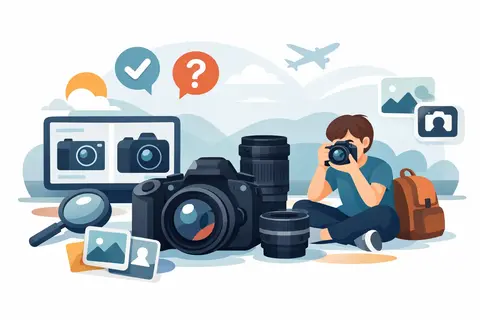
If you are looking for how to choose a photo camera for a beginner, the most common mistake is not buying a model that is too weak. The mistake is buying a camera that does not match what you actually plan to photograph. One person needs a lightweight camera for travel, another cares about portraits with a blurred background, and someone else needs good video and reliable autofocus. That is why the right choice starts not with megapixels, but with the use case.
In brief
- Start with the question “what will I photograph most often,” not with megapixels or ads.
- The mirrorless APS-C system is often a good starting point — a balance between quality, price, and lens choice.
- The lens affects the image more than a small difference between bodies; the kit lens is good for getting started, and the prime lens is for portraits.
- Check ergonomics, autofocus, and video features (4K, stabilization, microphone input) before purchase.
- Plan the budget as for the system — include lenses, memory cards, a bag, and a spare battery.
What to choose for different tasks
| Task | Solution | Why |
|---|---|---|
| Travel and everyday photography | Compact mirrorless camera with a versatile kit lens (e.g., wide-to-medium zoom) | Convenient to carry, good enough image quality, and a wide focal length range without changing lenses. |
| Families, children, events | Fast autofocus and a compact APS-C body with a lightweight tele/zoom lens | Autofocus speed and better performance in low light help capture moving moments; APS-C offers a good quality-to-price ratio. |
| Content creation / video attached to photo | Mirrorless camera with 4K recording, stabilization, and microphone input; articulating screen if you’re filming yourself | In video mode, stable autofocus, 4K quality, and a good audio connection are important; a tilting screen makes self-recording easier. |
| Portraits and poorer lighting | A fast prime lens (35mm or 50mm equivalent depending on the system) with an APS-C or full-frame body | A fast prime lens provides better bokeh and offers an advantage in low light; sensor size affects background blur and dynamic range. |
Frequently asked questions
Does a beginner need a full-frame sensor?
A full-frame sensor potentially provides better image quality, but it usually also increases system costs. For a beginner, APS-C is often a more sensible compromise between image quality, price, and available lenses.
What does “kit lens” mean, and is it enough to get started?
A kit lens is usually a versatile zoom lens that comes with the body and covers a wide focal range. It is a practical starting point because it allows you to understand your habits and later decide on specific prime or specialty lenses.
Is 4K video mandatory if I mainly take photos?
4K is not essential if photos are the priority, but it is a valuable addition, as many users are starting to shoot social media content or family videos. If you plan to start creating videos regularly, 4K, together with stabilization and a microphone input, ensures long-term usability.
How do you choose between a fixed (prime) and a zoom lens?
A zoom lens provides greater flexibility and convenience in everyday use, while a prime lens is usually brighter and delivers better image character and bokeh. If the main goal is portraits or shooting in low light, a prime lens can provide a clear quality improvement.
How important is camera ergonomics for a beginner?
Very important — if the camera is not comfortable, it will be used less and the learning pace will decrease. Before buying, it is recommended to try the camera in your hands, check the button layout, the grip comfort, and the intuitiveness of the menu.
Is it worth renting a camera before buying one?
Yes — renting lets you try the format, ergonomics, and whether a particular system fits your use case. It reduces the risk of buying an unsuitable system and helps you understand which lenses or accessories will be needed in the future.
Useful links
- Lenses - Link to an expanded selection of lenses and explanations that help choose between kit and prime lenses.
- Mirrorless cameras - The article recommends starting with a mirrorless system — this category helps review the available models for beginners.
- Memory cards - Memory cards should be taken into account when budgeting; this page summarizes different cards and performance variants.
- Audio technology - If you plan to film with a microphone connection, this section helps you choose a suitable external microphone.
- NOMA - It is recommended to try or rent the equipment before purchasing to reduce the risk of making the wrong choice.
- Video filming equipment - If video functions are important, this category helps you find additional video equipment and accessories.
How to choose a photo camera for a beginner based on needs
For a beginner, a camera is usually bought for one of three goals - everyday photos and travel, family and children photography, or content creation, where video is also important alongside photos. These scenarios sound similar, but the technical requirements differ.
If simplicity and mobility are the priority, a mirrorless camera with a versatile kit lens is often the logical choice. It will be compact enough, easy to carry, and will deliver much better image quality than a phone in more challenging lighting. If you plan to photograph moving children, events, or pets, autofocus speed and performance in low light will matter more. For video needs, you should look not only at 4K recording, but also at stabilization, microphone connectivity, and a screen that can be turned toward you.
So the first question is not “which camera is the best,” but “what will I use it for most often.” The clearer the answer, the lower the risk of overpaying for features that will not be used.
Camera type - where a beginner should start
In practice, beginners most often compare three options - a compact camera, a DSLR, and a mirrorless camera. Each solution has its own logic.
A compact camera is simple and convenient, but today it is a justified choice only in certain situations. If you need a very small body or a large optical zoom without changing lenses, it can be useful. However, for most beginners who want to grow in photography, a compact camera quickly becomes a limitation.
A DSLR can still deliver very good image quality, a wide selection of lenses, and pleasant ergonomics. However, for many new users it feels too large and heavy for everyday use. In addition, the market is increasingly moving toward mirrorless systems.
A mirrorless camera is often the most balanced option for a beginner today. It combines good image quality, modern autofocus, convenient video functionality, and a relatively compact body. That is why, in most cases, a beginner is advised to start with a mirrorless system rather than a more technically complex or less future-proof alternative.
Sensor size - it is not all about megapixels
Beginners often focus on the number of megapixels, although in practice sensor size and overall system quality are more important. The larger the sensor, the better the camera usually handles low light, dynamic range, and background blur.
The most common options are Micro Four Thirds, APS-C, and full-frame sensors. For a beginner, APS-C is often a very good middle ground - it offers high quality, a reasonable price, and more affordable lenses than full-frame systems. The advantage of Micro Four Thirds systems is smaller and lighter bodies and lenses, which can be very convenient for travel or everyday use. A full-frame camera offers higher potential, but it usually also means higher costs not only for the body, but for the entire system.
If the budget is limited, a APS-C camera with a good lens is almost always a smarter purchase than a full-frame body with compromise optics.
The lens affects the result more than it seems
When choosing your first camera, do not look only at the body. The lens often affects the final image more than a small difference between two similar camera models.
Many beginners start with a kit lens, for example in the 18-45 mm, 16-50 mm, or 18-55 mm range. This is a practical start because it lets you understand which focal lengths you use most often. With such a lens, you can photograph everyday scenes, travel, family, and simple portraits.
If you already know that you are primarily interested in portraits or indoor photography, a bright prime lens can be a very valuable purchase, for example a 35 mm or 50 mm equivalent depending on the system. It helps achieve a more expressive background and better results in poorer lighting. On the other hand, if universal use is important, a kit lens is the safest option at the start.
Here is one of the main trade-offs - a more universal zoom lens offers convenience, but a brighter prime lens often gives a better image character. A beginner does not have to choose both right away.
Ergonomics and ease of use are critically important
Technical specifications look good in a table, but in real use a lot depends on whether the camera is comfortable to hold and whether the menu is understandable. For a beginner, these factors are not secondary.
If the camera feels uncomfortable, too heavy, or complicated, it often ends up on the shelf. That is why before buying it is worth evaluating the grip shape, button layout, touchscreen quality, and how intuitively you can change ISO, shutter speed, or aperture. An electronic viewfinder can also be a big advantage, especially in bright sunlight when the screen is not easy to see.
A good beginner model is not only one that can do a lot, but also one that does not get in the way of learning.
Video features - important even if you primarily photograph
Even if at the time of purchase you are mainly thinking about photos, it is worth looking at video functions too. Many users later start filming for social media, family events, or product content for work.
The most important parameters here are 4K recording, autofocus quality in video mode, image stabilization, and microphone input. If you plan to film yourself, a tilting screen will be very useful. If you will be filming handheld, in-body stabilization can significantly improve the result, although it usually makes the camera more expensive.
If video is only an additional function for you for now, there is no need to overpay for high-end professional codecs or specific color profile options. But for basic comfort, autofocus and 4K quality are already justified requirements today.
Budget - think about the system, not just the price tag
When evaluating how to choose a photo camera for a beginner, the budget is often applied only to the body. That is not correct. A camera is a system, and the costs also include lenses, memory cards, a bag, an extra battery, a tripod, or a microphone.
That is why for a beginner, a mid-range body with a decent lens is often a better deal than the most expensive body with no budget left for the rest of the equipment. If you plan to develop the hobby, also check in advance how wide the lens availability is for the specific system and what the price level is.
Sometimes the best solution is not to buy everything at once. If you have doubts about a particular model or need, a practical approach is to first try or rent the equipment to understand whether the chosen format really matches your style. This approach reduces the risk of a wrong purchase, especially if you are torn between several systems.
The most common mistakes when choosing your first camera
The most common mistake is buying based on advertising rather than the use case. The second mistake is focusing too much on one parameter, such as megapixels or zoom range. The third is completely ignoring lenses and accessories.
Another typical situation is choosing a camera that is too complicated with the idea of “I’ll grow into it anyway.” In reality, that does not always happen. If the camera is not intuitive, the learning process becomes slower and motivation decreases. It is better to choose a model you will want to use regularly.
You also do not have to start with the most expensive brand or a full-frame system. A quality entry-level or mid-range model from a reliable manufacturer will be more than enough for many users for several years.
What to check before buying
Before making the final decision, it is worth asking yourself a few practical questions. Will the camera be easy to carry every day. Does the kit lens match your photography style. Will the system have lenses available that you can buy later. Will the video functions still be sufficient in a year, not just today.
If possible, you should hold the camera in your hands. Sometimes two comparable models are technically very similar, but one simply “fits the hand” better. That factor is not insignificant. In a specialized store or consultation, this can be assessed much more accurately than from specifications online. A wider selection of equipment and consultative support can also be viewed at masterfoto.lv.
The first camera is not an exam in making the perfect choice. It is a working tool with which you will start building experience, understanding your habits, and developing your eye. So choose a model that matches your real tasks today and leaves reasonable room for growth tomorrow.