
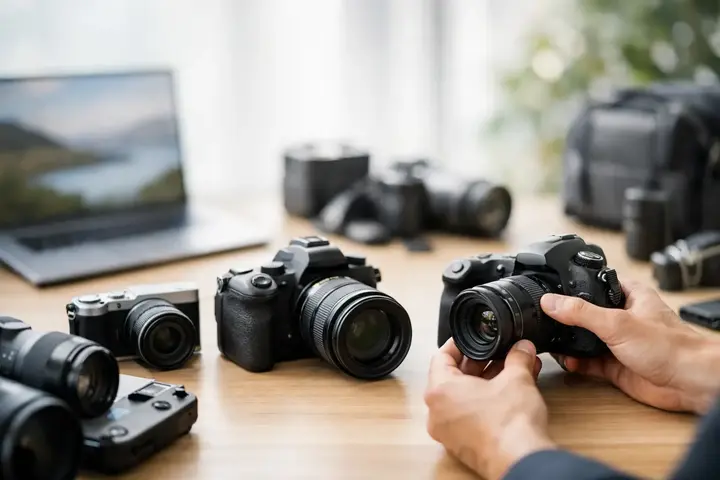
Your first camera is rarely just a camera. It determines how convenient it will be to shoot while traveling, how confidently you will get portraits in low light, and whether video recording will become a technical compromise. That is why the question how to choose a camera? should not start with a specific brand or megapixel count. It should start with the task you want to solve.
Photo equipment is a system: the camera body, lenses, batteries, memory cards, light, and sometimes a tripod or microphone. A properly chosen body gives you a good start, but in the long term it is important to understand in which system you will be able to grow.
In brief
- Start with what you’ll photograph most often — travel, portraits, sports, or video — rather than with a brand or megapixels.
- Choose a system (body + lenses) with a sufficient range of lenses and accessories, not just a strong body.
- Sensor size, autofocus, and stabilization affect results more than advertising specs.
- Plan your budget for the whole kit: lenses, memory cards, batteries, and rain protection are often just as important.
- Before buying, hold the camera in your hands, check ergonomics, menus, and autofocus performance in real use.
What to choose for different tasks
| Task | Solution | Why |
|---|---|---|
| Travel and everyday photography | Compact mirrorless body with a versatile zoom lens and one light-sensitive prime lens. | A compact system is easier to carry, the versatile zoom covers most situations, and the prime lens improves performance in low light and for portraits. |
| Portraits and indoor shooting | Full-frame or APS-C body with a fast prime focal length (35mm/50mm equivalent) and reliable face/eye autofocus. | A fast prime lens lets you get more background blur and better low-light performance, while autofocus speeds up the workflow. |
| Sports and wildlife photography | Fast body with a strong burst mode, tracking autofocus, and a range of telephoto lenses. | A fast burst rate and accurate tracking autofocus increase the chance of capturing moving moments, while telephoto lenses provide the needed reach. |
| Content creation and video | Camera with solid autofocus in video mode, in-body stabilization, a vari-angle screen, and good audio ports. | Reliable autofocus, stabilization, and convenient audio options improve both self-shooting and interview quality without complex post-production. |
| Studio and product photography | Body with low noise at high ISO or a full-frame sensor, high-quality prime lenses, tripod, and studio lighting. | In controlled conditions, light quality and lens sharpness matter more than a portable body; a tripod and prime lenses provide maximum quality. |
Start with your photo and video scenarios
For everyday, family, and travel photography, the most important things are usually compact size, quick startup, intuitive controls, and good results in automatic modes. In such a situation, a mirrorless camera with a universal zoom lens is often more practical than a large professional-grade body. A camera that is regularly with you will be more valuable than a technically more impressive model that stays at home.
For portraits, events, and photographing children or pets, the priority is reliable autofocus, especially eye and face detection, as well as the ability to use light-sensitive lenses. Wildlife and sports require a fast burst mode, effective subject tracking, and sufficient telephoto reach.
If the camera is intended for video, the note “records 4K” is not enough. You need to check what frame rate it records at, whether there is in-body image stabilization, a microphone input and headphone jack, how long the camera can record without overheating, and whether it uses the full sensor area. For a content creator who films themselves, a tilting screen and reliable face autofocus are useful. For interviews, promotional videos, and company communications, audio equipment and lighting are often just as important as the camera.
How to choose a camera by sensor size
Sensor size affects image quality, the angle of view with a given lens, performance in low light, and the ability to achieve a blurred background. It is not the only criterion, but it helps to understand the relationship between price, size, and result.
Full-frame sensor cameras are suitable for professional use, weddings, reportage, portraits, and work in challenging light. They usually provide more room for post-processing, especially in darker scenes and at higher ISO. Keep in mind that the lenses for this system are also often larger, heavier, and more expensive.
The APS-C sensor is a balanced solution for enthusiasts, travelers, and versatile content creators. Such cameras are often more compact, but image quality is sufficient for large prints, client work, and high-quality video. Meanwhile, the Micro Four Thirds system is especially interesting for those who want a light kit with comparatively compact telephoto lenses and effective stabilization.
A smaller sensor does not by itself mean a worse camera. If you mainly shoot in daylight, publish content digitally, and want minimal weight, a compact system may be more rational than a full-frame kit. The decision should be made based on real usage conditions, not just a specification table.
Megapixels: when there are too few and when there are too many
24 megapixels is completely sufficient for most users. Such resolution allows you to print, crop, and prepare images for internet use without limitations. Higher resolution is useful in advertising, architecture, product, landscape, and studio photography, where very large prints or frequent cropping are required.
However, a higher megapixel count means larger files. This affects memory card choice, archiving costs, computer performance, and processing time. In addition, a high-resolution sensor will require more precise focusing, a more stable camera, and high-quality lenses. If you do not need these things, priority is often better given to autofocus, ergonomics, and the lens rather than the maximum megapixel count.
The body is only half of the system
The lens affects the character of the image at least as significantly as the camera body. The included universal zoom lens is a good starting point: it covers everyday shots, travel, and family events. However, it is not always the best solution for portraits, low light, or sports.
A fixed-focal-length lens with a larger maximum aperture, for example a 35 mm or 50 mm equivalent, helps when shooting indoors and creating stronger background blur. A telephoto lens is necessary for animals, sports, and distant events, while a wide-angle lens is useful for interiors, architecture, and vlogs.
Before choosing a system, check what lens lineup is available for it specifically for your needs. A beginner does not have to buy several lenses right away. Often the best first kit is a camera with a universal zoom and one light-sensitive fixed-focal-length lens.
Autofocus, stabilization, and ergonomics in daily work
Modern camera autofocus systems differ significantly. When photographing static subjects, such as products or landscapes, almost any current mirrorless camera will be sufficiently accurate. Moving people, sports, animals, and video require a model with confident subject recognition and tracking.
In-body image stabilization helps you shoot handheld with a longer shutter speed and achieve smoother video. It does not replace a tripod if you are filming an interview, creating product photos, or working with long exposures, but in everyday use it is a very practical feature. It is especially useful if you use lenses without optical stabilization.
Ergonomics cannot be fully judged from pictures online. Pay attention to the grip size, button layout, viewfinder, screen mechanism, and the body’s weight together with the lens. For a photographer working several hours at an event, a small increase in weight can be tiring. Conversely, for someone with larger hands, a body that is too compact may be uncomfortable even if its specifications are very good.
Don’t forget about video and workflow
For video needs, choose a camera based on the project, not just the maximum resolution. For social media video, more important things are often stable autofocus, a clear vertical format, a good microphone, and fast file transfer. In more professional work, 10-bit recording, log profiles, RAW or ProRes formats, timecode options, and reliable cooling matter.
Also check the budget for necessary accessories. Faster video formats may require a specific type of memory card. Long filming sessions will require extra batteries or external power, while quality dialogue calls for a wireless microphone or recorder. The camera is the central element, but the final material depends on the entire kit.
Plan the budget for the kit, not just the camera
A mistake is to spend the entire budget on the body and then postpone buying a lens, memory card, bag, or spare battery. A practical distribution allocates part of the budget to accessories and the next lens. If you plan to work outdoors, rain protection, a comfortable bag, and a reliable tripod will be useful. For studio work, you should also budget for lights, modifiers, and backdrops.
There is no need to buy everything at once. A less frequently used telephoto lens, video stabilizer, studio light, or specialized audio equipment is worth trying in rental first. This helps you understand whether the specific gear truly fits your workflow before making a larger investment. Master Foto consultation or a rental solution can help compare kits based on a real task rather than just price.
Before buying, check these practical questions
Ask yourself what you will photograph most often, in what lighting you will work, whether video is a priority, and how large a kit you are willing to carry. Find out whether the chosen system has the necessary lenses, how much extra batteries cost, and which memory cards the desired video mode requires. If possible, hold the camera in your hands and try the menu, buttons, and autofocus.
A good camera is not the one with the longest list of features. It is the model you will gladly take with you, quickly understand, and be able to expand as your skills or projects grow.
Frequently asked questions
How do I choose a sensor size — do I need a full-frame sensor?
Sensor choice should be based on real needs: full-frame sensors offer better low-light performance and more cropping flexibility, but they also increase kit weight and cost. APS-C and Micro Four Thirds can be a better compromise for travel and a lightweight kit if you mostly shoot in daylight.
Are megapixels the most important parameter?
No — for most users, 24 MP is completely enough for print and the internet. Higher resolution increases file sizes, demands on optical hardware, and may require better lenses and more stable focusing.
Which lenses should I buy first?
A good start is a versatile zoom lens together with one light-sensitive prime lens (35 mm or 50 mm equivalent). After that, choose a telephoto or wide-angle lens depending on your specialization.
How can I evaluate autofocus and ergonomics before buying?
It’s best to hold the camera in your hands and try real shooting — check button placement, grip comfort, the menu, and autofocus response in a moving environment. A direct test reveals nuances that cannot be seen from the spec sheet alone.
What should I check in video features when choosing a camera?
Check frame rates, in-body stabilization, microphone and headphone ports, cooling, and file formats (e.g., 10-bit recording or log profiles if wider color grading is needed). Also consider memory card requirements and battery consumption for longer filming sessions.
How do I plan my budget so I don’t have to sacrifice accessories?
Plan your budget as a kit: include the lens, memory cards, spare batteries, a bag, and rain protection as separate items. If needed, try specialized equipment through rental or use consultations to understand before investing whether you really need it.
Useful links
- Objektīvi - See the lens category to choose the prime, telephoto, or wide-angle solutions mentioned in the article.
- Bezspoguļa kameras - The article recommends considering mirrorless systems for travel and everyday photography; this category helps compare models.
- Atmiņas kartes - Video and high-resolution photos require suitable memory cards, which the article mentions in relation to file size and speed.
- Aizsardzība pret lietu - The article recommends planning protection for field use; this section helps choose rain covers and protective solutions.
- Audio tehnika - Audio is emphasized in the video section; this category is useful for choosing microphones and wireless audio solutions.
- Objektīvu somas - The article mentions ergonomics and protection; lens bags are essential when planning a travel kit and safe storage.
- Specefekti produktu fotografēšanai - In studio and product photography, the article recommends special solutions; this section offers ideas for backdrops and special-effect accessories.
- Sigma 35mm F1.2 DG II ART (Sony E) - The article suggests considering fast prime lenses for portraits and indoor shooting; this product example illustrates such a lens range.