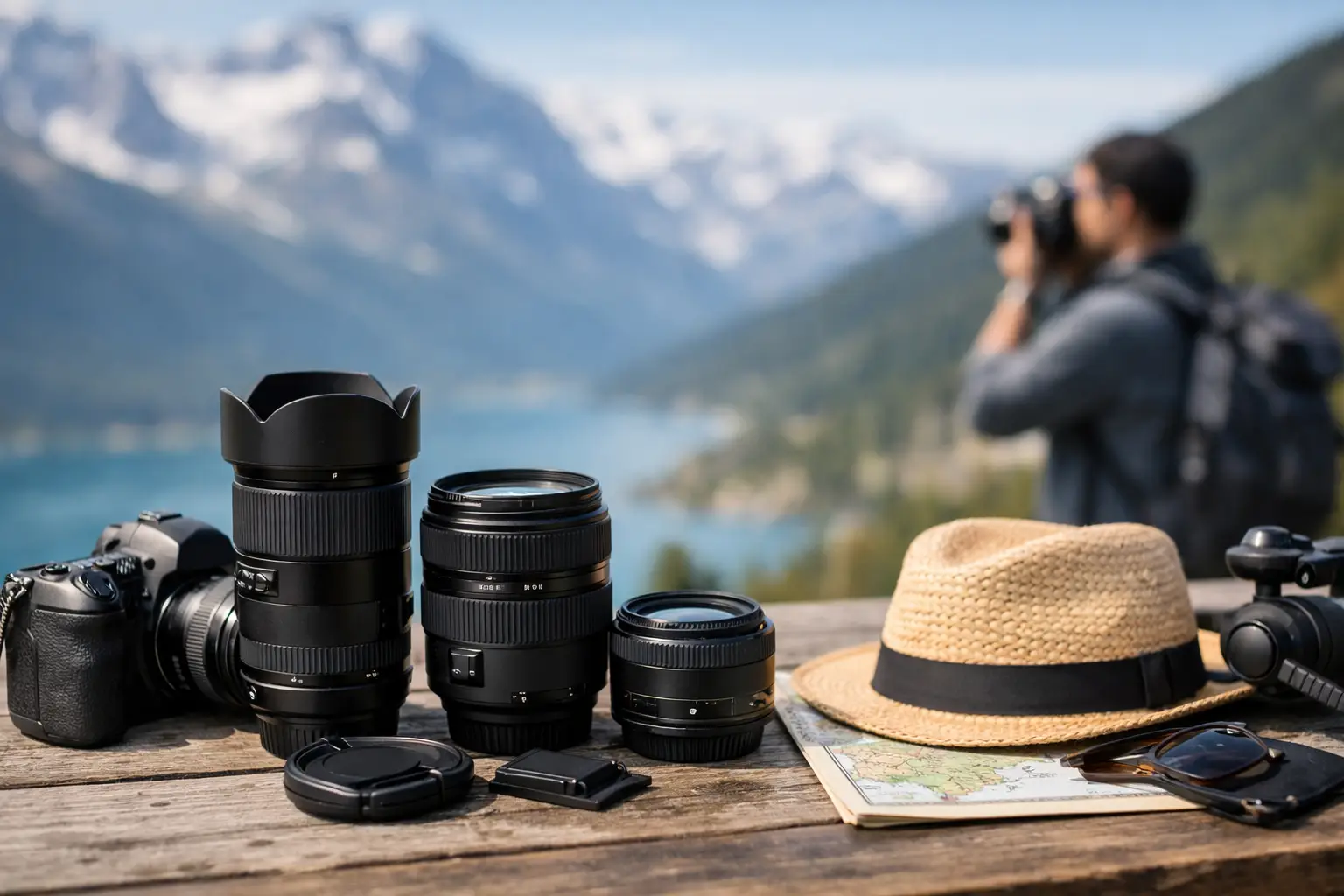
Airport security, one backpack, and a day where you photograph architecture in the morning, street scenes in the afternoon, and a sunset over the sea in the evening - it is precisely in such conditions that it becomes clear how to choose a lens for travel photography. A good travel lens is not just technically sharp. It needs to be versatile enough, comfortable to carry, and suited to what you actually photograph.
In brief
- Start with what you plan to photograph — focal length and size matter more than popular reviews.
- A versatile zoom (e.g. 24–70 / 24–105 mm) is practical for most city trips; wide-angle is useful for architecture/nature; a fast prime is better for evenings and street photography.
- Keep the sensor crop factor in mind — the focal length equivalent changes depending on the camera.
- Aperture speed (f/2.8 vs f/4) is a trade-off between low-light performance and weight/size.
- Optical stabilization and a camera with IBIS make handheld shooting easier; if you plan to film with a gimbal, consider weight and autofocus behavior.
- If you are unsure, try renting or a short test before buying.
What to choose for different tasks
| Task | Solution | Why |
|---|---|---|
| City and street photography | Versatile zoom lens (e.g. 24–70 mm or APS‑C equivalent) or a lightweight 24–105 mm | Provides wide views and enough reach for portraits or details, reduces lens changes and carrying load. |
| Architecture and interiors | Wide-angle lens (e.g. 14–35 mm or APS‑C 10–20 mm) | Lets you capture tight spaces and wider facades without needing to step back, but distortion control should be considered. |
| Nature, hiking and safari | Compact versatile zoom or a telephoto lens combined with a wide-angle lens (or 70–300 mm tele if needed) | Weight and durability matter a lot when traveling; a telephoto lets you capture distant details, while a compact zoom keeps mobility high. |
| Evening and low-light photography | Fast prime lens (e.g. 35 mm or 50 mm f/1.8–f/2) or a faster zoom (e.g. f/2.8) if you do not mind the weight | Faster optics let you use lower ISO and faster shutter speeds, improving image quality without a tripod. |
| Content creation — photo and video with a gimbal | A lightweight and stable setup with good AF behavior; choose a lens with lower weight and better focus breathing performance | Not only image quality matters, but also weight balance on the gimbal, stabilization, and AF performance in video mode. |
| Minimal weight/one-camera travel | One compact versatile zoom or one fast prime lens depending on your style | Less weight and more simplicity increase the chance that you will actually bring the lens and use it all day. |
Frequently asked questions
Is a versatile zoom lens always the better choice for travel?
A versatile zoom is often the best compromise between flexibility and convenience because it reduces lens changes. However, if your trip mainly focuses on evenings or low light, it may be worth choosing a fast prime lens or a two-lens kit.
How important is f/2.8 versus f/4 for travel?
f/2.8 offers a bigger advantage in low light and better background blur, but it usually means more weight and size. If you mainly shoot in daylight or your camera handles high ISO well, f/4 or a variable aperture may be the more practical choice.
How does the sensor crop factor affect the choice?
The crop factor changes the actual angle of view — meaning the same focal length on APS‑C will look longer than on a full-frame camera. So evaluate focal lengths with the camera sensor in mind to get the right wide/telephoto framing.
Is lens optical stabilization mandatory if the camera has IBIS?
If the camera has in-body stabilization (IBIS), lens stabilization is not mandatory, but in some cases the combination of both systems gives better results. In practice, the choice depends on your usual shutter speeds, video needs, and the weight of the setup you choose.
Should I buy a telephoto lens for travel?
A telephoto lens is especially useful if your trip includes animals, sports events, or distant details. However, telephoto lenses usually add weight and bulk, so think about whether the use justifies the burden or whether it would be better to rent the lens temporarily.
How can rental options help with the decision?
Rental lets you try a specific lens in real conditions without a long-term investment, helping you confirm whether the choice fits your style. It is a recommended solution if you are unsure about weight trade-offs or the practical usefulness of a specific focal length.
Useful links
- Lenses and accessories (rental section) - Check rental options if you want to try a lens before buying or need short-term equipment for travel.
- Lenses (category) - View a wide range of lenses and compare different wide-angle, zoom and prime models.
- Video equipment (rental section) - If you plan to film while traveling, this section helps you choose stabilizers and other video equipment for rent.
- RENTAL (main section) - General information about rental as a solution for trying lenses and equipment without purchase commitments.
- Video stabilizer accessories (category) - View accessories for stabilizers that help optimize weight and balance on a gimbal.
How to choose a lens for travel photography without unnecessary gear
The most common mistake is to start by asking which lens is the best, rather than what you plan to photograph. There is no single ideal option for all travel. For one person, a compact body and low weight will matter most; for another, a larger zoom range will matter, so they do not have to change lenses in a dusty or humid environment.
In practice, the choice is almost always based on four factors - focal length, aperture, size, and system compatibility. If any of them does not match your route, a technically good travel lens can become inconvenient. That is why before buying or renting, it is worth evaluating not only the specification sheet but also your shooting style.
Start with the camera and sensor format
What is 24 mm on a full-frame camera will look different on an APS-C or Micro Four Thirds system. That is why focal length should always be evaluated together with the sensor crop factor. If you ignore that, it is easy to buy a lens that seems wide enough, but in reality is too narrow for travel scenes.
For full-frame users, a universal starting point is often a 24-70 mm or 24-105 mm range. In APS-C systems, similar flexibility is usually provided by lenses around 16-50 mm, 17-70 mm, or 18-135 mm. If priority is light weight, mirrorless systems have a clear advantage here, though DSLR users can also find very practical solutions.
Main lens types for travel photography
For travel photography, it is worth looking at lenses not by brand but by use case. This immediately narrows the choice and reduces the risk of overpaying for features that will not be used on the road.
Universal zoom lens
If you want one lens for the whole day, a universal zoom model is usually the safest choice. Ranges such as 24-105 mm, 24-120 mm, or in the APS-C segment 18-135 mm allow you to photograph a wide landscape at one moment and details, a portrait, or a street scene from a slightly greater distance the next.
This solution has a clear advantage - fewer lens changes and a faster workflow. The downside is also clear - such lenses are rarely the brightest or completely free of optical compromises. Still, in travel photography this compromise is often justified.
Wide-angle lens
If the focus of the trip is nature, architecture, interiors, or city panoramas, a wide-angle lens will be very useful. On full-frame systems this usually means 14-35 mm, 16-35 mm, or a fixed 20 mm or 24 mm lens. In the APS-C segment, around 10-20 mm or 11-18 mm is often chosen.
A wide-angle lens helps when spaces are tight and there is nowhere to step back. At the same time, keep in mind that with too wide a focal length, people at the edges of the frame may look distorted, and composition becomes more demanding. It is not a lens that automatically creates better shots - it simply offers a different way of working.
Bright prime lens
A 35 mm or 50 mm prime lens is still a very logical choice for travel, especially for those who value low weight and good performance in low light. It is suitable for street photography, evening scenes, café interiors, and portraits with pleasing background blur.
The compromise here is obvious - there is no zoom. If you are willing to move more and adjust the frame with your position, a prime lens can deliver very high image quality in a compact size. If you need maximum flexibility, one prime lens for the whole trip will not always be enough.
Telephoto lens for specific routes
Wildlife, mountains, sporting events, or details from a long distance require a different approach. Then a 70-200 mm, 70-300 mm, or similar tele range is useful. This is not a typical first travel lens because weight and size increase, but on certain trips it is indispensable.
If the route includes safari, birdwatching, or landscapes with isolated elements in the distance, a telephoto lens can provide results that a universal 24-70 mm simply cannot. If the trip is mainly a city break, the telephoto may stay in the hotel more often than you would like.
Focal length is more important than megapixels
Many buyers overvalue sharpness in lab tests when choosing a travel lens and underestimate the importance of focal length. In real use, the right range affects the result more than small optical differences between models of a similar class.
If you like photographing wide views and urban scenes, a starting point around 24 mm full-frame equivalent is very practical. If you more often create portraits, details, and street shots from a distance, an upper limit around 70 mm or 105 mm will be much more useful. That is why there is no point automatically choosing the largest possible zoom if its wide end is too narrow for your style.
A good test is to look at your previous shots and see which focal lengths repeat most often. This is a much safer method than relying on forum recommendations without context.
Aperture - how much do you really need
f/2.8 sounds appealing, and for good reason. A brighter lens helps in low light and gives more control over background blur. But in travel photography, it comes at a price - greater weight, larger size, and usually a higher cost.
If you mostly photograph in daylight and want a light setup, f/4 or a variable aperture such as f/3.5-5.6 may be completely sufficient. Modern cameras with stabilization and better ISO performance compensate for part of this compromise. On the other hand, in evening streets, interiors without a tripod, or travel video work, brighter optics still offer a significant advantage.
There is no universal answer here. If mobility is the priority, it is not always worth carrying a heavier f/2.8 lens for the entire trip just for a few evening shots.
Weight, size, and stabilization
A travel lens is judged not only by the image, but also by how long you actually want to carry it. Sometimes a theoretically better model loses in practice because after a couple of hours it starts to get in the way. This is especially noticeable if you photograph all day on foot, travel with hand luggage, or work together with a gimbal.
Optical stabilization can be very useful if you photograph handheld at lower shutter speeds or film video. If the camera already has built-in stabilization, lens stabilization is not always mandatory, but in certain combinations it still provides an advantage. This is one of those points worth checking for the specific system rather than just in general.
One lens or a two-lens kit
A one-lens strategy is the most convenient. Less to think about, faster to react, easier to move around. That is why for many travelers, a good universal zoom lens is the most rational purchase.
A two-lens kit is worth considering when the trip includes clearly different scenarios. For example, a universal zoom for the day and a bright 35 mm or 50 mm for the evening. Such a combination gives more control, but it requires more space in the bag and more frequent lens changes.
If you are not sure whether a particular format suits you, a rental option is especially practical here. It lets you check whether the chosen lens really matches your route and shooting habits before making the final purchase decision.
Practical scenarios to choose by
For city trips, a universal range with good coverage at the wide end works best. If you plan a lot of architecture and street photography, 24-70 mm or the APS-C equivalent will often be more precise than a superzoom solution.
On nature and hiking routes, weight and durability matter more. Here, a compact universal zoom or a wide-angle and light tele combination often wins, if the route also includes animals or distant landscapes.
Content creators who both photograph and film should also look at autofocus performance, focus breathing, stabilization, and lens weight on a gimbal. A technically good photo lens is not always the most convenient for video work.
If the main goal is maximum quality and deliberate framing, a good prime lens can be the best travel companion. If the goal is flexibility and quick response, a zoom will almost always be more practical.
How to avoid typical selection mistakes
The first mistake is buying based on reviews rather than your route. The second is overestimating the need for very bright optics without considering weight. The third is choosing a starting focal length that is too narrow and quickly becomes limiting on trips.
Another common problem is ignoring the total load of the bag. A lens may be suitable on its own, but together with the camera, chargers, filters, a laptop, and other equipment it can make the kit uncomfortably heavy. That is why a good solution is not only to compare specifications, but also to hold the lens in your hands or try it in real use.
If the choice seems too broad, it is worth narrowing it down to three questions - what you will photograph most often, how much weight you are willing to carry, and whether you value versatility or image quality in specific situations more. With this approach, even within a wide selection, the decision becomes much clearer.
The best travel lens is not the one with the most impressive specifications, but the one you will actually take with you every day and use without hesitation. If a lens matches your route, camera, and working style, it will perform much better on a trip than a technically superior but inconvenient compromise.