
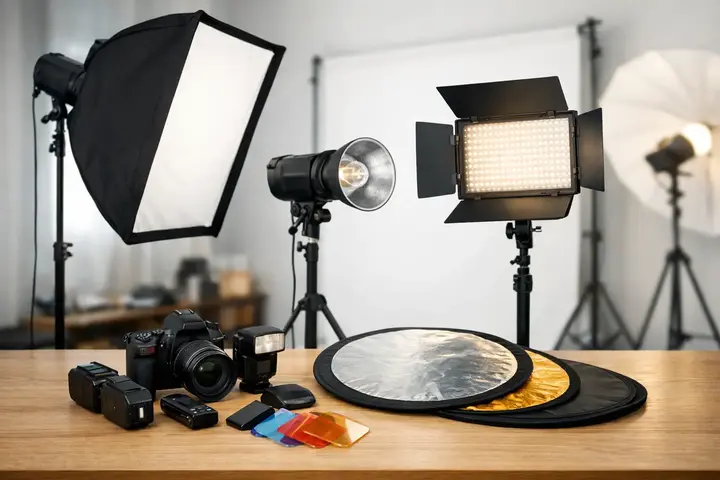
If skin tones look gray in the frame, a product casts dirty shadows, or the background always turns out uneven, the problem often isn’t the camera. Usually, what’s missing is a properly matched studio lighting kit that suits the space, the task, and the workflow. Light is what determines how predictable the result will be - in portraiture, e-commerce product photography, and video content alike.
When choosing studio equipment, people often look for one universal solution, but in practice that rarely happens. A kit that works well for interviews and content creation will not always be optimal for full-body portraits or object photography with accurate color rendering. That’s why a meaningful choice starts not with the brand or the price, but with the specific use case.
In brief
- Choose the kit based on the main use case — photo, video, or both — not by brand or price.
- LED kits are more convenient for video and mobile production; pulse/studio flash units provide more power for photography.
- Start with 1–3 lights depending on the task; pay attention to modifiers (softbox, grid), stands, and power supply.
- Check CRI/TLCI, fan noise, synchronization (flash units), and system expandability.
- If you are unsure, consider renting or a kit you can easily expand later — usability matters more in the long term.
- Room size, wall color, and mobility significantly affect how powerful a kit you need and which one to choose.
What to choose for different tasks
| Task | Solution | Why |
|---|---|---|
| YouTube interviews and live streams | Bi-color LED panel kit with high CRI/TLCI and remote control, plus a softbox or diffuser | LED lets you see the result in real time, adjust color temperature, and quickly change the setup without flash. Low-noise fans and battery power ensure convenient use in the studio and on location. |
| E-commerce product photography | Studio pulse (flash) kit with softbox, grid or reflectors, and stable stands | Pulses provide more power and a short flash duration, which allows you to work at lower ISO and maintain sharpness and color accuracy. Modifiers help control reflections and shadows on small surfaces. |
| Portraits and beauty photography | A combination of a key light with a softbox, fill light, and a contour/hair light, with a powerful pulse or a high-quality LED with high CRI where possible | A soft, controlled light character gives good skin tones and accurate shape modeling. Pulses are better suited for freezing motion, while LED provides convenient compositional preview and quick adjustment. |
| Product photos for small items (jewelry, electronics) | A light box or small LED panels with a diffuser and color-accurate lighting (high CRI), background kit | Diffusion and small, even light reduce reflections and show details. A dedicated background and holder provide a clean, repeatable look for catalogs. |
| Mobile content creation or location work | Lightweight LED kit with battery power, compact stands, and quickly foldable modifiers | Portability, fast setup, and battery life are the main requirements. Compact solutions let you work without mains power and reduce setup time. |
When a studio lighting kit is more suitable than individual lights
Buying individual lights makes sense when you already know your workflow and it’s easier to expand an existing system than to start from scratch. A studio lighting kit, on the other hand, is usually a smarter starting point when you need to quickly get a compatible solution. A kit often already includes light stands, light modifiers, power solutions, and sometimes even a carrying case.
This reduces the risk of buying components that are technically good but awkward to use together. This is especially relevant for beginners, small studios, company marketing teams, and content creators who need a predictable workflow rather than a long process of assembling parts one by one.
The first decision - for photo or video needs
The key question is simple: do you need light for photography, video recording, or both scenarios. For photo work, flash systems or studio strobe lights are still very often preferred. They provide high power, short flash duration, and effective freezing of motion. This is especially useful in portraits, fashion photography, or product shoots where a sharp, clean result with lower ISO is needed.
For video work, continuous LED lights are more relevant. They let you immediately see shadow falloff, light direction, and the overall atmosphere. This speeds up setup and makes work easier in small teams. In addition, modern LED solutions offer enough power for interviews, advertising content, social media videos, and even small studio setups.
If you plan to photograph and film equally regularly, you need to weigh the trade-offs. Continuous light is more universal, but not always as powerful as a strobe solution. Conversely, flashes are excellent for photo work, but they cannot be used as the main lighting for video tasks.
LED kits
LED kits are suitable for interviews, podcasts, product videos, livestreams, and content creation in small spaces. Here you should look not only at power, but also at light quality - CRI and TLCI ratings are important when accurate skin tone and product color reproduction is required.
The fan noise level is also practically important. If you record with a microphone placed nearby, a loud light can create an unpleasant background noise that is difficult to remove in post-production.
Strobe light kits
Strobe or studio flash kits are more often chosen for portraits, commercial product photography, and work where high light output is needed. They let you use a lower ISO, a smaller aperture, and maintain more precise control over the image.
Here you need to consider synchronization, recycle time, and flash consistency. If you shoot in bursts or work with a client flow, slow charging between frames becomes a real bottleneck.
How many lights do you really need
Many people start with the idea that at least three lights are needed. In reality, it all depends on the task. One light with a suitable softbox and a reflector can be perfectly sufficient for portraits, product content, and video conversations. Such a kit is simple, quick to set up, and easy to control.
A two-light system gives more flexibility. You can create a classic key and fill setup, light the background, or separate the subject from the background with a rim light. This is often the optimal solution for a small business, a content studio, or a photographer who wants a solid foundation for different scenarios.
Three or more lights become relevant when you need a consistent commercial setup, more complex arrangements, or work with larger objects. Keep in mind that with flexibility comes higher demands on space, stands, power supply, and setup time.
What a good studio lighting kit includes
Not every kit is equally functional. Sometimes an attractive price means the basic components are there, but usability will be limited. That’s why you should check not only the number of lights, but also their practical комплектācija.
Stands are important. If they are too light, a larger softbox becomes unstable and safety suffers. Equally important are the light modifiers - softboxes, umbrellas, reflectors, grids, and diffusers. They affect the character of the light much more than it may seem at first.
You should also evaluate the mounting system. A widely used bayonet standard gives you more options to expand the kit later with other modifiers. If the system is closed or proprietary, future expansion can become more expensive and inconvenient.
How the space affects the choice
A studio lighting kit for a small room will be different from one intended for high ceilings and full-body shooting. In a small space, a too-powerful light can even be a hindrance, because it is difficult to control precisely. In a larger space, a weak LED panel quickly reaches its limits.
You also need to take into account wall color and reflective surfaces. White walls help diffuse light, but sometimes reduce contrast control. In a dark room, it will be easier to achieve a more dramatic mood, but you will need more power or lights positioned closer.
If the equipment must be moved regularly between locations, weight, assembly speed, and transport convenience become important. For studio work this is less critical, but for a mobile content creator - very much so.
Power, color temperature, and control
Power should not be judged separately from the intended use. For video lights, not only watts matter, but also the actual illumination on the subject at a given distance. For photography, what matters is how easily you can work with the desired aperture and ISO.
Color temperature adjustment is useful if you work in mixed lighting or want to adapt quickly to the room. However, bi-color lights sometimes sacrifice maximum output compared with single-temperature models. That is not a defect, but a compromise you should know about before buying.
Remote control is also valuable - especially when the lights are placed high up or in hard-to-reach places. When working with multiple lights, it saves time every time you set up.
What to pay attention to if you plan to use the kit for a longer time
A cheap starter kit can be perfectly sufficient for the first projects. But if regular use is expected, it is better to think one step ahead. Will the system have available extra modifiers, spare parts, more powerful light sources, and compatible stands?
In a more professional environment, service availability and the ability to quickly replace equipment become important too. If a light stops working in the middle of a project, a theoretically good specification no longer helps. Here, the ability to consult a specialized retailer or, if necessary, use rental equipment to test a specific solution before purchase is often decisive.
That is why, for some users, the most rational move is not to buy the most expensive system right away. Much wiser is to choose a kit that exactly matches today’s tasks, while allowing room to grow without replacing the entire system.
How to avoid typical selection mistakes
The most common mistakes are made by those who buy based only on power or only on price. Power without a quality modifier will not deliver the needed result. A low price without a solid kit quickly turns into extra costs for stands, mounts, and light shapers.
The second common pitfall is an overly universal approach. If your main job is product photography for a catalog, the requirements will be different from those of a YouTube studio or beauty salon social media video. The more precisely the task is defined, the more precise the choice will be.
If you are torn between two solutions, the more practical one is usually the one you will be able to use more often and more quickly. Light that sits on a shelf because setup is too complicated does not pay off, regardless of the specification.
If a studio lighting kit is chosen with a clear goal, it becomes not just a purchase, but a work tool that directly affects image quality, workflow speed, and result consistency. A good starting point is to understand what you shoot or film most often, how much space you have available, and whether the equipment needs to be stationary or mobile. From there, the right solution becomes much clearer.
Frequently asked questions
How many lights do I usually need in a studio?
It depends on the task: one softbox with a reflector is often enough for a portrait or a video interview. Two lights provide a key+fill setup, while three or more are useful for more complex commercial setups or full-body photos.
Is it better to choose an LED or a pulse (flash) kit?
The choice depends on the primary use: LED is usually more suitable for video and live streams because you can see the result immediately; in photography, pulse systems provide more power and the ability to freeze motion. If you plan to use both, weigh the trade-offs or combine both solutions.
Which technical parameters are important before buying?
Pay attention to CRI/TLCI (color accuracy), maximum real-world output, fan noise level, and remote control options. For flashes, synchronization, recycle time, and stability are also important.
How do room characteristics affect lighting choice?
In a small room, choose light that is easier to control and more compact modifiers to avoid overly strong or hard-to-manage light. In a large room or with high ceilings, more power or additional lights is needed to ensure even lighting.
Is it better to buy or rent a kit if I want to try solutions?
Renting is a good solution if you want to test equipment before buying or if a project requires specific gear for a short time. Buying makes sense if you will regularly use a particular kit and plan to expand or service it in the long term.
How do I ensure the kit's longevity and expandability?
Choose a system with a broad ecosystem of modifiers and mounts, stable stands, and accessible service/resource sources. Plan for growth — it is better to start with a smaller, more usable kit that can be expanded than to buy the cheapest full kit without extra options.
Useful links
- LED light panels - More information about LED panels and suitable models for video and photo use.
- Studio flashes - Selection and kits for pulse/flash systems suitable for professional photography.
- Photo umbrellas - Modifiers that help soften light in portraits and product photography.
- Light modifiers - Accessories such as grids and barndoors that help control light direction and contrast.
- Background kits with light - Solutions for achieving an even background and simplifying product photography setups.
- Power sources - Information on batteries and adapters important for mobility and location work.
- RENTAL - An option to try or temporarily use professional kits before buying.