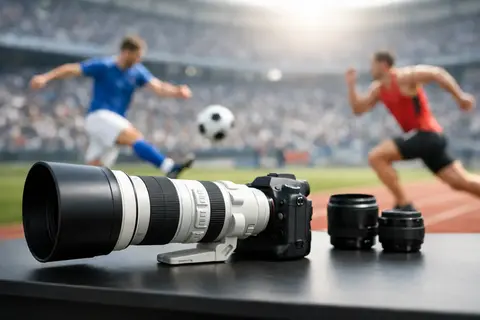
At the edge of a football field, 70-200 mm may seem ideal, but in a hall it often turns out to be too short, while in athletics 300 mm already becomes the bare minimum. That is exactly why the question of how to choose a telephoto lens for sports is not just about a “longer lens,” but about a specific sport, the distance to the athlete, the light, and the camera system.
In brief
- First determine the main sport, the average distance to the action, and the lighting level — then choose focal length and aperture.
- For indoor use, priority is light-gathering ability (e.g., f/2.8) and fast autofocus; in a stadium, reach is more important (100–600 mm).
- Zooms (70–200 mm, 100–400 mm) provide flexibility for different situations; prime telephoto lenses offer better optics and light-gathering ability for specific distances.
- Optical stabilization makes framing easier at longer focal lengths, but it does not stop fast athlete movement — shutter speed and aperture are more important.
- If you are not sure, rent the lens and try it in your working environment before buying.
What to choose for different tasks
| Task | Solution | Why |
|---|---|---|
| Indoor team sports competitions (basketball, volleyball, floorball) | 70-200 mm with f/2.8 or equivalent light-gathering ability; if a lighter option is needed — 70-200 mm f/4 in bright venues or for an APS-C body | In halls, light is limited — f/2.8 allows shorter shutter speeds and lower ISO; 70-200 mm provides the necessary framing flexibility. |
| Outdoor stadium disciplines (football, athletics, motorsport) | 100-400 mm or 200-600 mm zoom; for professional needs — 300 mm/400 mm prime lenses | Greater distances require more reach; a zoom allows quick framing adjustments, while prime lenses usually deliver better optical performance. |
| Dynamic close-up situations (combat sports, dance) | A wider range or a lighter 70-200 mm zoom with fast AF and good ergonomics | Close and unpredictable movement requires quick transitions between frames and easy mobility — a heavy, long telephoto does not suit the working style. |
| Bird and long-distance action photography (bird flight, wildlife sports) | 400–600 mm prime or 100–400/200–600 mm zoom with stabilization | Long distance — reach is needed and stabilization often helps to frame and hold the image more easily at longer focal lengths. |
| Occasional sports photography or a one-time event | Consider rental (short-term rental) or a 70-200 mm all-purpose option | If use is infrequent, renting lets you try a suitable tool without a large investment; 70-200 mm is a versatile choice. |
| Long sessions without a tripod (handheld photographer) | A lighter zoom (e.g., a compact 100-400 mm) or 70-200 mm f/4 with a monopod/shoulder support | Weight and ergonomics affect endurance and image quality in long sessions; heavier lenses require a tripod or monopod. |
Frequently asked questions
What focal length should I choose if I photograph basketball in a hall?
In a hall, the most practical option is usually a 70–200 mm range with f/2.8 light-gathering ability on a full-frame body. If you use APS-C, 70–200 mm becomes “longer” in practice, so you should assess whether it turns into a convenient or too narrow angle of view.
Does lens stabilization remove the need to use a large aperture?
No — stabilization helps hold the camera steady and reduces the effect of hand shake, but it does not stop athlete movement. To get sharp sports shots, the priority is a short shutter speed and a wide aperture (low f-number).
When is it better to choose a prime telephoto lens instead of a zoom?
A prime telephoto lens is a good choice if you work at a specific distance and want maximum light-gathering ability and optical quality. If situations change or the distance on site is not predictable, a zoom provides the flexibility needed and reduces lens-swapping time.
Is it worth buying a more expensive f/2.8 lens if I only photograph sports occasionally?
If you photograph sports rarely, it is often more economical to rent a suitable lens for a specific event rather than buy an expensive f/2.8 model. For regular tasks, the investment pays off, but for occasional use, rental lets you try and compare solutions without a large upfront payment.
How can I tell whether autofocus is enough for my sports genre?
It is important not only to look at specifications, but also at real tests with your camera body or to try the lens in practice. Sometimes a good AF result in tests does not mean ideal performance with a specific body, so rental options and real-world tests are very useful.
Useful links
- Lenses and accessories (rental options) - Allows you to try different telephoto lenses in your working environment before purchase, which helps avoid choosing an unsuitable one.
- RENTAL - General information about rental services — a practical solution for occasional or testing use.
- Lenses - A category with different telephoto lens types, useful for comparing specifications and models.
In sports photography, the lens determines more than just framing. It affects shutter speed, autofocus accuracy, the ability to isolate the athlete from the background, and also how long you can work handheld at all. A good telephoto lens for sports is one that fits your working environment, not just a specification table.
How to choose a telephoto lens for sports by discipline
The first step is to understand what you will photograph most often. Basketball, volleyball, and floorball take place in a relatively limited space, where lens speed and a sufficiently wide range are important. Here, 70-200 mm f/2.8 often works well, especially on a full-frame camera. If you use a APS-C body, this range becomes even “longer,” which is an advantage in some halls, but a drawback in others.
For football, motorsport, athletics, or bird-flight-like dynamic situations in a stadium, you usually need more reach. 100-400 mm, 200-600 mm, or 300 mm and 400 mm fixed lenses are a much more logical choice here. The larger the field and the farther the athlete is, the less useful a universal “mid-range” telephoto lens becomes.
In combat sports, dance, or events with athletic dynamics, the situation is more nuanced. There you often have to work close to the action, reframe quickly, and react to unpredictable movement directions. In such cases, a telephoto lens that is too long can hinder more than help.
Focal length - how much “reach” do you really need
When choosing a telephoto lens for sports, focal length is the first thing most people look at. That is justified, but with one caveat - the required distance should be considered together with the sensor size. 200 mm on a APS-C camera gives a narrower angle of view than on full frame, so the result differs in practice.
If you are looking for a more universal sports solution, 70-200 mm is usually the safest starting point. It works for indoor sports, portraits, award moments, and many situations where the athlete is not very far away. However, for outdoor teams and stadium disciplines, it is often not enough.
100-400 mm is a flexible option for those who work at different distances and do not want to invest right away in a fixed-focal-length telephoto lens. Meanwhile, 300 mm, 400 mm, or 600 mm solutions are already more targeted tools for specific needs. They usually offer very high optical quality and fast autofocus, but lose flexibility and often require a larger budget.
Lens speed is often more important than maximum zoom
In sports, movement is fast, and it can only be frozen with a sufficiently short shutter speed. That is why the lens’s maximum aperture is not just a matter of aesthetics. In a hall, f/2.8 is often a practical necessity, not a luxury.
If you photograph indoors, a lens with f/2.8 will show its advantage immediately. You will be able to keep a lower ISO or use a faster shutter while maintaining a cleaner image and sharper motion. A lens with f/4 or f/5.6 may be perfectly sufficient in daylight in a stadium, but under weaker light it quickly reaches its limits.
There is also a trade-off here. Faster telephoto lenses are larger, heavier, and more expensive. If you photograph sports only occasionally and mostly outdoors, a telephoto lens with a variable aperture may be more economically justified. If this is regular work in halls, saving on the lens often turns into lost shots.
Autofocus - a parameter you cannot ignore
A sports lens must not only focus, but focus consistently. Slow or inaccurate autofocus is, in practice, a more costly flaw than a small difference in sharpness in laboratory tests.
It is important to evaluate not only the lens motor, but also compatibility with your camera’s autofocus system. Some lenses work excellently with the latest mirrorless cameras, but on older bodies their potential is not used as well. If you plan to photograph athletes running straight toward the camera, or rapid direction changes, such as in basketball or motocross, autofocus performance becomes critical.
A practical approach helps here - not only reading specifications, but looking at real tests or trying the lens with your own body. In exactly these situations, rental options are especially valuable, because they let you evaluate the lens in your working environment rather than guessing from the description.
Stabilization helps, but does not solve everything
Optical stabilization in a sports lens is useful, especially at longer focal lengths. It helps keep the frame steady, makes framing easier, and sometimes helps with panning, for example in motorsport or cycling.
However, it must be understood that stabilization does not stop the athlete’s movement itself. If the shutter speed is too slow, the athlete will be blurred regardless of how good the lens stabilization is. Therefore, this feature should not be seen as a substitute for lens speed or a higher ISO.
In some genres, such as tennis or football in daylight, stabilization is a pleasant bonus. In a hall, by contrast, the biggest gain usually comes from f/2.8 and reliable autofocus, not from stabilization alone.
Weight and ergonomics matter more than it seems
Sports photography often means long periods standing, moving along the edge of the field, and being continuously ready to react. That is why the lens’s weight is not just a comfort issue, but a productivity issue. A heavy 400 mm or 200-600 mm telephoto lens gives reach, but working handheld with it for several hours is not easy.
If you photograph only occasionally or without a monopod, a lighter 70-200 mm or compact 100-400 mm will often be more practical. For professional use, where maximum quality and reach are the priority, weight becomes an acceptable compromise. It is important to be honest about your working style, rather than buying a lens just because it is technically the “best.”
It is also worth paying attention to the balance with the camera body, the zoom ring travel, the placement of customizable buttons, and the tripod foot. These small details do not stand out in a catalog, but in work you feel them immediately.
Is a zoom or a fixed-focal-length telephoto lens better for sports
A zoom lens gives flexibility. It is especially important if you photograph an unpredictable event where the distance to the athlete changes quickly. That is why 70-200 mm and 100-400 mm are popular for a reason - they let you react quickly and avoid missing the moment because of lens changes.
A fixed-focal-length telephoto lens, on the other hand, usually offers better speed, higher optical performance, and often faster autofocus response. It is a powerful tool at a specific working distance, but it is less forgiving of poor positioning. If you know where you will be working from and what kind of frame you are looking for, a fixed telephoto can be very effective. If situations change, a zoom is the safer investment.
Budget, purchase, and rental
Telephoto lenses for sports are rarely a cheap category. That is why it is worth considering the choice not only by price, but by how often you will use it. If you photograph sports every week, a quality lens is a long-term working tool. If a particular sports event is an exception, rental is often the more rational solution than compromising with an unsuitable model.
In practical terms, this means the following. For a beginner or enthusiast, a good 70-200 mm can be the safest investment, because it will be useful not only for sports. For a regular outdoor sports photographer, 100-400 mm or 200-600 mm is often more sensible. Meanwhile, for a professional who works in a specific discipline and demanding light, the justification for a more expensive fixed telephoto lens is much clearer.
If you have doubts between two ranges or apertures, the wisest thing is to try the lens in practice first. That is where it becomes clear whether you are missing 100 mm, whether the weight is acceptable, and whether the autofocus really keeps up with your pace of work.
How to choose a telephoto lens for sports without unnecessary risk
The safest approach is to start with three questions. What sport will be the main one, how far from the action will you be, and in what lighting conditions will you work. If you have clear answers to these questions, choosing a telephoto lens becomes much more precise.
Then evaluate the camera system, autofocus compatibility, weight, and budget. Only at the end should you look at whether a specific model offers additional advantages, such as better sealing, teleconverter support, or more comfortable ergonomics. This sequence helps avoid overpaying for features that do not make any significant difference in your real use.
If you have to choose between “more universal” and “better for my specific sport,” the second approach usually wins. In sports photography, a suitable lens delivers more than a theoretically versatile model. A good telephoto lens is not the one with the longest zoom, but the one with which you return with sharp shots and a predictable result even in a difficult situation.
If you are not sure, it is worth basing the choice not only on specifications, but also on a real work scenario - because in sports, the suitability of gear is shown best not by the description, but by the result in the frame.