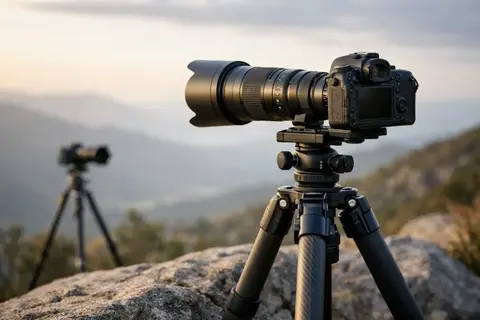
A heavy telephoto lens, full-frame camera, video head, external monitor - in such a setup, mistakes in choosing a tripod become expensive very quickly. A tripod for heavy photo equipment is not just an accessory for convenience. It is a support that affects image sharpness, workflow speed, equipment safety, and how confidently you can work in challenging conditions.
In brief
- Choose a stand by considering the actual workload — add a safety margin above the equipment weight.
- Prioritize the pipe diameter and the number of sections (often 3 sections and a larger diameter = greater rigidity).
- The choice of head determines safety: a gimbal head for telephoto lenses, a fluid video head for video setups.
- Carbon fiber is useful for transport cases, while aluminum provides a good price/durability compromise for stationary work.
- Before purchasing or renting, be sure to test the tripod in practice — with your camera/lens or an equivalent weight.
What to choose for different tasks
| Task | Solution | Why |
|---|---|---|
| Studio work with a heavy full-frame camera and video head | Heavier aluminum tripod with wider legs and high load capacity; stable video/fluid head with precise counterbalance. | In the studio, long-term stability and durability are more important than minimal weight; smooth panning is required for video work. |
| Bird or sports photography with a long telephoto lens | A tripod with larger-diameter 3-section legs and a gimbal-type head; choose a model with a real load-bearing reserve. | The gimbal head allows you to balance a long lens around its center of gravity and reduces the load on the head/leg joints. |
| Travel and location filming, when you have to carry for long periods | Carbon fiber tripod with a compromise between load capacity and folded length, combined with a lightweight video/gimbal head. | Carbon fiber reduces weight and dampens vibrations better, making long transport easier and providing better shoulder performance. |
| Macro and low-angle object photography | A tripod that allows stable work without extending the center column and with legs that can open in a low position. | A large center column increases oscillations; stability for low work is provided by a design that reaches the required height without a column. |
| Short-term project or experimental configuration | Consider renting a professional kit to test the solution before purchasing. | Renting allows you to try out the tripod and head in a specific work scenario without a long-term investment. |
| Work in windy or uneven outdoor areas | Tripod with wider leg sections, secure angle locks, and materials that withstand sand and moisture. | Wide sections and precise fasteners reduce immediate oscillations and improve ground grip on uneven surfaces. |
Frequently asked questions
Can you rely only on the maximum load capacity specified by the manufacturer?
No — the manufacturer’s maximum load capacity is a theoretical limit. In practice, it is recommended to choose a stand with a significant reserve above the weight of your equipment to ensure long-term stability and reduce vibrations.
Why are 3-section legs often better for heavy equipment?
A smaller number of sections usually means a larger diameter and stiffness of each section at full height. This reduces “wobble” and provides better torsional stability than travel tripods with 4–5 sections.
When to choose carbon fiber over aluminum?
Carbon fiber is useful when weight reduction and vibration damping are priorities, for example for travel or bird photography. If you mainly work in one place and price or maximum durability is more important, aluminum can be a more practical solution.
Is the center column a problem for heavy equipment?
Yes — extending the center column increases the risk of instability and amplifies vibrations. For heavy equipment, it is better to choose a tripod that reaches the working height without extending the column.
Which head should you choose for a long telephoto lens?
A gimbal-type head is often ideal for long telephoto lenses, because it allows the equipment to be balanced around the center of gravity. A ball head can be convenient for general photography, but with a longer telephoto lens it may become overloaded and lose precision.
Is it worth renting a tripod on the site before buying?
Yes — renting is especially useful if the stand is needed for a specific project or if you are not sure about the optimal model. It allows you to practically test the solution with your setup without a long-term investment.
Useful links
- Tripods - Basic category with a wide selection of stands — useful for readers who are starting to look for a solution for heavy equipment.
- Video tripod stands - Related to video configurations and fluid heads, which are mentioned in the article as an important element for video work.
- Tripod heads - Categorize head types (ball, gimbal, video), helping to choose the appropriate head for heavy equipment.
- Mini photo tripods - Useful for readers looking for the lightest, most compact solutions for mobility scenarios.
- Video equipment (rental) - The article recommends renting as a solution for the project — this page helps find rental options for video and tripod equipment.
- NOMA - General rental section that corresponds to the recommendation to try the equipment before purchasing.
A lightweight tripod with impressive specifications on the box often turns out in practice to be too flexible, unstable, or inconvenient. That is why the choice should start not with the price or the folded length of the tripod, but with the actual load and work scenario. Shooting in a stadium, in nature, in a studio, and at weddings requires different solutions even if the camera is the same.
What actually determines whether a tripod is suitable for heavy equipment
The first filter is load capacity, but it should not be taken literally. If the manufacturer states that the tripod can carry 15 kg, that does not mean it will be comfortable for long-term work with a 12 kg setup. In real use, not only maximum load capacity matters, but also torsional rigidity, vibration damping, and the quality of the joints.
In practice, it is safer to choose a model with a noticeable reserve above the actual weight of the equipment. If your camera with lens, L bracket, microphone, or monitor weighs around 5-6 kg, a tripod with an 8 kg limit will be a compromise, but a model with a 12-18 kg load capacity will usually provide a more stable result. The head must also be considered here, because the overall safety of the system is determined by its weakest link.
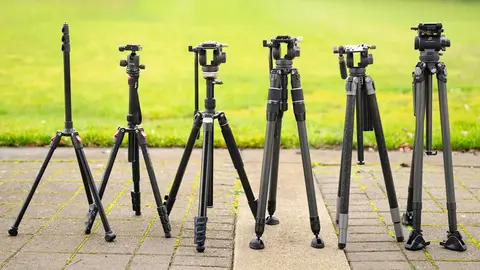
The second important factor is the leg tube diameter and the number of sections. The more sections, the more compact the tripod is for transport, but usually also the less rigid it is at full height. For heavy equipment, 3-section legs with a larger diameter are often preferable to 4- or 5-section travel tripods. They are longer when folded, but safer and more stable in the working position.
Tripod for heavy photo equipment - material and construction
Aluminum and carbon fiber are the two main options, and both have their uses. Aluminum tripods are usually more affordable and very durable under everyday working loads. They are well suited for studios, events, interiors, and situations where the tripod is not carried long distances.
Carbon fiber models are lighter and dampen vibrations better, which is a significant advantage for nature photographers, sports reporters, and videographers who move around a lot. However, lighter weight does not automatically mean the best choice for everyone. If the work is mostly done in one location, rigidity and budget efficiency may be more important than every kilogram saved.
You should also look at the leg locks. Twist locks are often more compact and less likely to snag during transport, while flip locks allow you to visually check quickly whether everything is locked. For heavy equipment, both solutions must work precisely, without play. If the mechanism feels soft already in the store, it will not get better over time.
Which head to choose for a heavy setup
Many look for a tripod, but the real problem is often the head. For heavy photo equipment, not every ball head is suitable just because its load rating looks sufficient on paper. If you mount a long telephoto lens on the tripod, weight distribution becomes critical, and the head must be able to hold the load without slowly sagging after locking.
A ball head is convenient for general photography, especially landscape, commercial work, and situations where the framing angle needs to change quickly. However, for very heavy equipment or long telephoto lenses, a gimbal head is often more suitable. It allows the lens to be balanced around its center of gravity and significantly reduces strain on the hands, especially in bird, sports, and nature photography.
For video work, on the other hand, a fluid video head with an appropriate counterbalance system is needed. There is no point in saving money if you are using a camera with a cage, follow focus, monitor, or other accessories. A too-weak video head will cause jerky panning and unpredictable starts or stops in movement.
How tall should the tripod be
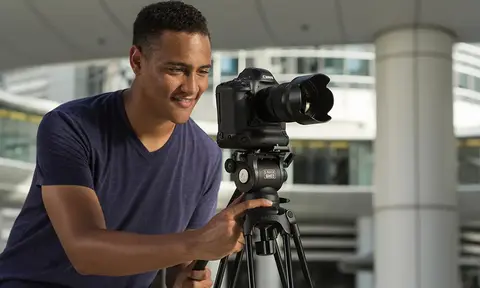
Height is often underestimated. If the tripod is too low at full working height, the operator starts compensating with an extended center column or an awkward posture. Both reduce stability and make longer work tiring.
For heavy equipment, the center column is usually not an ideal solution because it increases wobble. It is much safer to choose a tripod that reaches an ergonomic working height without extending the column. This is especially true for video and long shooting sessions with telephoto lenses.
A low working position can be just as important as maximum height. In product, macro, or nature photography, a tripod that allows stable work close to the ground without losing load capacity is useful. Not all models do this equally well.
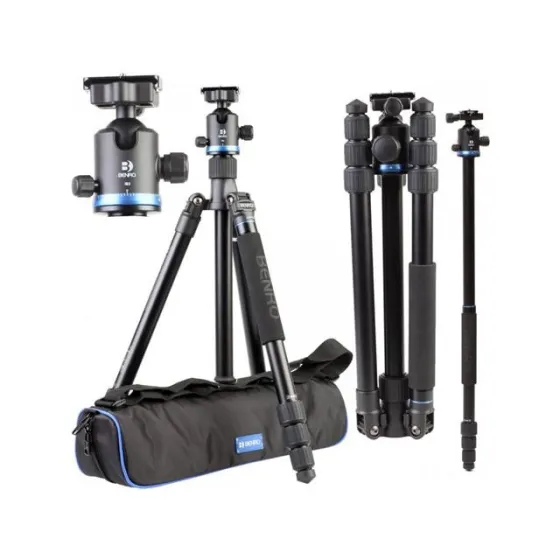 ProductBenro FIF28AIB2 foto statīvsView product
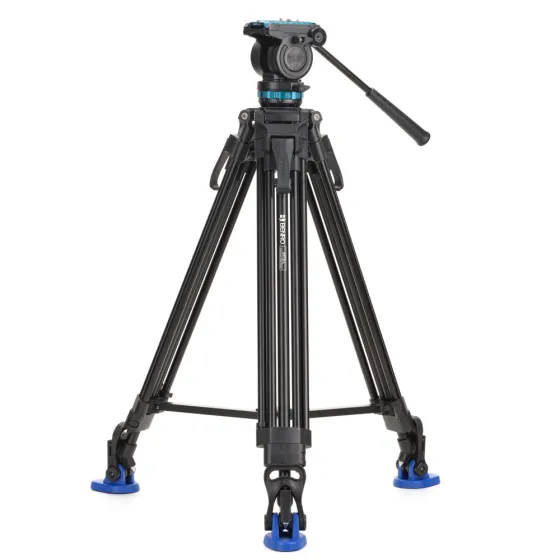 ProductBenro A572LLKH Lightning Lock Tripod with KH HeadView product
When mobility matters more than maximum rigidity
Not everyone needs the most massive option. If you travel a lot, film events, or work in locations where equipment must be carried all day, a tripod that is too heavy becomes a problem itself. In such a case, you need to find a balance between load capacity, weight, and folded size.
A compromise usually means giving up some maximum rigidity or height. That is not bad if the choice is deliberate. What matters is that the tripod matches your main work scenario, not every theoretically possible one. For one photographer, the ideal is a carbon tripod with a gimbal head for hikes; for another, a heavier aluminum setup for studios and sports halls.
Tripod for heavy photo equipment outdoors
Outdoor conditions introduce several more critical factors. Wind, uneven surfaces, sand, mud, and moisture quickly reveal how good the construction is. Wide leg sections, secure angle locks, and materials that can withstand frequent use are especially useful here.
If you plan to work near the coast or in winter conditions, maintenance also needs attention. Salt, fine sand, and dirt damage the locks faster than it seems. For professional use, it is important that the tripod can be disassembled, cleaned, and kept in working order without unnecessary complexity.
A good practice is to look not only at the tripod itself, but at the whole system - legs, head, quick-release plate, and lens mount. If one component does not match the others, the stability gain is lost.
What to check before buying or renting
Specifications help, but with heavy equipment it is highly advisable to test the tripod in practice. You should assess how quickly you can set up the legs, whether the head lock holds the load without movement, and how confidently the tripod behaves at full working height. If possible, the test should be done with your own camera and lens or an equivalent weight.
Pay special attention to vibrations. By lightly tapping the tripod or camera, you can see how quickly the system settles. The heavier the equipment and the longer the focal length, the more important this indicator becomes. A theoretically suitable model may turn out in practice to be too twitchy.
If the tripod is needed for a specific project rather than everyday use, rental is often a rational step. It allows you to check whether the chosen solution really suits your working style before making a long-term decision. In such situations, a specialized partner who can help match the tripod to a specific camera, lens, and task, as offered by Master Foto, is especially useful.
The most common mistakes when choosing a tripod for heavy equipment
The most common mistake is relying only on maximum load capacity. The second is focusing too much on low weight while ignoring stability. The third is choosing the wrong head, especially when working with telephoto lenses or video setups.
Another common problem is using the center column as the main working position. It can be useful temporarily, but for heavy equipment it is rarely the optimal solution. Also, do not forget about the quality of the quick-release system. A cheap or imprecise plate can cause micro-movements even if the legs themselves are good.
How to tell that the choice is right
The right tripod for heavy photo equipment does not make you feel like you are working at the limit. The camera stands securely, the head moves predictably, the locking mechanisms inspire confidence, and during a full working day you do not have to fight random vibrations or awkward ergonomics. It is not just about comfort. It is about repeatability of results.
If you work with expensive optics, commercial assignments, or challenging locations, a tripod is not the place for a random compromise. Sometimes it is better to buy a model one level higher or initially rent a suitable solution than to adapt the work to the tripod’s limitations.
A good tripod often stays with you longer than the camera or lens. So choose not the loudest specification, but the system that matches your equipment, your pace of work, and the environment in which you actually work.