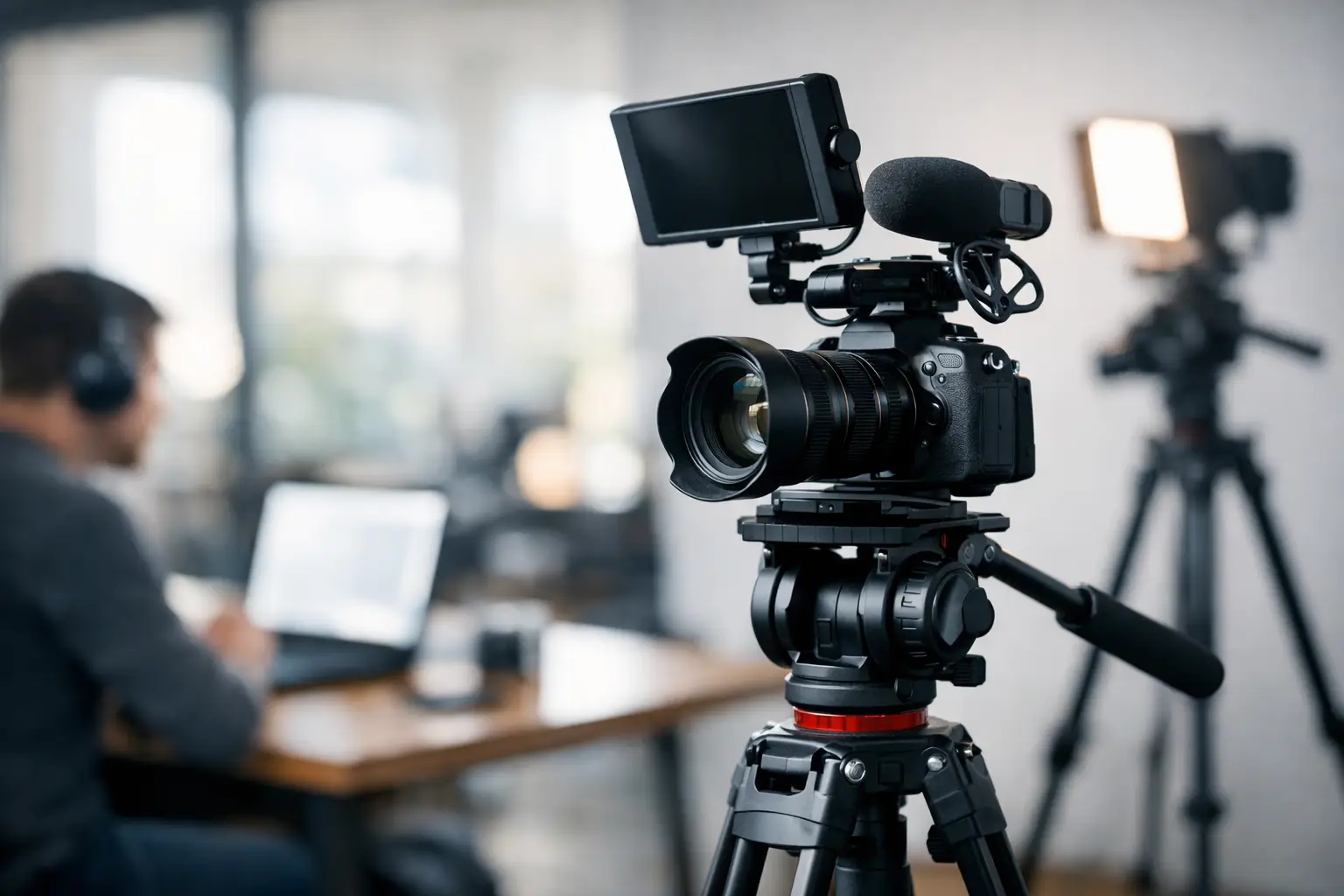
When the shot is good but the movement looks jerky or the camera slowly tilts forward, the problem is often not the camera. The question of how to choose a tripod for video shooting is in practice a question of stability, control, and how predictably your setup will work during filming. That is exactly why you should not choose a video tripod based on price alone or on how compactly it folds.
In brief
- Determine the real weight of the full video kit and choose a tripod with enough reserve.
- Prioritize a high-quality video head (fluid type) for smooth pan and tilt movements, while making sure the legs are stable enough.
- Choose the material (aluminum or carbon fiber) based on transport needs and budget.
- Before buying, check working height, leg sections, lock type, and counterbalance/head balance; rental options help you test solutions in practice.
What to choose for different tasks
| Task | Solution | Why |
|---|---|---|
| Interviews and studio recordings | Heavy tripod with a high-quality fluid video head and a low center of gravity for stability | In these tasks, precise, repeatable, and smooth head movement and maximum stability are the priorities. A heavier tripod reduces vibrations and keeps framing steady longer. |
| Events, news coverage, weddings | Lighter, quick-setup video tripod with a convenient lock and fast assembly | Speed and mobility are more important than maximum stability in these scenarios, so an optimal compromise between weight and rigidity is essential. A lighter design makes it easier to move between shots. |
| Solo vlogging and travel filming | Compact carbon fiber tripod or travel video tripod with a good head | Carbon fiber reduces carry weight, making the tripod more comfortable to carry for solo work. A compact solution makes transport easier without losing the necessary motion control. |
| Product video and low B-roll | Tripod with a low minimum height or the ability to lower the head close to the ground | Low-angle requirements call for the ability to work safely and stably near ground level. This makes it possible to achieve professional low-angle compositions. |
| Complex equipment (longer telephoto lenses, monitor, wireless audio, teleprompter) | Rigid tripod with fewer leg sections and a video head with a counterbalance system | A lot of additional equipment shifts the center of mass and requires good counterbalance so the camera does not tilt forward. Stable legs and counterbalance ensure precise and safe operation. |
| Time check before purchase (test project) | Choose rental or a short-term trial of different tripods and heads | Rental lets you practically understand which features and weight actually help your work. One or two days of shooting show real differences better than technical specifications. |
Frequently asked questions
How do you calculate what load a tripod should withstand?
Calculate the weight of the full video kit — include the camera, lens, batteries, external monitors, microphones, cage, and other accessories. Add a safety margin (usually 20–30%) above the load rating so the head and legs are not near their limit and movements remain smooth.
Can a photo tripod replace a video tripod?
A photo tripod can be a suitable solution for static compositions and light cameras without much movement. However, if you need smooth panning, counterbalance, or heavier equipment, a full video tripod with a video head will be the better choice.
Is a center column acceptable for video shooting?
A center column reduces tripod stability, so in video work it is usually avoided when rigidity is important. If you need height without extending the center column, choose a tripod whose own design provides sufficient working height.
Why choose carbon fiber over aluminum?
Carbon fiber significantly reduces weight, which matters if you often carry the tripod to shooting locations. However, carbon fiber usually costs more, so if the tripod will mostly stay in the studio, aluminum can be a more economical and sufficiently stable solution.
How important is counterbalance in a video head?
Counterbalance lets you hold the camera at a specific angle without excessive tightening and provides more natural movements. The heavier and more extended the equipment, the more important the counterbalance system is so the operator does not have to fight static resistance.
Useful links
- Statīvi - A wide range of tripods for different video and photo tasks; a good starting point for comparison.
- Video statīvi - A category focused on professional and semi-professional solutions for video shooting.
- Statīvu galvas - Choose a suitable video head with counterbalance and drag control to improve movement quality.
- Objektīvi - Long telephoto lenses change the weight center and require different tripod and head characteristics.
- Teleprompteri - If you use a teleprompter, check the tripod and head’s ability to support its additional weight.
- NOMA - Rental lets you practically try different tripod and head combinations before making a final decision.
A photo tripod and a video tripod are not the same thing. Many users start with a universal model because it seems like an economical solution, but in video work the difference becomes visible very quickly. When filming, smooth panning and tilting movement, resistance to vibrations, and the ability to safely hold not only the camera but the whole setup are important - the lens, monitor, microphone, wireless system, or teleprompter.
How to Choose a Tripod for Video Shooting Based on Your Type of Work
The first step is to understand exactly what you will be filming. If you create interviews, studio podcasts, or product videos, the tripod priority will be maximum stability and precise head movement. Here a heavier tripod with a quality video head and a mid-level or floor spreader usually works better.
If you film events, reportage, or weddings, the tripod needs to be quicker to set up and easier to carry. Then weight, setup speed, and the ability to quickly move from one shot to the next become important. In such a scenario, an overly bulky studio tripod will only slow down the work.
For content creators who film alone, a compromise between mobility and control is often needed. A compact video tripod can be the right choice, but only if its load capacity really matches your camera. A lightweight design is convenient for transport, but in wind, on uneven surfaces, or when working with a longer lens, it may turn out to be too weak.
The Most Important Parameter - Real Load, Not Just Camera Weight
One of the most common mistakes is to look only at the camera body weight. A video setup is almost always heavier than it first seems. The lens, battery grip, external monitor, microphone, cage frame, wireless audio receiver, and other accessories quickly increase the total load.
That is why the full working setup should be considered when choosing a tripod. If the camera with all accessories weighs, for example, 4 kilograms, it is not recommended to choose a tripod with a maximum load of exactly 4 kilograms. It is safer to leave a reserve. This improves not only safety but also movement quality, because the video head works more steadily when it is not at its limit.
Balance is also important. In some setups, the weight is shifted forward, especially if you use a telephoto lens or a teleprompter. Then it is not enough that the tripod theoretically holds the mass. The head must be able to balance this weight so that the camera does not fall forward or backward when you release the handle.
The Video Head Is More Important Than the Legs, But Only Up to a Certain Point
If you have to choose where to invest more, in video work the head is often the critical element. It determines whether panning will be smooth, whether tilting will happen without jerks, and whether the framing will remain precise. A fluid-type video head is the standard here because it is designed for smooth movements.
However, a good head cannot be fully utilized on a weak base. If the legs twist, vibrate, or are not rigid enough, even a high-quality head will not save the situation. The practical choice is always a setup where the class of the head matches the stability of the legs.
How to Choose a Tripod for Video Shooting by Head Type
For simple talking-head videos or static shots, some users are fine with a lightweight video head with basic resistance adjustment. But if you film interviews with repeated moving shots, events, or sports, it is worth looking at a model with more precise drag control and a counterbalance system.
Counterbalance is especially important. It helps keep the camera at a certain angle without excessive tightening. As a result, movement is more natural and the operator fights the equipment less. The heavier and more complex the video setup, the greater the importance of this function.
In some cases, the base shape is also relevant. Some video heads use a bowl mount, which allows you to level the head quickly on uneven surfaces. This is very practical for reportage, documentary filming, and work outside the studio. A flat base may be more universal in certain configurations, but leveling is usually slower.
Height, Working Ergonomics, and Transportation
The tripod should be tall enough to film in a comfortable position without extending the center column, if one is even included. In video tripods, the center column is not as common as in photo tripods because it can reduce stability. That is why you should check the actual working height with the legs extended and the head installed.
The minimum height is also important. If you film product videos, low-perspective B-roll, or interior details, the ability to lower the tripod closer to the ground can be very useful. At the same time, you should consider how quickly the height can be changed. In filming, time is often critical, and complicated leg locks can be more of a hindrance than a help.
Transportation is a separate issue. If you frequently travel by car, a larger and heavier tripod may not be a problem. If you work in urban environments, travel, or film alone in multiple locations during the day, every extra kilogram will be noticeable. There is no universal answer here - a lighter tripod is more convenient, but a heavier one is usually steadier in the shot.
Aluminum or Carbon Fiber
Aluminum tripods are often more affordable and a very sensible choice for studios, interiors, and work where transportation is not the main factor. They are durable, stable, and well suited for users who want a good price-to-performance ratio.
Carbon fiber models reduce weight, which is essential for mobile work. At the same time, they usually cost more. If the tripod regularly has to be carried to shoots, this investment often pays off. If the tripod will mostly stay in the studio or be moved minimally, aluminum may be the more rational solution.
Leg Construction, Locks, and Practical Stability
The fewer compromises in leg construction, the more predictable the behavior in use. Double legs often provide greater rigidity, especially in professional video tripods. They are well suited for heavier setups and situations where maximum stability is important. Single legs are lighter and more compact, but not always as stable under higher loads.
Attention should also be paid to the number of leg sections. More sections mean a more compact folded size, but usually also slightly less rigidity and longer setup time. Fewer sections are generally the more stable solution if transport size is not critical.
The type of locks affects work speed. Flip locks usually allow the legs to be opened and closed more quickly, while twist locks feel more compact and secure to some users. A lot depends on habit here, but in video work, speed is often a practical advantage.
When a Photo Tripod Is Enough and When You Need a Full Video Tripod
If you film rarely, mostly static shots, and use a lightweight camera, a good photo tripod with a suitable head can be an acceptable starting solution. This especially applies to simple social media videos, livestreams, or fixed product filming.
But as soon as regular panning movements, longer lenses, heavier equipment, or the need for repeatable, smooth movements appear in the work, a full video tripod becomes the logical step. The difference is not only in comfort. It is also visible in the quality of the final material.
Purchase or Rental - Which Is More Beneficial
Not everyone needs to immediately buy an expensive professional tripod. If you are filming a specific project, testing a new workflow, or only moving to more serious video equipment, renting may be the smarter decision. It allows you to understand how heavy a setup you really use and which features you actually need.
This is especially useful if you are choosing between several levels - a compact travel video tripod, a universal solution, or a studio-class model. After one or two full shooting days, the differences become much clearer than from a technical specifications table. In such situations, Master Foto’s approach of purchasing, rental and consultation in one place is a practical advantage.
What to Check Before the Final Choice
Before making a decision, it is worth evaluating four things. First, whether the tripod with a reserve can hold your full video setup. Second, whether the head has sufficiently quality movement for your filming style. Third, whether the working height and weight match your daily scenario. Fourth, whether the tripod will be comfortable to use not only in the first week, but also during longer shooting days.
A good tripod is rarely an impulse purchase. It is a work tool that affects shot stability, the operator’s pace, and the professional impression of the final result. If the choice seems too broad, the right question is not which tripod is the best, but which tripod is best for your filming tasks right now and in the near stage of development.