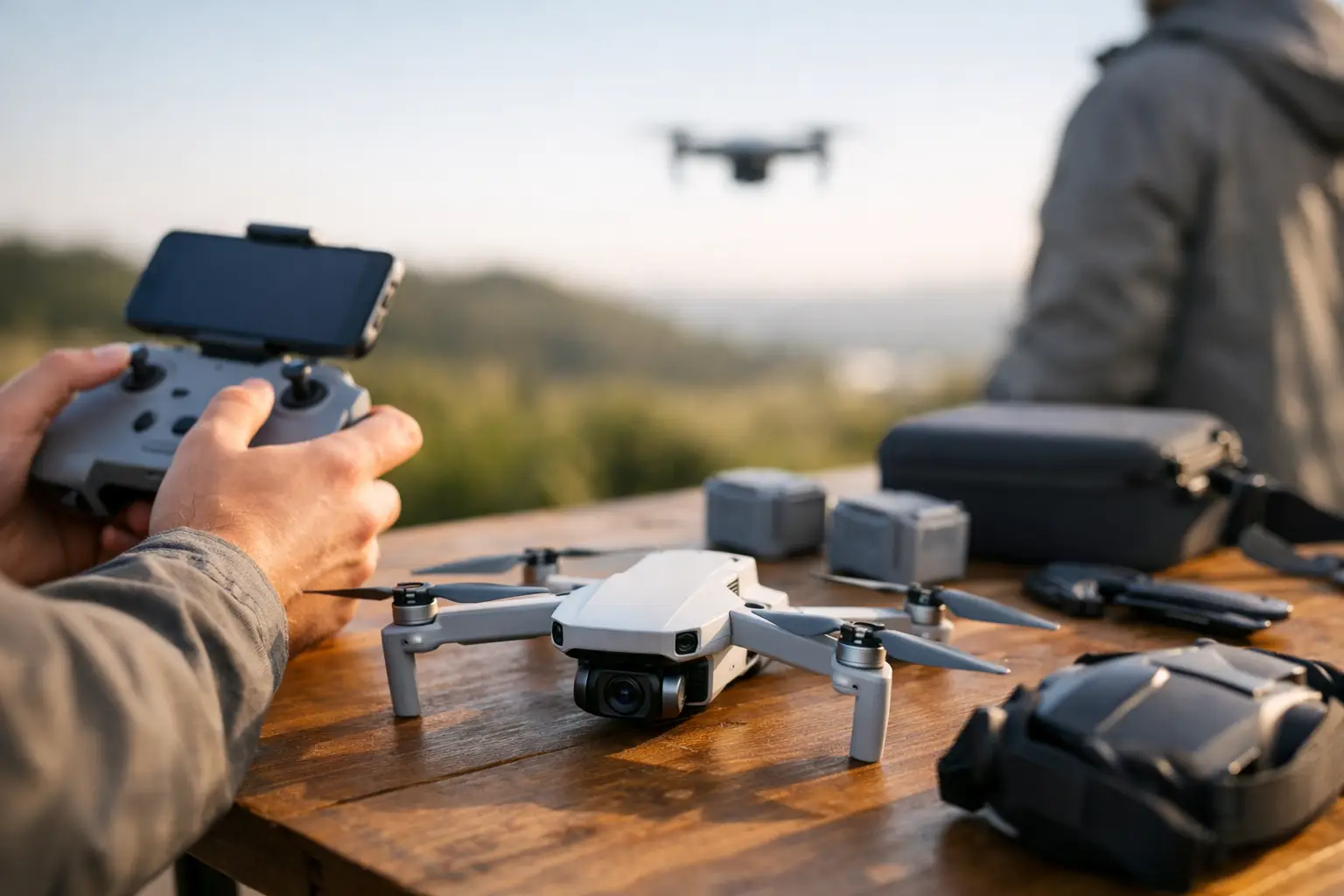
The first drone is often chosen with the wrong priority — by maximum flight distance, 4K printed on the box, or an impressive рекламotional video. In practice, the question of how to choose a drone for a beginner is much simpler and at the same time more demanding: you need to find a model that will be easy to learn to use safely, not just technically capable of taking off.
In brief
- Choose a beginner drone based on stability, easy-to-understand controls, and safety features, not just camera resolution.
- Plan your budget as a package: drone + extra batteries + bag/transport + spare propellers.
- A mid-range model with a mechanical gimbal and good GPS is often a better learning option than a cheap toy drone or an overly expensive pro model.
- Consider renting if you need a drone for only one project or to test before buying.
- Check how simple the manufacturer's app is and how reliable the automatic return and positioning features are.
What to choose for different tasks
| Task | Solution | Why |
|---|---|---|
| Beginner who wants to learn to fly | Mid-range drone with responsive controls, GPS, and automatic stabilization | Stability and precise control make learning easier, while GPS/AT functions help avoid small mistakes. |
| Traveler who values portability | Compact foldable drone with sufficient stabilization and an extra battery set | Foldable design is convenient for carrying, but very light models may be more sensitive to wind. |
| Content creator for video material | Model with a mechanical gimbal and a stable camera; extra batteries and a bag for equipment | The stability of a mechanical gimbal improves framing quality more than just high resolution. |
| One project / short-term use | Consider renting before buying | Rental lets you test the class and functionality without a long-term investment, so you can understand your real needs. |
Frequently asked questions
Does a beginner need a drone with a 4K camera?
4K is not necessary for a beginner. More important than resolution are stabilization, the sensor, and consistent exposure control, because they directly affect the final video quality.
How many batteries should I buy at the start?
One battery is usually not enough for learning, because the runtimes stated by manufacturers are under ideal conditions and real flight time will be shorter. At least one extra battery is recommended to make learning sessions longer.
Are obstacle sensors mandatory for a beginner?
Not necessarily, but they can be useful because they help reduce risk when flying in a new environment. However, sensors do not replace caution, and in models with sensors, their effectiveness in different directions often needs to be evaluated.
Is it better to buy or rent a drone if I'm not sure?
If the need is one-time or short-term, renting can help you test the features of the required class. If you plan to fly and practice regularly, a personal drone usually provides a more convenient and consistent experience.
What accessories are most essential at the beginning?
Initially, the most important items are extra batteries, spare propellers, and a suitable bag or protection for transport. These small things often improve convenience and reduce interruptions during training.
Useful links
- bags and cases - Bag and transport solutions for drones and accessories
- rental - Opportunity to try a drone short-term before buying
- cameras - Additional information about camera selection if video or photo quality is the priority
For a beginner, the most important thing is not record-high speed or professional filming capabilities. The most important thing is stability, predictable control, an understandable app, safety features, and costs that do not make you regret the purchase after the first inaccurate maneuver. That is why it is worth looking at drone selection not as a comparison of one specification, but as a whole — what the drone will be used for, where it will be used, and how quickly the user wants to move from the first flight to intentional filming.
How to choose a drone for a beginner by use case
Before looking at models, you need to understand the main task. If the drone is intended for leisure and first-time experience, the requirements will be one thing. If the goal is to create quality video for social networks, real estate reviews, or travel content, the priorities will be different.
Beginners often make the mistake of buying an overly simple toy-class drone, thinking it will be a safer start. In reality, very cheap models often fly unstably, have poor GPS accuracy or none at all, and control becomes more difficult precisely when the user should be learning the basics. That is why a beginner model should be easy to use, but not technically primitive.
On the other hand, an overly expensive professional drone is not always the smartest choice for a first purchase. It will offer higher image quality and more settings, but it also increases the risk of costs, requires more knowledge, and does not always help you learn the basic principles faster. If the main task is to learn to fly and understand the workflow, a mid-range model with good stabilization is often the more logical choice.
The most important parameters for a first drone
Specification tables can seem too similar, but some things are essential for a beginner.
Flight stability and GPS
If a drone holds position well in wind and responds accurately to commands, the learning process is much more predictable. GPS, automatic positioning, and return to home are not just conveniences. They are functions that help avoid typical beginner mistakes, such as losing orientation or flying too far away.
This is especially important in Latvian conditions, where even in seemingly calm weather the wind can be more noticeable in open areas than it first appears. A light drone without good stabilization may be convenient for carrying, but not always pleasant for the first training sessions.
Camera quality and stabilization
Many start with the idea that the main thing is 4K. However, in video quality the bigger difference often comes not from resolution, but from stabilization, sensor quality, and camera performance in high-contrast lighting. If the drone films 4K, but the footage is jerky or has poorly controlled exposure, the result will be mediocre.
For a beginner, it is recommended to look for a model with a mechanical gimbal rather than relying only on electronic stabilization. This helps get a smoother image and at the same time makes it easier to control the frame while flying.
Flight time and batteries
The maximum flight time stated by manufacturers is almost always achievable in ideal conditions. In practical use, the real time will be shorter, especially on a windy day or when filming more actively. That is why one battery pack is often not enough for a beginner.
If the budget allows, it is worth thinking not only about the drone itself, but also about additional batteries. This is one of the purchases that truly improves the user experience, because training flights become longer and more productive.
Obstacle sensors and safety features
Obstacle sensors are not mandatory for every user, but they can be very valuable for a beginner. They do not provide complete protection and do not replace attention, but they can help in situations where flying takes place in a new environment or the pilot is overly focused on framing.
A compromise should be taken into account here. Models with more sensors will be more expensive, and in the budget class their performance is not always equally precise in all directions. If you have to choose between better flight stability and partial sensors, stability is often more important.
How to choose a drone for a beginner by budget
The budget determines not only the brand or the camera, but also how long the drone will remain relevant. A too-low price often means a short usage cycle — after a few flights it becomes clear that there is a lack of stability, image quality, or reliability. Then the first purchase effectively becomes an intermediate step rather than a solution.
On the other hand, the first drone does not have to be a top-class model. If the user is still figuring out how often they will fly and what exactly they will film, it makes more sense to choose a balanced option with good handling, a decent camera, and predictable service availability. This is especially important if spare propellers, batteries, or consultation on operation will be needed later.
Practically, the budget should be planned as a package, not a single product. The drone price is only part of the costs. Often you also need to account for additional batteries, a memory card, a bag or protective accessories. If the entire budget is spent only on the drone, everyday use may turn out to be limited.
Which compromises beginners most often underestimate
The most common misconception is the idea that a smaller drone is always better for a beginner. A compact model is convenient for travel and everyday carrying, but it may be more sensitive to wind. So for someone who mostly flies outdoors, the lightest option is not always the most comfortable.
The second common misconception is related to automatic modes. They do help produce visually appealing shots, but they do not replace skills. If the first drone is bought only for automated flights, the user may quickly stop developing and remain dependent on predefined scenarios.
The third point is overestimating image quality compared with control quality. For a first drone, a better user experience and a more stable connection are usually more important than a small gain in specifications. If the drone is easy to control, the video result usually becomes better as well.
Does a beginner need to buy a drone or rent one at first
It depends on the goal. If the drone is needed for one project, a trip, or testing a specific content format, renting can be a rational start. It allows the user to understand whether they really need that particular class, camera, and functionality before making a full purchase decision.
If the plan is to fly regularly, learn, and develop skills long-term, a personal drone will be the more convenient solution. Then the user gets to know their equipment, practices consistently with one control logic, and more quickly starts to anticipate the drone’s behavior in different conditions.
This is where not only product availability matters, but also consultation. In a specialized tech store, such as Master Foto, it is easier for a beginner to compare models not just by advertising promises, but by real usage scenarios.
Practical questions before buying
Before making a choice, it is worth answering a few very specific questions. Will the drone be used more for photo or video? Will flights take place in urban environments, in nature, or while traveling? Is maximum portability more important, or stability in windy conditions? Does the user want a simple result in automatic mode, or do they plan to learn more manual control and deliberate framing?
These questions help quickly filter out unsuitable options. For example, a traveler will need a foldable design and a compact set, while a real estate content creator may care more about camera stability and predictable shot quality. Someone who simply wants to start flying safely will value reliable control and a clear app more.
The most common mistakes when buying a first drone
The most expensive mistake is not buying an expensive model. The most expensive mistake is buying a model you do not want to use. That happens when the drone is too complicated, unstable, or does not match the real task.
Another mistake is ignoring the operational side. Spare propellers, battery availability, charging convenience, and transport seem secondary until the drone is used regularly. Then it becomes clear that these small things often determine whether the equipment is used every week or left on a shelf.
It is also worth avoiding choosing based only on one video comparison or one popular opinion. In the drone market, a good model for one user can be a bad fit for another. That is why comparisons should be based on your own scenario, not just universal top lists.
If the drone is the first one, the safest approach is to choose a model that forgives mistakes, provides a solid foundation for learning, and does not limit development after a few flights. A good beginner drone is not the one with the most features. A good beginner drone is the one the user wants to fly again the very next day.