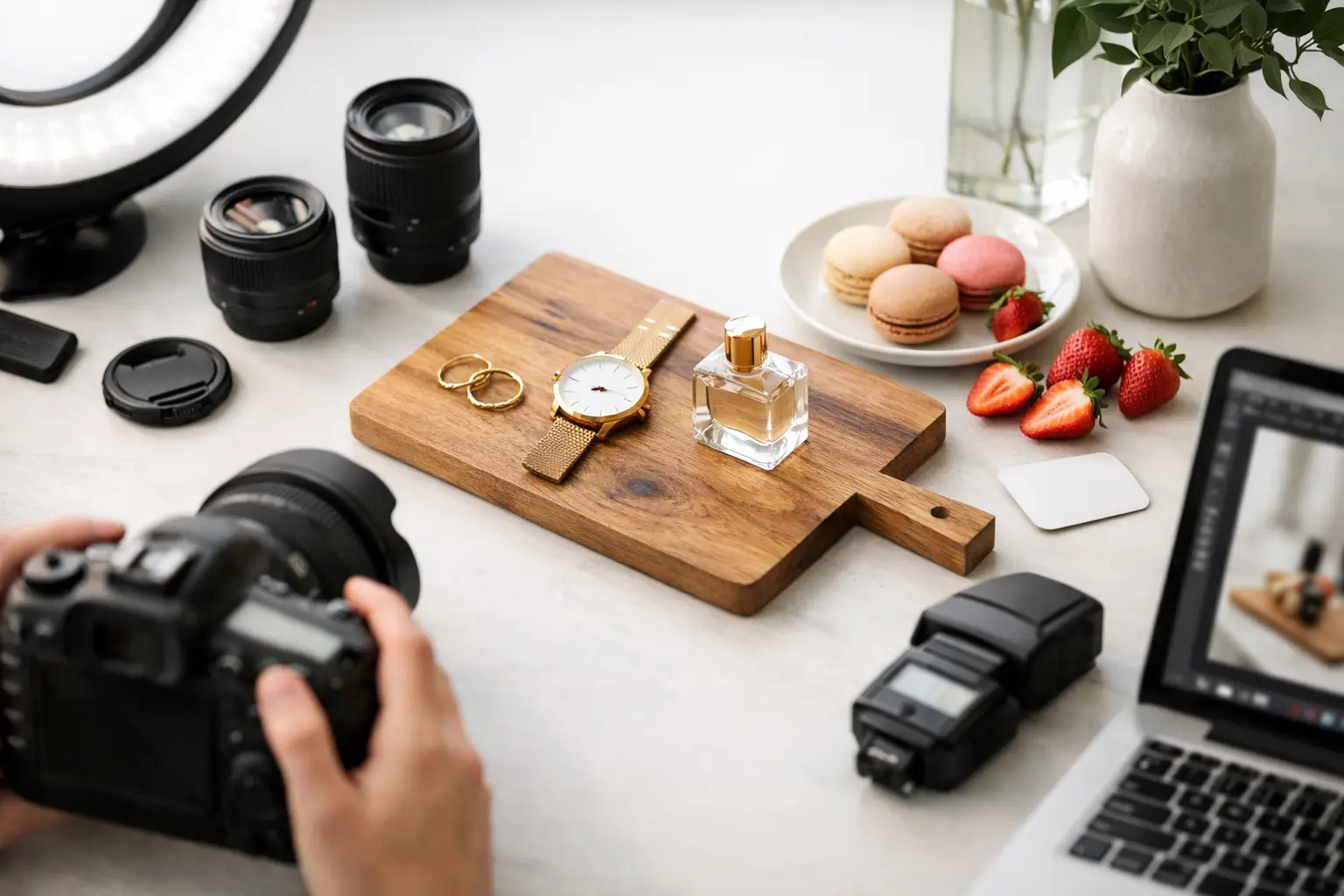
A product shot can be technically correct and still sell nothing. Often the problem is not the lighting or background, but the lens chosen for product photography. The lens determines perspective, edge distortion, background rendering, and how accurately the item will look on the customer’s screen.
In brief
- The lens determines perspective, edge distortion, and detail sharpness — the right choice improves how the product is perceived in an e-commerce store.
- Standard/short telephoto lenses (e.g., 50 mm, 85 mm, 90–100 mm macro) are most often the practical choice for product shots.
- Macro lenses provide high magnification and sharpness for details, but they also reveal dust and require more preparation.
- Apertures are more often set to f/8–f/16 to ensure sufficient depth of field across the whole product.
- If you need flexibility or for rare use cases, choose a high-quality zoom or test the lens through rental before buying.
What to choose for different tasks
| Task | Solution | Why |
|---|---|---|
| Small items on a white background (cosmetics, accessories) | 50 mm or 85 mm fixed lens or 90–100 mm macro lens | These focal lengths preserve proportions, provide good detail reproduction, and minimize distortion on a white background. |
| Very small details (jewelry, engravings, textures) | 90–105 mm macro lens (focus stacking, if needed) | Macro offers high magnification and excellent sharpness needed to show materials and engravings. |
| Large objects and interiors (home appliances, furniture) | 35 mm or 50 mm depending on room size, carefully avoiding an overly wide angle | A wider view shows context, but you must watch out for perspective distortion; choose a focal length that keeps shapes from being distorted. |
| Fast e-commerce photography with items of different sizes | High-quality standard zoom or a rental lens for the project period | Zoom improves workflow fluidity and reduces time between shots; rental lets you try specialized lenses without a long-term investment. |
| Advertising / premium brand shots (life-style, close-ups) | Higher-end fixed telephoto (85 mm or a high-quality zoom) and a wider aperture if background separation is needed | Quality optics deliver better contrast, less aberration, and a more appealing perspective for a premium visual style. |
| Product photography in a studio with a tripod and flashes | Optically corrected fixed lens, tripod, and fixed aperture f/8–f/16 | The tripod stabilizes the composition, while a medium aperture provides sharpness across the entire object; optical correction reduces post-processing time. |
Frequently asked questions
What focal length is most suitable for product photography?
A universal starting point is 50 mm full-frame equivalent, which gives a neutral perspective. Depending on the object size, 85 mm or 90–100 mm macro is often used for details, and 35 mm for larger or contextual shots.
Is a macro lens necessary for all close-ups?
Not necessarily — macro is especially useful when you need high magnification and maximum sharpness in details. However, macro also reveals surface imperfections and requires more careful preparation and more frequent focus stacking.
What aperture range is usually used for studio product photography?
In practice, f/8–f/16 is most often used because it provides sufficient depth of field across the entire product. The choice depends on the product size, sensor format, and the required level of detail.
Is a fixed lens always better than a zoom?
A fixed lens usually offers better optical performance and sharpness, especially for a similar price. However, a high-quality zoom provides practical flexibility during one session, which can be beneficial in e-commerce and for workflow speed.
How can perspective distortion be reduced in a product shot?
Choose a longer focal length and increase the working distance from the object to reduce distortion. If you need to use a wider angle, avoid shooting too close and center the product straight on.
Do you always need to buy the most expensive lens for professional product photography?
Not necessarily — the most important thing is to choose a lens according to the final use. If the product is a regular part of your work, investing in better optics pays off; for occasional needs, rental or a universal solution may be more sensible.
Useful links
- Objektīvi un aksesuāri — rental - Rental lets you test specific lenses before buying or use specialized optics only for a project.
- Objektīvi - The category page helps find suitable fixed and macro lenses for product photography.
- Statīvi - A tripod is essential for stable composition and precise focus control in product shots.
- Foto foni - A properly chosen background makes post-processing easier and ensures clean product presentation for the catalog.
If you are shooting for e-commerce, a catalog, or a social media campaign, lens choice affects not only image quality but also the perception of the product itself. Too wide an angle can distort the shape. Too narrow can make work difficult in a small studio. That is why there is no single universally best option - there is only the most suitable one for a specific task.
Why the lens in product photography is so important
In product photography, the buyer often makes a decision based on details. Material texture, edges, proportions, label legibility, and color fidelity are practically important elements. A camera alone does not solve this. If the optics create visible geometric distortion or cannot provide sufficient sharpness across the frame, even in good lighting the result will be a compromise.
This is especially true for items with straight lines - cosmetics packaging, electronics, watches, glasses, interior products. In such cases, control of perspective is more important than a dramatic background or very pronounced blur. Meanwhile, for jewelry, handmade items, or premium-segment products, high detail and precise micro-contrast are often required.
What focal length is suitable for product photography
In practice, the safest choice is often a standard or short telephoto lens. For a full-frame camera, these are usually around 50 mm, 85 mm, or 100 mm. On an APS-C camera, a similar view would be roughly in the 35 mm, 56 mm, or 60 mm range. These focal lengths provide natural perspective and help avoid shape distortion.
50 mm is a good starting point for universal product photography. It works for packaging, small objects, and situations where the studio space is not very large. It lets you get a neutral rendering without moving too far from the subject.
85 mm often gives an even cleaner perspective and a visually more pleasing separation of the product from the background. It is especially useful for advertising shots where a premium look matters. The drawback is working distance - in a small room, space may be insufficient.
90 mm, 100 mm, or 105 mm macro lenses are a very strong solution when photographing small objects, details, or textures. They allow high magnification and high sharpness. If you regularly photograph jewelry, cosmetics, watches, or technical details, this is often the most practical investment.
Wider lenses, such as 24 mm or 35 mm, are not automatically wrong, but they must be used carefully. They can be useful for larger products, interior elements, or lifestyle shots where the environment needs to be shown. But for a classic catalog shot, they tend to create perspective that makes the product visually inaccurate.
Prime or zoom lens
This is one of the most common questions. A prime lens usually offers a simpler optical design, higher sharpness, and often a better price-to-quality ratio. In product photography, where the camera often stands on a tripod and the composition is precisely adjusted, a prime lens is a very logical choice.
A zoom lens, on the other hand, offers flexibility. If a session requires photographing different-sized objects or quickly changing framing, a good standard zoom can save time. It is especially useful for companies that work with a wide range of products and where workflow matters.
Here you need to look at the quality level. A cheap all-purpose zoom may be enough for simple web images, but for catalogs, print, or premium brand visual communication, it is usually more advantageous to use a high-quality prime or a higher-end zoom.
When a macro lens is needed for product photography
If the product needs to be shown large in the frame, a regular lens will quickly reach its limits. A macro lens for product photography makes it possible to focus very close and preserve the detail that is essential for textures, engravings, fabrics, cosmetic packaging surfaces, and other fine nuances.
It is important to understand that a macro lens is not only for very small objects. It is often simply an optically precise tool with excellent sharpness and minimal distortion. That is why it is also chosen when medium-sized products must be photographed with high quality requirements.
At the same time, macro optics reveal all imperfections - dust, scratches, fingerprints, micro-defects in the packaging. This means more time must be spent on preparation and post-processing. If the goal is to quickly photograph a large volume of products for an online store, macro is not always the most efficient solution for every shot.
Aperture, depth of field, and the real working mode
In product photography, a very wide aperture is not always the top priority. In portraits, f/1.8 or f/1.4 can be a big advantage, but in a product shot, you often need the entire item to be sharp. That is why in practice you often work in the f/8 to f/16 range, depending on the product size, shooting angle, and sensor format.
This means that when choosing a lens, optical correctness, sharpness at medium apertures, and stable performance across the frame are often more important than an extremely wide aperture. If you work in a studio with strobes or constant light, light output becomes less critical than, for example, in reportage.
There are also situations where one frame is not enough. When shooting very close up, depth of field can be so shallow that focus stacking is needed. Then the lens must be able to work accurately and predictably, especially in manual focus.
What to pay attention to when buying a lens for product photography
The first criterion is distortion control. The straighter the lens renders lines and edges, the less time you will need for corrections. The second is sharpness in the center and at the edges. In a product catalog, the center of the frame is not the only important part, because the product often occupies a large portion of the composition.
The third is minimum focusing distance. If the lens cannot get close enough, you lose flexibility. The fourth is working convenience - autofocus accuracy, the quality of the manual focus ring, compatibility with your camera system, and overall build quality.
If you photograph only occasionally or want to test a specific focal length before buying, a rental option is a very rational step. It is especially useful if you need to shoot a single campaign, a seasonal collection, or a specific product type that does not require a specialized lens in daily work. This approach carries less selection risk and makes it easier to understand exactly what works for your workflow.
Typical scenarios and the most suitable optics
For small products on a white background, such as cosmetics, accessories, or electronics accessories, 50 mm, 85 mm, or 90-100 mm macro lenses work most safely. They help maintain correct proportions and accurately render surfaces.
For larger items, such as household appliances, chairs, or decor, you often need to find a balance between space and perspective. Here 35 mm or 50 mm can be useful, as long as the camera is not placed too close. The closer you get with a wider lens, the greater the risk of distortion.
For lifestyle product shots, where the product is shown in its usage environment, the choice is more flexible. Wider optics can be used if they help show context. But you should still make sure the product itself does not lose its shape and does not look different from reality.
Is a more expensive lens always better
Not always. If the final use is small images for an online store, the difference between a mid-range and high-end lens will not always be decisive. But if you work with brand communication, print materials, close-ups, or the premium product segment, optical quality becomes clearly visible.
More expensive lenses usually offer better edge sharpness, less chromatic aberration, more accurate contrast, and more stable repeatability of results. That does not mean you should start with the most expensive model. It means the lens should be chosen according to the task, not only by the technical specifications list.
The practical approach is this: if product photography is a regular part of your work, the lens is one of the most important investments. If it is an occasional need, it may be more sensible to use rental or start with one universal, optically correct solution and only then expand the kit.
In product photography, good results rarely come from a single component. Light, tripod, background, and post-processing are important, but the lens sets the foundation on which everything else is built. If the choice is precise, the work becomes predictable, the images are more consistent, and the product in the frame looks exactly as it should in the customer’s eyes.