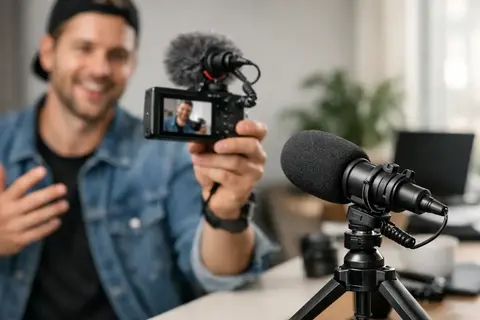
Viewers sometimes forgive poor visuals, but bad sound - almost never. That is exactly why the question of how to choose a microphone for vlogging usually becomes relevant very quickly - often already after the first videos, when the built-in camera or phone microphone starts limiting the result. If the voice sounds distant, there is echo in the room, or wind and street noise dominate in the background, even good content loses its sense of quality.
A microphone suitable for vlogging is not one universal model for all scenarios. The choice depends on what you are filming, how far the microphone will be from the speaker, what device you are recording with, and how much control you want over the sound. In practice, this means that before comparing models, you should evaluate the usage situation.
How to choose a microphone for vlogging based on the type of filming
If you record vlogs at home, in a studio, or in another controlled environment, the priority is usually a clear and full voice. In such a situation, directional microphones or USB microphones work well if the filming format is more like a talking head at a desk. On the other hand, if you move around a lot, film outdoors, or record yourself handheld, a wireless clip-on microphone will be much more practical.
The type of shot is also important. If the camera is close to the face, a small on-camera directional microphone can deliver a sufficiently good result. If the camera is farther away, sound from a microphone mounted on top of the camera usually becomes thinner and more spacious. In that case, a clip-on microphone will be a safer solution because it is closer to the mouth.
If you create travel, event, or everyday vlogs where the environment and movement constantly change, the most important thing is not only sound quality in laboratory conditions. Setup speed, battery life, reception stability, and how easily the system connects to a phone or camera also matter.
Main microphone types for vlogging
Clip-on microphone
A clip-on, or lavalier, microphone is one of the most practical solutions for vlogging because it is close to the sound source. It helps achieve more consistent sound even when the camera is held at arm’s length, placed on a tripod, or positioned farther from the speaker. This type is especially suitable for interviews, talking to the camera, and moving shots.
Here, it is important to distinguish between wired and wireless options. A wired solution is usually cheaper and simpler, but it can interfere with movement. A wireless system gives more freedom, but costs more and requires keeping an eye on charging, connection, and receiver compatibility with the recording device.
Directional microphone on the camera
A directional, or shotgun-type, microphone is a good solution if you want to improve the quality of the built-in microphone without complicated setup. It focuses more on the sound in front of the camera and picks up less of the surroundings than the built-in microphone. Vloggers often choose it when filming with a camera and wanting a compact setup.
However, there is an important limitation - such a microphone is still where the camera is, not where the mouth is. If you film a wide shot or the camera is far away, even a good directional microphone cannot fully compensate for the distance. In small rooms with echo, it may pick up more of the room than you would like.
Wireless compact microphone for phone and camera
Today, small wireless microphones with a transmitter and receiver designed for both phones and cameras are very popular. They are especially suitable for content creators who want quick setup and the ability to film alone. Many models allow recording one or two speakers, which is useful for interviews or duets.
Here, it is important to pay attention not only to convenience, but also to audio control. Some systems have built-in noise reduction, a safety track, internal recording, or the ability to adjust the level. These are not just extra bonuses - they can save the material if the shoot happens in one take.
USB microphone for a stationary format
If your vlog content consists mainly of recordings at a computer, product demonstrations, streaming, or educational videos from a workstation, a USB microphone can be a logical choice. It is not a classic solution for dynamic vlogging outdoors, but in a controlled environment it can provide a very convincing voice with relatively simple setup.
How to choose a microphone for vlogging based on the device
Before looking at the brand or price, you should check the connection. Not all microphones work equally well with a camera, phone, or computer. In practice, compatibility often determines whether a particular model will be convenient for everyday use.
If you film with a camera, make sure it has a microphone input and, if needed, a headphone output for sound monitoring. If you use a smartphone, the connection type matters - USB-C, Lightning, or a 3.5 mm adapter. Some microphones are designed for only one platform, while others come with multiple adapters or receivers. For a computer, USB connection is usually the simplest.
It is also worth looking at power supply. Some microphones run from the camera connection, while others require a separate battery or charging. If you film longer sessions, this aspect becomes very practical rather than theoretical.
Sound quality is determined by more than just the microphone
A common mistake is to evaluate a microphone separately from the recording conditions. Even an expensive model will not deliver the expected result if the speaker is too far away, the room has hard reflective surfaces, or there is strong wind outside. Vlogging-friendly sound often starts with proper placement, not with the highest price on the shelf.
That is why you should look at the whole setup. If you film outdoors, wind protection is not just an optional accessory. If you record indoors, sometimes moving the microphone closer helps more than switching to a more expensive model. If you speak in a quieter tone, a microphone with a clean signal and good preamp compatibility with the camera or receiver will be useful.
The directional pattern is also important. An omnidirectional clip-on microphone will capture the voice naturally, but also more of the surrounding environment. A directional microphone will focus better on the speaker, but will become more sensitive to placement. There is no single correct option - you need to evaluate the specific filming style.
What to check before buying
In the specifications, it is worth looking at more than just the frequency range. For vlogging, much more practical parameters are the connection, included accessories, capsule type, sensitivity, ability to control the level, overload protection, and physical form factor.
If the microphone is intended for a camera on a cold shoe mount, you should also assess the size and weight. A microphone that is too large on a compact camera or gimbal system can be inconvenient. If you choose a wireless kit, it is important to understand whether the receiver can be used without additional adapters and whether it will interfere with everyday shooting.
It is also very useful to think one step ahead. Maybe today you film alone, but in a month you will want to record conversations between two people. Maybe right now you use a phone, but soon you will switch to a camera. In such situations, a more flexible solution often pays off better than the cheapest entry-level option.
How much to invest in a vlogging microphone
The budget should be considered together with the content goal. If vlogging is a hobby and videos are made irregularly, a simple, reliable microphone that is compatible with your device and significantly improves sound compared to the built-in microphone is enough. If the content is part of brand communication, client projects, or regular publishing, audio quality becomes a matter of reputation.
A more expensive model usually provides not only better sound, but also a sturdier body, less interference, a wider package, and more reliable everyday use. At the same time, you do not always need to buy the most complex system right away. For many creators, the smartest step is to start with a solution that fits today’s needs but does not limit the next stage of growth.
If you are still unsure about the most suitable option, it is worth evaluating audio equipment not only by description, but by the actual filming scenario. This is where specialized consultation or the ability to compare different categories in one place, as offered by Master Foto, can help.
A good vlogging microphone is not the one with the loudest marketing description. A good microphone is the one you can connect quickly, use predictably, and trust with your content every time you press the record button.