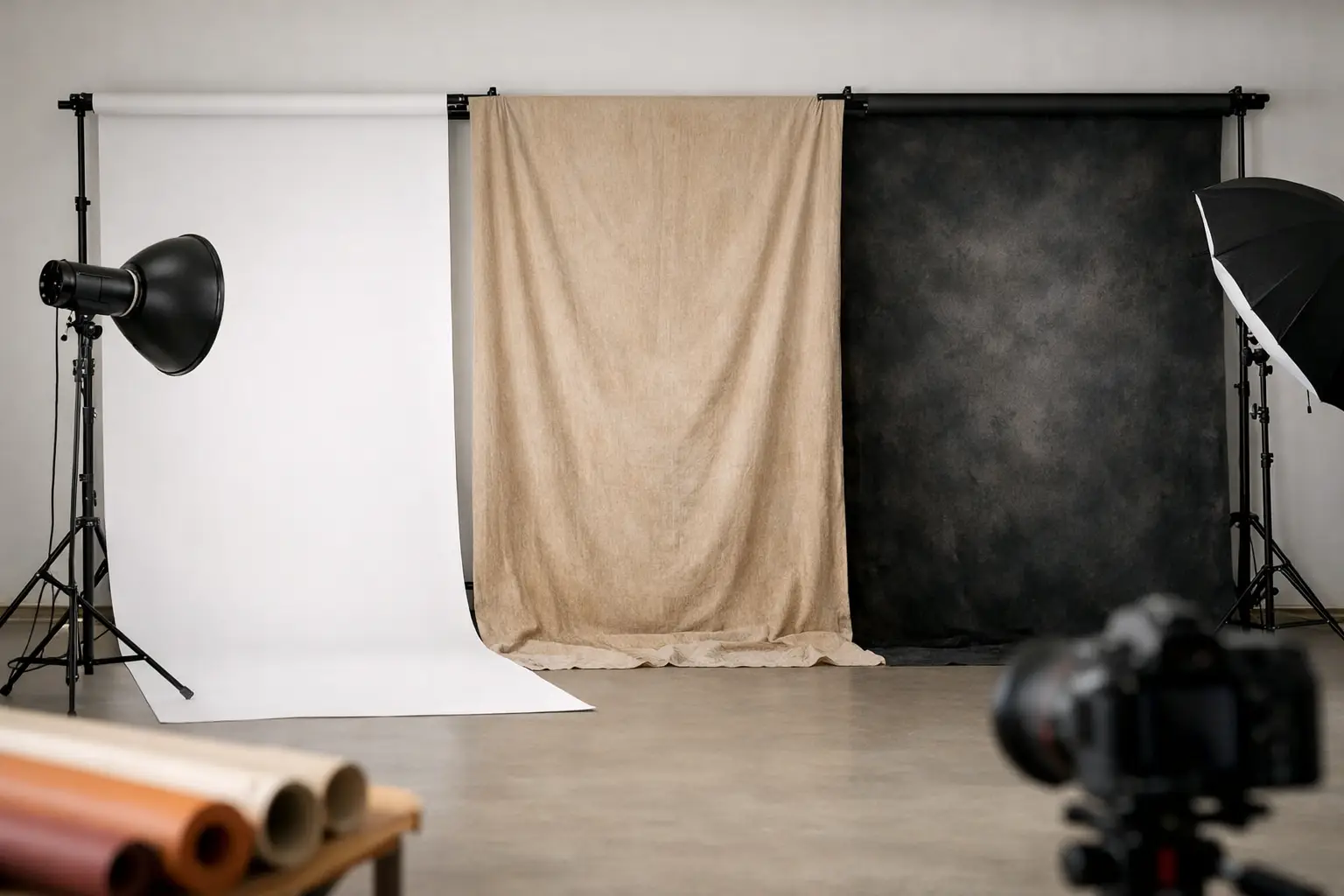
When everything in the frame is in order, but the image still looks cheap, the problem is often not the camera or the light. Very often it is the background. That is why the question of how to choose a studio backdrop is not just about taste - it directly affects light control, color rendering, the amount of post-processing, and how quickly you can even start working.
In brief
- Choose the background based on the task — portraits, products, and video require different material and size priorities.
- Paper gives a smooth, neutral surface; fabric is truly portable but can wrinkle; vinyl is durable and easy to clean.
- Color affects lighting setup — gray is versatile, white needs precise illumination, and black requires control over reflections.
- Make sure there is enough width and distance between the subject and the background to avoid shadows and incorrect framing.
- Choose a rigid mounting system or rental if you need a large, heavy, or infrequently used background.
What to choose for different tasks
| Task | Solution | Why |
|---|---|---|
| Portraits (head-and-shoulders framing) | Neutral paper or high-quality fabric background with an even tone and sufficient width | Paper provides a smooth, texture-free surface, while fabric offers mobility; the main thing is tonal consistency and the ability to control light. |
| Full-body portraits and group shots | A wider roll or vinyl background and a stable support system | You usually need both width and distance so the background does not end at the feet and to avoid shadows or creases on the floor |
| Product photography (e-commerce) | Smooth paper or matte vinyl background and an easy-to-clean surface | A clean, predictable texture makes post-processing and accurate color reproduction easier; vinyl is practical when the product is placed on the surface |
| Video interviews and moving content | Tightly stretched fabric background or carefully lit paper with a stable stand system | Video reveals wrinkles and dirt; fabric provides portability, but when stretched it keeps a smooth appearance in frame |
| Chroma key / background replacement | A special green or blue background that is evenly lit and free of wrinkles | Uneven tone, shadows, and wrinkles make cutout work harder; quality has a major impact on the editing result |
Frequently asked questions
Which material should I choose if I move the studio often?
Fabric backgrounds are usually more convenient for transport because they fold up and do not take much space. If absolute smoothness is needed, you can combine fabric with proper stretching or use paper rolls that are set up in the studio.
How can I reduce wrinkles in a fabric background?
Use a tensioning system or a hot iron/steamer before setup to smooth the surface. Another option is to stretch the fabric on a frame or choose a material with a slight texture that helps mask wrinkles.
How wide should the background area be for portraits and product photos?
For a single person in a head-and-shoulders frame, a narrower background is usually enough, but a full-body portrait or a two-person shot requires a significantly wider roll or vinyl solution. You should also account for the distance from the subject to the background to avoid shadows.
When is it better to rent a background system instead of buying?
Rental is practical if you need large sizes, specific colors, or if you use the background rarely and do not want to invest right away. It lets you test materials and sizes before buying, especially for projects with changing requirements.
How do I choose between a white, gray, and black background?
White is universal for catalogs but requires precise lighting, gray is flexible and easier to adapt depending on the lighting, while black creates a deep, dramatic effect if there are no unwanted reflections in the room. The choice should be based on the goal of the work and the available light control.
How can I reduce reflections on a vinyl background?
Choose a matte vinyl material and think through the lighting angles — avoid creating mirror-like effects with direct, strong light. If reflections persist, polarizing filters or softer lighting can help.
Useful links
- Foto foni - A category with paper, fabric, and vinyl backgrounds suitable for portrait and product work
- Foto studijas aksesuāri - Mounts, stands, and accessories needed for stretching and securing backgrounds
- Foni, Turētāji, Atstarotāji - Rental options for larger or less frequently used backgrounds and holder systems
The right backdrop helps separate the subject, reduces visual noise, and makes shooting more predictable. The wrong one creates reflections, wrinkles, uneven tone, or simply limits framing. If you photograph portraits, products, video interviews, or social media content, backdrop selection should be seen as a technical decision, not a decorative detail.
How to choose a studio backdrop based on the task
The first step is to define exactly what you will be filming or photographing. The solution needed for a portrait often differs from what works for e-commerce products or video recording. If the backdrop is chosen too generically, compromises then begin with lighting, framing, and editing.
In portrait work, the most important factors are tonal consistency, width, and how well the backdrop behaves under different lighting setups. If you photograph full-body portraits, a narrow backdrop or a short piece of fabric that ends behind the model’s feet will not be enough. For headshots, a more compact solution can be used, as long as the material does not form wrinkles or catch unwanted reflections.
In product photography, the priority is a clean surface and predictable texture. For smaller items, a paper backdrop or a smooth vinyl surface is often enough, but for larger objects you must account for greater width, durability, and easy maintenance. In video, it is especially important how the backdrop looks in motion and in a wider frame. What looks acceptable in a photo often reveals wrinkles, a dirty edge, or uneven lighting in video.
Material determines more than it first seems
In choosing a studio backdrop, material is one of the key decisions. It affects not only the look of the image, but also storage, transport, and operating costs.
Paper backdrop
Paper backdrops are a classic choice for portrait, fashion, and product work. Their main advantage is a smooth, uniform surface without texture. This makes it possible to get a clean background that is easy to light and simpler to process in post-production. Paper works especially well in situations where a neutral and professional result is required.
However, paper is not the most durable option. It is easily damaged by shoes, moisture, and frequent movement. If you photograph full-body portraits or products placed on the floor, you should expect to regularly cut off the lower part. That is normal, but it is worth planning for this cost and consumption aspect from the start.
Fabric backdrop
Fabric backdrops are popular with content creators, mobile teams, and those who regularly take backdrops on location. They fold up more compactly, are convenient to transport, and are often reusable for longer than paper. In addition, fabric can be a good solution when a more textured or visually warmer backdrop is needed.
The downside is wrinkles. If a fabric backdrop is not stored or stretched properly, wrinkles become visible in the frame and require extra time for ironing or retouching. In some cases a slight texture is desirable, but for commercial product photography or a clean corporate portrait it can be distracting.
Vinyl or PVC backdrop
Vinyl and PVC backdrops are durable, easy to clean, and well suited for products, food photography, or situations where the surface needs to withstand dirt. They can be wiped clean, and they usually last longer in intensive everyday use. This is a practical solution for studios where the backdrop is used frequently.
However, keep in mind the weight and reflections. Cheaper or overly glossy vinyl materials can create unwanted reflections under improper light. Therefore, this option works well only if light control is well thought out and the material surface matches the specific task.
Color is not just aesthetics
When choosing a backdrop, color should be evaluated based on what you want to achieve in the frame, not just personal preference. A white backdrop is versatile and widely used for catalogs, business portraits, and video content, but it requires precise lighting. If the backdrop is not lit evenly enough, white quickly turns gray. If you light it too aggressively, excessive light reflection appears on the subject’s edges.
A gray backdrop is one of the safest solutions. It is flexible because, depending on the light, it can appear darker or lighter. That is why many studios use it as a default option. A black backdrop works well for dramatic portraits and product shoots, but in a space with uncontrolled reflected light it does not always remain truly deep in tone.
A green or blue backdrop is a technical solution for compositing and keying work. If you are filming video and plan to replace the background in editing, such a choice is justified. But quality matters even more here - uneven tone, wrinkles, and shadows make cutouts harder.
Size and space - the most common beginner mistake
One of the most common reasons a backdrop does not work in practice is choosing the wrong size. Before buying or renting, you need to understand not only what you will shoot, but also how much space is available in the studio or home. Backdrop width without sufficient distance to the subject and lights often does not solve the problem.
If you are photographing one person to the waist, a relatively compact backdrop may be enough. Full-body portraits, shots of two people, or video with movement require a wider and also more deeply placed solution. Keep in mind that a backdrop is not just a wall behind the subject. It needs space for stretching, lighting, and distance to avoid shadows.
In small rooms, roll or foldable solutions often work better, as they can be set up and taken down quickly. If the space is permanently intended for studio work, a more stationary system with multiple backdrops is more convenient. This is where not only the backdrop itself matters, but also mounts and stands.
How to choose a studio backdrop together with a mounting system
A good backdrop without a suitable mounting system creates unnecessary complications. If the backdrop is wide or heavy, it needs a stable system. A lightweight stand kit may be enough for mobile use, but for intensive studio work it will not always be the most convenient solution.
For paper rolls and wider vinyl backdrops, smooth unrolling and secure fixation are especially important. If the system is unstable, the backdrop may twist, sag, or create unwanted lines in the frame. For fabric backdrops, it is important that they can be stretched sufficiently; otherwise wrinkles will be visible even under soft light.
If the backdrop is planned for occasional use or a specific project, rental is often the more practical option than an immediate purchase. This is especially true for larger sizes, specific colors, or testing situations when you are not yet sure which material best suits your working style. In such cases, expert consultation is also useful, because a theoretically suitable solution is not always the most convenient one in practice.
When to choose a universal solution and when a specialized one
If you work on different projects, it is most practical to start with one or two universal backdrops. Usually this means a neutral paper or fabric backdrop in gray, white, or black. Such a basic kit covers most portrait, product, and content-creation tasks.
Specialized backdrops make sense if your work regularly repeats one specific scenario. For example, ongoing product catalog work, video podcasts, chroma key recordings, or children’s photography with easy-to-clean surfaces. Then it is worth choosing the material and format that optimizes that exact process rather than trying to be universal for everything.
In a professional environment, the right choice is often not one perfect backdrop, but a set with clear logic. One for everyday work, one for mobile shoots, and one for specific tasks. If you need to compare options in practice, this approach can be easier to plan together with a specialized equipment partner, such as Master Foto, where both selection and consultative support are available.
The best studio backdrop is not the one that looks impressive in a catalog, but the one that makes your workflow faster, more predictable, and technically cleaner already at the next shoot.