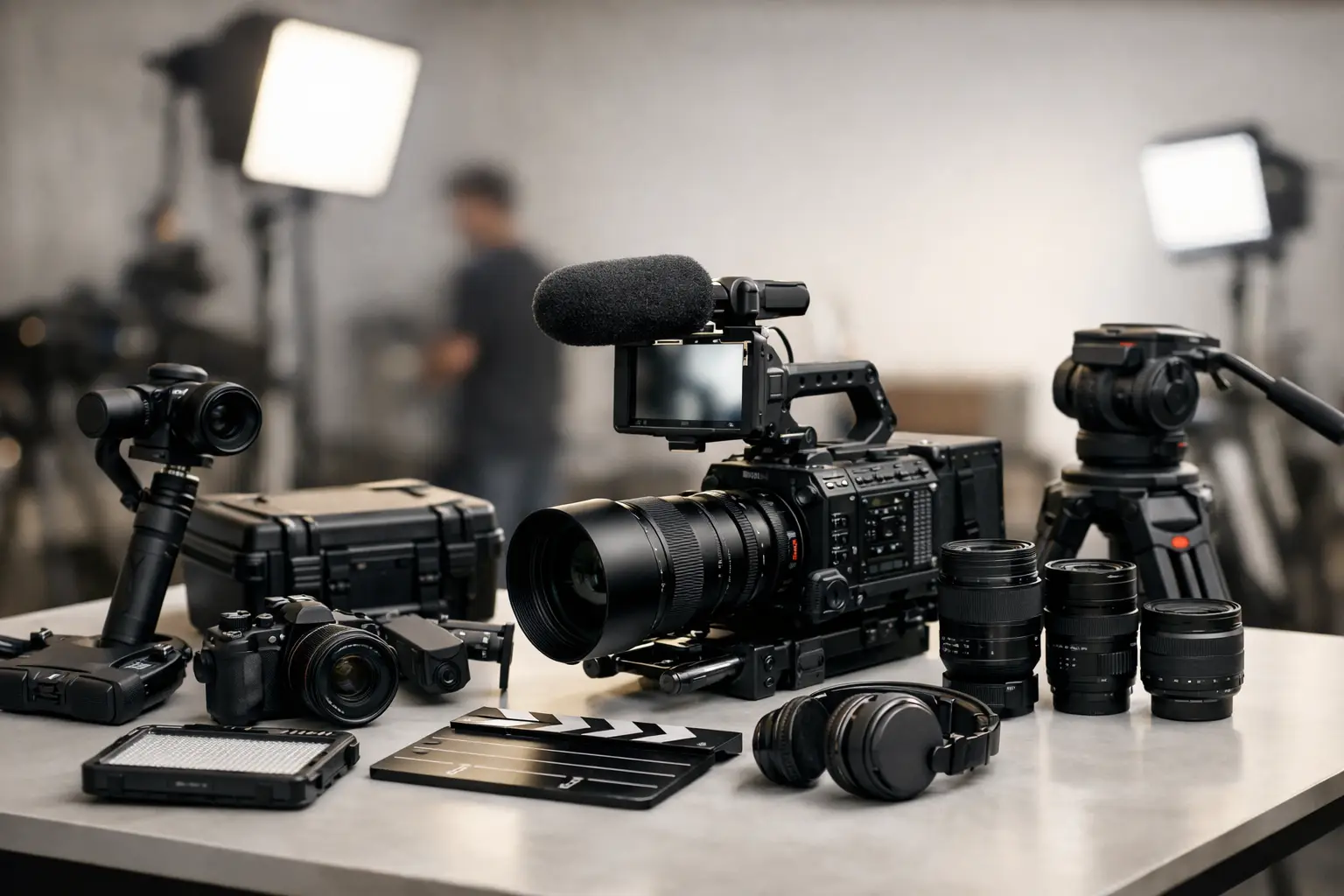
A filming day gets expensive very quickly if, in the first hour, it turns out that the lens does not have the required focal range, the light lacks power, or the sound is recorded with noise. That is why the question of how to rent video equipment for a project is not just about an available camera. It is about the right set, deadlines, compatibility, and risks that can affect the final result.
How to rent video equipment for a project without unnecessary surprises
Video equipment rental is especially logical when the gear is needed for a specific period, a specific task, or a specific shooting day. Not every project makes sense to buy a separate cinema lens, teleprompter, gimbal stabilizer, or a powerful LED light kit. Rental allows you to match the equipment more precisely to the real need, rather than adapting the project to what is on the shelf.
In practice, mistakes usually start not at the time of booking, but earlier - with an insufficiently defined task. If it is not clear exactly what you will be filming, how many people will be on the team, what environment the work will take place in, and what the final format is, choosing equipment becomes a guessing game. As a result, either too much is taken, or that one essential element is missing.
That is why the first step is not to look at models, but to formulate the project’s technical requirements. Only then does it make sense to compare cameras, lenses, audio solutions, and lights.
Start with the shooting scenario, not the camera
If you are filming an interview, the needs will be one thing. If you are creating a commercial clip with moving shots, quite another. For event filming, on the other hand, long operating time, reliable autofocus, sufficient memory, and battery reserve will be important.
Before renting, it is worth answering a few practical questions. Will you be filming indoors or outdoors? Will the light be controlled? Will speech need to be recorded on location? Will the shots be static, handheld, or moving? Is the final material intended for social media, advertising, YouTube format, or television? These factors affect not only the camera choice, but also codecs, lens focal lengths, filters, tripods, and monitoring.
Sometimes the client thinks the main thing is the camera body, but often the decisive factor is optics, light, or sound. A mid-range camera with a suitable lens, proper lighting, and a good microphone will in practice deliver a better result than a more expensive body without the rest of the system.
What equipment set is usually needed
For a simple video project, a camera and one lens are rarely enough. A functional set usually consists of several categories, and each has its own role.
The camera choice determines image quality, recording formats, dynamic range, and ease of use. But the lens affects the character of the frame, compression, low-light performance, and freedom of movement. For interviews, a portrait range is often enough, but for documentary or dynamic situations, a more versatile zoom lens will be more convenient.
Audio equipment should not be left until the last minute. If there is speech in the project, recording quality affects perception no less than the image. Depending on the situation, you may need a wireless microphone, a directional microphone, an external recorder, or headphones for monitoring. If there is no sound engineer on the team, the simpler and more reliable the system, the better.
Lighting is critical both indoors and outdoors. Even in daylight, fill light or light modifiers may be needed. Interview filming often requires at least two or three lighting units, stands, and light modifiers. If the location is small, you need to look not only at power, but also at size and power supply options.
Stabilization is another point that is often underestimated. Depending on the task, you may need a tripod, monopod, gimbal, or shoulder rig. Not every moving shot requires a gimbal, and it will not be the fastest solution for every operator. Sometimes a good video tripod with a fluid head is more practical and safer.
How to rent video equipment for a project according to budget
When planning a budget, it is important to think not about the cheapest equipment, but about the cost per completed task. If a cheaper set prolongs filming, creates post-production problems, or requires additional staff, it is no longer the most economical option.
A good principle is to divide the budget into four parts - image, sound, light, and a safety reserve. A safety reserve means extra batteries, memory cards, cables, mounts, power adapters, and sometimes even a spare body. This is not unnecessary comfort, but protection against downtime.
If the budget is limited, first preserve quality where mistakes are most visible. In interviews, that is usually sound and light. In a dynamic commercial clip, optics and stabilization may matter more. In event filming, the priority is often reliability and continuous work over a longer period.
There are also situations where more expensive equipment is justified only in part. For example, a higher-end camera will be useful if color correction, specific recording formats, or complex lighting are planned. If the final video is intended for quick publication on social media, the biggest gain may not come from a cinema-level camera, but from a fast, reliable, and easy-to-use system.
Check compatibility before confirming the booking
One of the most common problems in rental is not equipment availability, but its mutual compatibility. The camera may be excellent, but the lens does not fit the mount. The microphone may require a different connection. The monitor may have a different power standard. The gimbal may not support the weight of the chosen body and lens.
That is why before booking, the entire set should always be reviewed as a system. Mounts, battery types, media formats, recording duration, power solutions, and transport method are important. If filming takes place outside the studio, special importance should be given to how quickly the equipment can be set up and reconfigured.
If several operators or assistants are involved in the project, it is desirable for the set to be logical and predictable for the whole team. A technically powerful but complicated solution will not always be the best if the work pace is high.
What to check when receiving the equipment
Even if the booking is prepared correctly, at the time of pickup you should not limit yourself to a visual glance at the number of bags. In practice, you need to check whether everything powers on, and whether the set includes chargers, batteries, plates, cables, mounts, and other intended accessories. This is especially important for audio equipment and lights, where one missing adapter can ruin the entire plan.
It is advisable to immediately make sure of the camera settings, memory card readability, lens operation, and microphone signal. If filming is planned in log profile, at a high frame rate, or with external recording, this should be checked not on location, but before departure.
Experienced teams often perform a short test recording with the full chain - image, sound, monitoring, and data storage. It takes a few minutes and saves much more.
The rental period is not just a calendar issue
When planning a rental, you should think not only about the number of filming days. Often it is more justified to take the equipment a little earlier to prepare settings, run tests, and assemble rigs. This is especially true for more complex projects, multi-camera filming, or situations where different team members will use the equipment.
After filming, time may also be needed for safe data copying, equipment organization, and inspection. An overly compressed schedule creates mistakes, haste, and the risk of damaging or incompletely returning the set. In a real working environment, one extra rental day is often cheaper than one ruined shooting shift.
If the project depends on weather, people’s availability, or location approval, flexibility should be built into the deadlines. In such cases, timely communication with the rental partner is especially important.
When you need consultation, not just a booking
If you know the exact model, mount, focal range, and power setup, booking will be quick. But in many projects, it is more effective to first discuss the task and only then assemble the equipment. This reduces the risk of taking unsuitable or unnecessary gear.
Professional consultation is especially useful if you are filming your first commercial project, transitioning from photo to video, planning a live stream, working with a teleprompter, drone, or a more complex lighting system. In such situations, there is no point paying for equipment whose potential you will not be able to use, or even worse - which you will not be able to properly integrate into the rest of the workflow.
In the Latvian market, the advantage is working with a specialized partner who understands cameras, lenses, audio, lights, stabilization, and accessories in one place. That is precisely why the Master Foto rental approach is practical - the client does not have to look for solutions piece by piece in different places if the project can be assembled into one system.
The better the equipment matches the specific task, the less time you will spend on compromises on set. And that is usually the main benefit of properly organized rental.