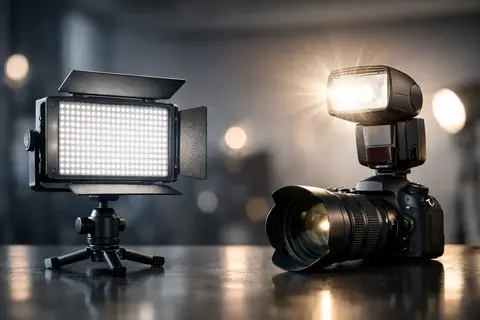
When choosing a light source for your first portrait session, product photography, or regular video work, the question of LED light or flash usually comes up very quickly. And there is no universal right answer, because both solutions do similar work with a different approach. That is precisely why the choice is determined not just by budget, but by the specific task, the working environment, and how much control you want over the result.
In brief
- LED light is a continuous light source — good for video, tests, and precise light positioning.
- Flash provides more power and a short burst — better for freezing motion and working against daylight.
- The choice depends on the task: video → LED, demanding photo tasks and events → flash.
- A practical approach is to combine both systems or try equipment rental before buying.
- Mobility, power supply, and color quality can change the decision regardless of technical data.
What to choose for different tasks
| Task | Solution | Why |
|---|---|---|
| Interviews and talking-head videos | LED light | Continuous light lets you see shadows immediately, balance color temperature, and keep the subject comfortable without repeated tests. |
| Product photography (small, matte objects) | LED light | It is easy to correct reflections and position light in real time, which reduces trial and error. |
| Commercial portraits and outdoors against daylight | Flash | Flash provides higher power and a burst that helps overpower bright background light and achieve lower ISO with a cleaner result. |
| Events, reportage, weddings | On-camera or battery flash | A compact flash offers a lot of power in a small form factor and is easier to move in a dynamic environment. |
| Freezing sports and dynamic motion | Flash | The short flash burst is often more effective than shutter speed for stopping motion and getting sharpness. |
| Video and content creation with a limited crew | LED light (universal kit) + flash later if needed | LED provides immediate visual feedback and versatility; flash can complement photo needs. |
| Testing before purchase or infrequent use | Rental of both LED and flash | Rental lets you compare the impact on workflow in practice and choose the optimal combination without an immediate large purchase. |
Frequently asked questions
Why is LED light better for video filming?
LED light provides continuous illumination, so you can see the result in real time and immediately adjust shadows and reflections. This makes it easier to work on interviews, social media content, and anything that requires continuous lighting.
Does flash always deliver better photo quality?
Flash often provides more power and the ability to work at lower ISO, which can improve image cleanliness. However, it requires a better understanding of synchronization and light control, and it is not always the more convenient solution for small product photography or video tasks.
What should I do if the job requires both photo and video?
The best solution is to think systemically: choose an LED kit as the base for video work and add a flash for photography or short-term power needs. If you are unsure, consider rental to try both approaches in practice.
Can modern LEDs replace flash outdoors in sunlight?
Some modern COB LEDs and panels are very bright, but often still not enough to fully compete with flash power against direct sunlight. If you need a lot of power or are working in strong natural light, flash may provide a better reserve.
What technical aspects should be considered before choosing?
You should evaluate power, color rendering (CRI), power options (battery or mains), mobility, and compatibility with modifiers. In photography, synchronization and flash duration are also important, while in video work continuous light and quiet cooling matter.
Is it easier for a beginner to start with LED or flash?
For beginners, it is often more intuitive to start with LED because the result is visible immediately and there are no synchronization settings to combine. However, if the main goal is commercial photography or events, it pays off faster to learn flash workflows.
Useful links
- Continuous lighting - A category with LED solutions that helps evaluate light power and quality for video needs.
- RENTAL - An option to try LED or flash systems in practice before making a large investment.
LED light or flash - the main difference
The most important difference is simple. LED light is a continuous light source - you see how the light falls on the subject or person before the frame is captured. A flash fires only at the moment of exposure, providing a short but very intense burst of light.
This difference affects almost everything - workflow, exposure control, motion freezing, battery consumption, compatibility with video, and also how easy it is for a beginner to understand the behavior of light. That is why the choice between the two is not just a technical preference. It is a choice of working method.
When LED light is the more logical choice
LED lighting is especially convenient in situations where predictability matters. If you are filming interviews, creating social media content, recording courses, or working with product video, continuous light is the most practical option. You immediately see shadows, reflections, color temperature, and how the light affects the background.
In photography, LED light is also useful when you want a simpler workflow. For example, in food, object, cosmetics, or small product photography, precise light placement is often more important than maximum power. Here, LED allows you to work calmly and without surprises.
Another major advantage is versatility. The same light can be used for both photography and video. This matters for content creators, small teams, and companies that create both photo and video materials in a single day. If the equipment needs to be used for different tasks, LED often reduces complexity.
Where LED light has limitations
The main compromise is power. Although modern LED panels and COB-type lights have become significantly stronger, they still do not always compete with flash in situations that require very bright light or working against strong daylight. This is especially true for portraits outdoors in sunny weather.
Another aspect is motion. If you are photographing dancers, sports, children in motion, or splashes in a product shot, the short pulse of a flash will often freeze motion more precisely than LED light. With LED, this can be compensated for with a higher ISO or a wider aperture, but that will not always be the desired solution.
When it is better to choose a flash
Flash is still a very effective solution in photography, especially for portraits, fashion work, wedding photography, events, and studio shoots. Its main advantage is the power-to-size ratio. A relatively compact flash can deliver a very strong burst of light, helping you control ambient light and achieve a clean, contrasty image.
If you are photographing indoors with higher ceilings, in darker locations, or outdoors against daylight, a flash often gives you more reserve. It allows you to lower ISO, achieve a cleaner file, and shape the light more precisely with softboxes, reflectors, or other light modifiers.
Flash is also very practical if you want to freeze motion. It is not always the shutter speed that does this - often it is the flash pulse duration that creates a sharp frame. This is an important argument in commercial photography, work with moving objects, and dynamic portrait sessions.
Where flash requires more experience
If LED shows the result immediately, flash requires more understanding of exposure and the relationship between lights. You have to take synchronization, power settings, and sometimes transmitters, receivers, and system compatibility into account. For a beginner, this can seem less intuitive.
Another limitation is video. If you also work with filming, flash does not solve that task. This means that some users have to build two separate lighting systems - one for photo, another for video needs.
LED light or flash for portraits
In portraits, the choice most often depends on style. If you want to quickly see how the light shapes the face, how the shadows behave, and how soft the result is, LED light is very convenient. It also helps when working with people who are not used to being photographed, because the process is calmer and more predictable.
On the other hand, if the goal is a technically clean portrait with more power reserve, a lower ISO, and the ability to effectively dominate ambient light, flash is often better. Especially if you are shooting in larger spaces or outdoors during the day.
In practice, many photographers use LED for tests, video content, or simple portrait situations, and flash for commercial or more demanding tasks. That is not contradictory. It is a normal working setup where each tool has its place.
Product and e-commerce photography
In product photography, the choice depends on the surface of the object and the workflow speed. For matte products, small objects, and catalog-style shoots, LED light is often very convenient because reflections can be seen immediately. This is especially helpful when photographing glass, metal, packaging, or cosmetic products, where even a small change in the angle of light is significant.
However, if you are shooting larger volumes, need consistent results, and a shorter exposure time, flash is usually more efficient. It allows you to work with a lower ISO and ensures even, repeatable power. In a commercial environment, this often means faster work and cleaner post-processing.
In video work, the choice is clearer
If the primary task is video, LED light is practically always the right answer. Filming requires continuous light, and modern LED solutions offer broad functionality - adjustable power, color temperature, sometimes RGB modes and effects.
It is important to look not only at brightness, but also at light quality. Color rendering, cooling noise, power options, and compatibility with modifiers all have a real impact on the work. In interview, advertising video, or studio content production, these factors are often more important than the brand or design itself.
Mobility, power, and working environment
For small teams and on-location work, not only light quality matters, but also logistics. A flash mounted on the camera or a compact battery flash is very convenient for event and reportage work. It takes up little space and provides a lot of power.
LED solutions vary. Small panels are convenient and mobile, but more powerful COB lights require stands, modifiers, and sometimes more powerful batteries or mains power. This is not a disadvantage if you work in a controlled environment, but it should be taken into account on location.
This is often where the choice is made between a simple kit and a flexible system. If projects change and you need to test different solutions, rental is a sensible way to compare equipment in practice before buying a permanent kit.
How to make the right decision
If you need one answer for all cases, there isn’t one. If the main focus is video, easy setup, and the ability to see the result immediately, choose LED light. If the priority is photography, higher power, and freezing motion, flash more often wins.
If you work with both photo and video, it is worth thinking not in the categories of "one or the other," but "which first." For some users, it makes more sense to start with a quality LED kit and later add a flash for photo tasks. For others, especially portrait and event photographers, the first purchase will be a flash, while LED will be added as video needs grow.
The most important thing is not to separate the equipment from real-world use. A good decision is not the one that looks more impressive in specifications, but the one that allows you to work faster, more accurately, and with fewer compromises in a specific job. If you have doubts before buying, it is worth comparing both approaches in practice and choosing the system that matches your everyday tasks, not just the ideal scenario.