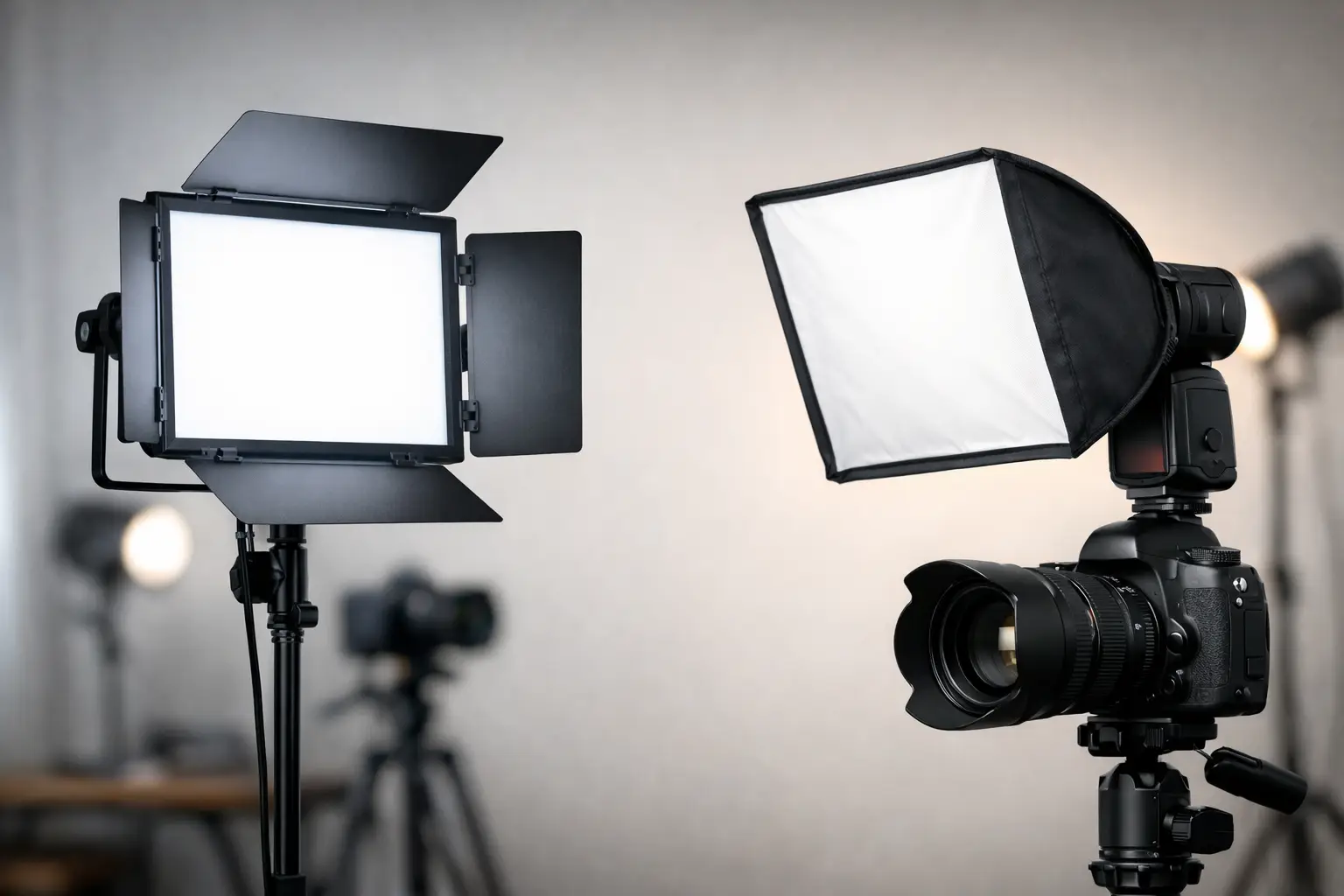
When skin looks gray in the frame, the background turns dirty yellow, or the product does not gain the needed volume, the problem is often not the camera or the lens. The problem is the light. That is exactly why the question of whether to choose LED panels or flashes is not theoretical - it directly affects workflow, the final result, and the budget as well.
In brief
- The choice between LED panels and flashes depends on whether you mainly film (LED) or photograph with a need for power and precision (flashes).
- An LED panel provides continuous light and faster visual adjustments on set; a flash gives a short, powerful burst with greater light output.
- For beginners focused primarily on video content, an LED kit is often more practical; for photographers with commercial assignments, a flash system often pays off more.
- Consider the full kit — modifiers, stands, power, and transport can be decisive in budget and mobility decisions.
- If you're unsure, use rental to test specific solutions in your workflow.
What to choose for different tasks
| Task | Solution | Why |
|---|---|---|
| Interviews and talking-head video | LED panels (bi-color, adjustable brightness) | Continuous light lets you accurately evaluate shadows and quickly adjust color temperature during filming. |
| Commercial product photography (catalogs) | Flashes with softboxes and transmitters | Flash light provides high power and the ability to shoot at lower ISO and greater depth of field. |
| Fast social media clips and reels-format content | LED panels or sticks (compact, mobile models) | Fast setup and existing light let you see the result in real time and film without additional flicker issues. |
| Outdoor action and reportage with movement | Battery-powered flashes (portable battery flashes) | A short light burst helps freeze motion and provides the needed power in a compact package. |
| Small studio product photography on a stand | LED panels with soft modifiers | The subject is stationary, and continuous light allows you to precisely shape reflections and work with long exposures. |
| Complex studio work (large modifiers, high precision) | Professional flash systems with generators or powerful batteries | Large softboxes and repeated commercial shoots require high power and consistent reproduction. |
Frequently asked questions
Can LED panels fully replace flashes?
No, LED panels and flashes serve different purposes. LEDs are more convenient for video and real-time adjustments, while flashes provide much greater power and pulse control, which is often needed for commercial photography.
How do you choose between bi-color and RGB LED panels?
Bi-color panels let you adjust color temperature between warm and cool, which is practical for adapting to room lighting. RGB panels offer colorful accents and creative options, but their color accuracy should be evaluated depending on the task.
Are flashes suitable for video recording?
Usually flashes are not suitable as the main video light because they produce pulsed light rather than continuous light. However, flashes can be used for synchronized moments or as supplemental lighting in controlled scenes.
What is the main limitation of cheap LED panels?
Cheaper LED models often have lower CRI/TLCI, less even light, and insufficient power. This can create additional post-production work and limit use in situations requiring high color accuracy.
When is it worth using rental instead of buying?
Rental is recommended if you're unsure whether the technology fits your workflow or if the tasks are occasional. With rental, you can try both LEDs and flashes in real working situations before investing long term.
How important is the power solution for LED and flash operation outside the studio?
Power is critical because powerful LED panels require larger adapters or batteries, while battery flashes often provide better mobility. Plan battery запас and evaluate weight and charging requirements according to mobility needs.
Useful links
- LED light panels - Direct access to the LED panel category, useful for choosing products by power, color accuracy, and modifier compatibility.
This choice is especially relevant for those who photograph and film at the same time, work with social media content, product shots, portraits, or small interviews. There is no universal solution. There is only the right solution for a specific task.
LED panels or flashes - the main difference
The difference starts with the basic principle of how the light works. An LED panel provides continuous light - you see the result immediately, even before you press the shutter or start filming. This is convenient when you need to adjust shadows, evaluate reflections on a product, or understand how light falls on a face.
A flash works in pulses. It does not illuminate the scene continuously, but gives a short, powerful burst of light precisely at the moment of capture. This makes it possible to get much greater power, control motion more effectively, and often also work at lower ISO.
Simply put - LED is visible, predictable, and convenient for video work. A flash is powerful, efficient, and very suitable for photo tasks where a controlled result is needed.
When LED panels are the more logical choice
LED panels are often the first sensible step for content creators and teams that regularly film. If the task is interviews, podcasts, product videos, live streams, or short social media formats, continuous light makes work significantly easier. You can see precisely how the face, background, and object texture will look.
Another advantage is the learning speed. For someone without deep studio lighting experience, LED is more understandable. Set up the light, turn the angle, change the brightness, and the result is visible immediately. This reduces the number of mistakes and speeds up shooting in small teams.
LED panels can also be very useful for product photo and video work, especially when photographing small items on a stand. In such a scenario, the object does not move, the camera can work with a longer exposure, and the extra power of flashes is no longer decisive. The ability to precisely shape reflections on glass, metal, or packaging becomes more important.
However, LED is not without limitations. Compared with flashes, panels often lack power, especially when you need to illuminate a larger space, work in daylight, or use large light modifiers. If you need to overpower bright window light or achieve a very clean image with low ISO, LED quickly reaches its limits.
LED panel strengths in practice
LED panels perform best in video work, small studios, e-commerce product content, and situations where quick setup is important. With bi-color models, you can adjust the color temperature to match the room lighting, while RGB solutions provide additional creative possibilities for backgrounds or accents.
It should be noted that not all LED panels are the same. Cheaper models can suffer from lower color accuracy, less even light, and insufficient output. In professional work, CRI and TLCI ratings are not a formality - they directly affect skin tones and post-production time.
When flashes are the superior solution
If the main task is photography, flashes are still the most effective tool in many cases. In portrait, fashion, event, commercial, and product photography, they provide what LED panels often cannot - a large light reserve in a compact form.
A short light burst helps freeze motion. This is important not only in sports or dance. In children’s portraits, moving hands, splashes, fabric movement, or reportage situations, a flash often gives a sharper and cleaner result than continuous light.
In the studio, flashes allow you to work with large softboxes, octaboxes, reflectors, and other modifiers without losing as much efficiency as with a weaker LED source. In addition, it is often possible to shoot at lower ISO and a smaller aperture, which is essential in product and catalog photography where a greater depth of field is needed.
Another argument in favor of flashes is battery efficiency. A powerful pulse light in a mobile session is often more practical than a very strong LED solution that requires bulky power supplies and more careful heat management.
Where flashes require more experience
A flash is not as intuitive as an LED panel. You do not see the light pattern continuously, so you have to rely more on experience, test shots, and light measurements. If a person is only beginning to understand lighting, this process can feel slower at first.
There are also practical limitations in video work - a flash is not suitable as the main continuous light source for video. That is why teams doing both in one project often face not the question of which is better, but how to properly divide tasks between the two systems.
LED panels or flashes for portraits, products, and video
In portraits, the choice depends on style. If you are shooting classic studio portraits, business portraits, or fashion frames with precise light control, flashes usually provide better reserves and flexibility. If you are creating simple social media portraits, backstage content, or also filming reels format video at the same time, LED may be more practical.
In product work, you should look at the object size and the workflow pace. For small items on a table, LED panels are often very convenient because reflections can be adjusted in real time. For larger products, packaging series, and commercial photography that requires an even, repeatable result, flashes are usually the safer investment.
In video, the answer is simpler - LED is the primary choice. Whether you are filming an interview, a course, an advertising clip, or a product demonstration, continuous light is required. The main question here is not whether LED, but how powerful the LED should be, with what color accuracy, and with what modifier system.
What to choose for a beginner and what for professional work
For a beginner, the choice often should be based not on the maximum theoretical quality, but on what can actually be used from the first day. If the main content is video, podcasts, product demonstrations, or simply portraits in a small space, an LED kit will be quicker to learn and easier to understand.
If the goal is to develop a serious photo service - portraits, events, studio work, e-commerce catalogs - a flash system often pays off better in the long run. It opens wider opportunities to work with different light modifiers, control ambient light, and achieve a more stable result at a professional pace.
For a professional user, the correct answer is most often a combination. Continuous light for video needs and part of product tasks, flashes for photo projects where power and precision are needed. This approach makes it possible to avoid overpaying for universality that in practice is often not universal at all.
Budget, mobility, and rental logic
When it comes to budget, it is not correct to compare only the price of one device. You need to look at the full kit - stands, modifiers, batteries, transmitters, and transport. Sometimes LED seems cheaper at first, but costs quickly rise for powerful work. A flash may require more accessories, but deliver higher efficiency in the long term.
Mobility is another important factor. If you work in client spaces, shoot in offices, or travel to locations, weight and setup speed are just as important as power. There is no single winner here - a compact LED solution may be more convenient for a video team, while a battery flash with one softbox can be more efficient for a photographer.
If you are still not sure about a specific system, a rental approach is often the smartest step. It lets you test how a particular type of light behaves in your workflow, not just according to specifications. This is especially useful if the boundary between photo and video tasks for you changes often.
How to make the right decision
The practical question is not simply LED panels or flashes. The practical question is - what do you shoot most often, in what environment do you work, and how quickly do you need a repeatable result. If 70 percent of the work is video, LED will be the main tool. If 70 percent is photo, especially with commercial requirements, flashes will be the more logical center.
If the split is similar, it is worth building the system in stages. Start with the light that solves the daily work already now, and then add the other technology. This approach is safer than trying to solve absolutely everything in one purchase.
Master Foto in client practice, what works best is not a categorical choice, but a precise matching of equipment to the task. The sooner you accept this principle, the less time you waste on compromises and the more on results.