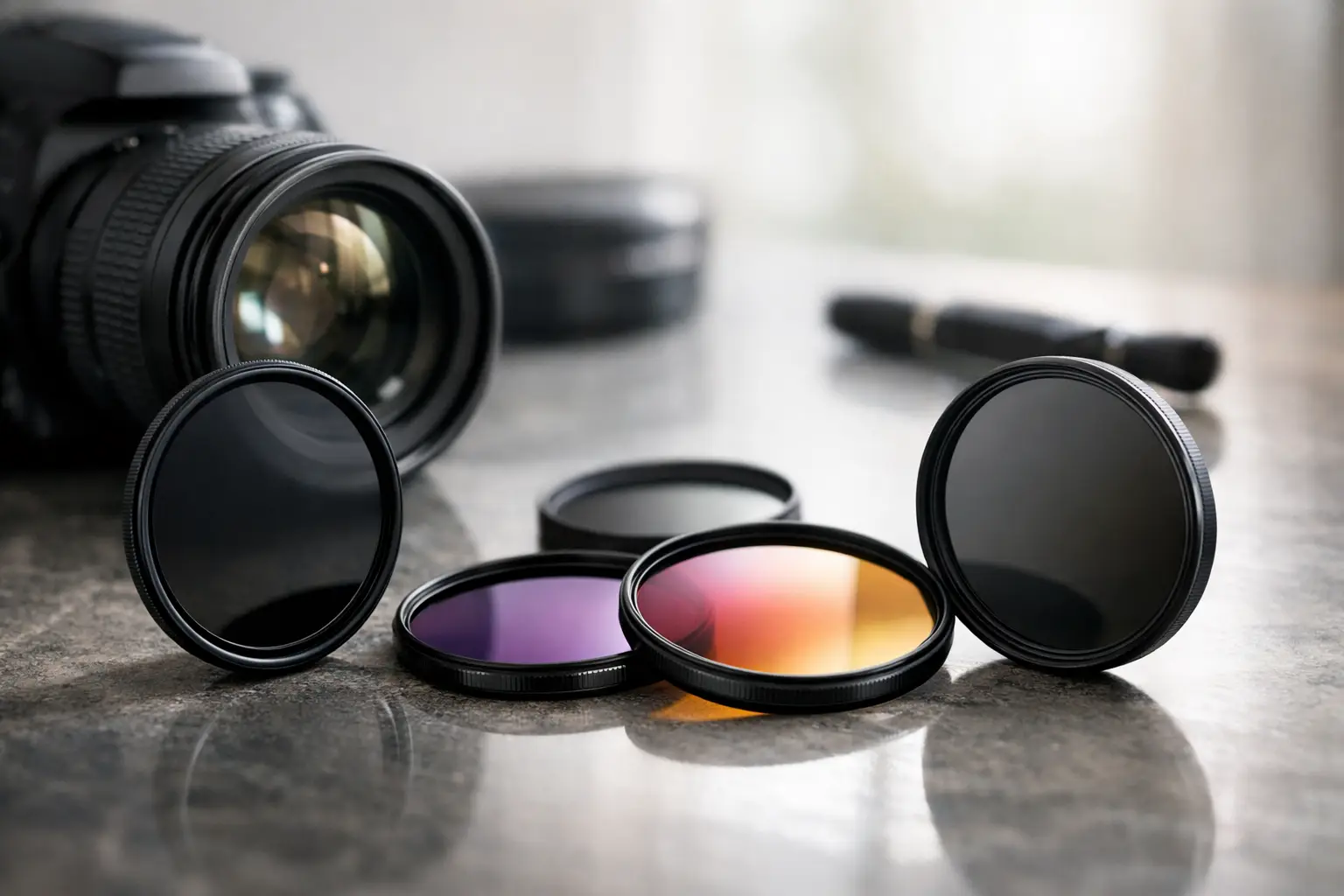
If the sky in the frame is overexposed, water reflects like a mirror, or shutter speed in sunlight becomes an obstacle, lens filter comparison becomes not a theory but a practical necessity. The right filter can solve the problem at the moment of shooting, while an unsuitable filter can reduce contrast, introduce unwanted reflections, and worsen image sharpness.
In brief
- Choose the filter based on the task: UV for protection, CPL for controlling glare, ND for reducing light, Mist for creative softening.
- The optical quality of the filter (glass, coatings, frame) directly affects contrast, color, and vignetting; a cheap filter can degrade the image.
- In video shooting, ND is often needed, but with gimbals and matte boxes, square systems or slim frames are more convenient.
- For wide-angle lenses, use a thinner (slim) frame to reduce vignetting, and watch out for the variable ND 'X' pattern at high values.
- Filters should be kept clean and properly maintained — dust, fingerprints, and water leave visible flaws in backlight.
What to choose for different tasks
| Task | Solution | Why |
|---|---|---|
| Landscape photography on a sunny day | CPL combined with ND (if a longer shutter speed is needed) | CPL reduces glare and deepens the sky, while ND allows for a longer exposure to capture water or cloud movement. |
| Outdoor video with a gimbal | A quality ND (fixed or variable) and a slim frame / square system if using a matte box | ND helps maintain the correct shutter speed, while slim frames and square filters provide ergonomics and avoid vignetting. |
| Product photography of glass or shiny surfaces | CPL filter | CPL will reduce glare and control reflections, improving the look of the object without extensive post-processing. |
| Portraits with softer light and glow | Black Mist or a similar mist-type diffusion filter | Mist filters soften sharpness and diffuse light sources, creating a more organic and cinematic look. |
| Everyday protection on business trips or while traveling | A quality UV / protection filter with good coatings | UV filters reduce the risk of front lens wear; sometimes it is more economical to replace the filter than a lens element. |
Frequently asked questions
Which filter is best for a landscape with water and sky?
A CPL filter helps reduce glare from water and deepen the sky color, but if you want to blur motion (for example, a waterfall), add an ND filter. The combination gives the best on-location control without needing much post-processing.
Does a UV filter really protect the lens, and should it always be left on?
UV filters are often used as mechanical protection against dust and scratches; however, in more professional situations they are removed to avoid extra glare or loss of contrast. The decision should be based on the working environment — useful for travel and reportage, often unnecessary in the studio.
How do you choose between a fixed and variable ND filter for video shooting?
Fixed ND filters usually provide more even darkening and no risk of an 'X' pattern, while variable NDs are more convenient when quick adjustment is needed. If you work in a controlled environment and want maximum quality, choose fixed ND; if mobility is the priority, a high-quality variable ND may be better.
Can a CPL be used on a wide-angle lens?
The effect of a CPL on a wide-angle lens can be harder to control because the polarizing effect is not uniform across the frame. To avoid an uneven result, use a quality CPL and test the effect at different angles, or use it only when the effect can be predicted.
How do filters affect image color and contrast?
High-quality filters with good coatings preserve neutral color reproduction and high contrast, while cheap filters can cause color shifts, loss of contrast, or ghosting effects. That is why optical quality and multi-layer coatings are essential, especially when working with high-resolution optics.
How should lens filters be maintained and cleaned properly?
Clean the filter with a blower, a microfiber cloth, and a suitable liquid, avoiding rough materials and pressure. Regular care reduces the impact of fingerprints and salt or sand, which become quickly visible in backlight.
Useful links
- Lens filters - A category with different types of filters for browsing available solutions
- CPL polarizing filters - A directly related category for CPL filters, useful for landscape and product photography
- ND neutral density filters - A wide range of ND filters and variant comparisons for video and photo needs
- Lenses - Information about lens diameters and compatibility with filters
- Video shooting equipment - Tools and accessories (gimbals, matte box) for more convenient filter use in video work
A filter is not a universal accessory for every task. In some cases, it helps achieve a result that cannot be fully restored in post-production, such as a polarizing effect or a longer exposure in daylight. In others, it is more of a working tool with a specific function than an essential piece of equipment. That is exactly why it is worth comparing filters by their real-world use, not just by price or brand.
Lens filters compared by use
In practice, four filter types are most often chosen - UV, CPL, ND, and effect filters, such as Black Mist or similar diffusion models. Each affects the image differently, and the most important question is not which one is "the best," but which one is suitable for the specific job.
A UV filter is now most often used for front lens protection. In digital photography, its effect on ultraviolet light correction is minimal, so this filter is more of a mechanical shield against dust, scratches, sand, or salt spray. It can be useful in reportage, travel, events, and other situations where the environment is not gentle with equipment. At the same time, a cheap UV filter on a high-quality lens is often the fastest way to lose contrast and get additional reflections in backlight.
A CPL, or circular polarizing filter, reduces reflections from non-metallic surfaces and deepens colors. It is especially useful in landscape photography, architecture, car photography, and products with glass or water. A CPL can make skies more expressive and lets you see through reflections from a window or water surface. However, it reduces the amount of light, usually by about 1 to 2 stops, and with very wide-angle lenses the effect can become uneven.
An ND, or neutral density filter, reduces the amount of light without changing the color balance. Its main purpose is to allow longer exposures or wider apertures in bright light. Photographers use it for waterfalls, seascapes, motion blur, and urban shots, while videographers use it to maintain the correct shutter speed in sunny conditions. Here, filter quality is essential, because cheaper ND models tend to introduce color shifts or uneven darkening.
Mist-type filters, including Black Mist, affect the character of the image rather than exposure. They soften the sharpest details, slightly blur light sources, and reduce digital "sterility." In video work, these filters are especially popular in interviews, commercials, and portraits where a softer and more organic result is desired. They are not a technical solution for every shot, but a creative tool with a clear visual effect.
UV, CPL, and ND filters - key differences
If lens filter comparison has to be reduced to a simple decision, then the UV filter protects, CPL corrects reflections, and ND controls the amount of light. This difference sounds simple, but in practice the choice is determined by the workflow.
For a photographer who works outdoors every day and often changes locations, a UV filter can be a justified safety choice. This is especially true for expensive lenses, where repairing or replacing the front element costs significantly more than a quality protective filter. But in a studio or controlled conditions, many professionals remove the UV filter to reduce the number of additional glass elements in front of the lens.
A CPL filter will be much more valuable in cases where surface reflections need to be controlled. In product photography, it helps manage the appearance of glass, plastic, and lacquered surfaces. In landscapes, it gives foliage and skies more saturation. In low light or indoor reportage, however, a CPL often becomes an obstacle because it takes away light and lengthens exposure.
An ND filter, on the other hand, is almost essential in video work if you film with natural motion blur and follow the classic shutter speed-to-frame rate relationship. Without an ND filter in sunny weather, you either have to close the aperture or increase the shutter speed, and both options change the image’s character. In photography, ND is not always necessary, but it becomes very useful when the desired effect is directly based on a longer exposure.
How filter quality affects the result
Two filters with the same label can behave very differently. The differences come from glass quality, coatings, frame construction, and manufacturing precision. This is usually where disappointment arises if the choice is based only on the lowest price.
A quality filter should provide high light transmission, minimal reflections, and neutral color reproduction. Multi-layer coatings help reduce ghosting and flare, especially in backlight or night scenes with bright light sources. This is important not only for photo, but also for video, where moving footage quickly reveals optical imperfections.
Frame thickness is important too. On wide-angle lenses, a thicker filter can cause vignetting, especially if you screw another filter onto the front. That is why slim-type frames are often the safer choice for wider focal lengths. At the same time, a very thin frame is not always the easiest to grip, especially in cold weather or when working quickly.
Variable ND filters are a separate story. They are convenient because they let you quickly adjust light reduction, but cheaper models tend to show uneven darkening or the so-called X pattern at higher settings. If filming is done in a controlled setup and there is time to change filters, fixed ND filters often provide more predictable results. If speed and mobility are the priority, a quality variable ND may be the most practical option.
How to choose a filter for your work
The right choice starts not with the diameter, but with the task. If the main goal is to protect the lens in everyday use, a quality clear or UV filter is enough. If you regularly photograph landscapes, water, cars, or shop windows, a CPL filter will provide a visible benefit on the very first use. If you film outdoors or want long exposures, look at ND solutions.
The next step is lens diameter. The filter must match the lens thread size, for example 67 mm, 72 mm, or 82 mm. If you use several lenses, it is often more economical to buy a filter in the largest required diameter and use step-up rings for smaller lenses. This reduces costs, but it is not always convenient if lenses need to be changed frequently on location.
The lens class also matters. On a high-resolution full-frame lens, the filter’s optical quality becomes much more visible than on a simpler kit lens. The higher the optical potential, the less sense there is in limiting it with poor-quality front glass.
Video creators should also think about workflow speed. If filming with a gimbal, rig, or matte box system, classic screw-on filters are not always the fastest solution. Sometimes square or rectangular filter systems are more ergonomic, especially when ND and diffusion filters need to be combined often. For a solo operator, however, screw-on filters are often more rational because of the smaller kit and faster setup.
When a filter helps, and when it is better to go without one
A filter should not be considered an obligatory element on the lens at all times. Every additional glass surface theoretically increases the chance of reflections, contrast loss, or dirt-related problems. If shooting takes place in difficult backlight, at night in the city, or in situations where every bit of contrast matters, sometimes the best decision is to remove the filters.
This is especially true for UV filters, which are often left on the lens by default. If protection is not needed in a specific situation, the safest choice in terms of image quality is often to work without one. On the other hand, ND and CPL filters are usually used when a specific optical effect is needed and cannot be fully replaced in post-production.
Filter maintenance also affects results more than many assume. Fingerprints, salt, dust, and microfiber residues become visible very quickly in backlight. That is why a quality filter without regular cleaning will not deliver the result expected from it.
If you are unsure between several options, the most practical approach is to compare not only the specifications, but also your real working scenario. That is where the difference appears between a purchase "just in case" and a filter that truly works in your frame. In the context of Master Foto consultation and equipment selection, that is usually the main question - what do you want this filter to achieve at the moment of shooting.