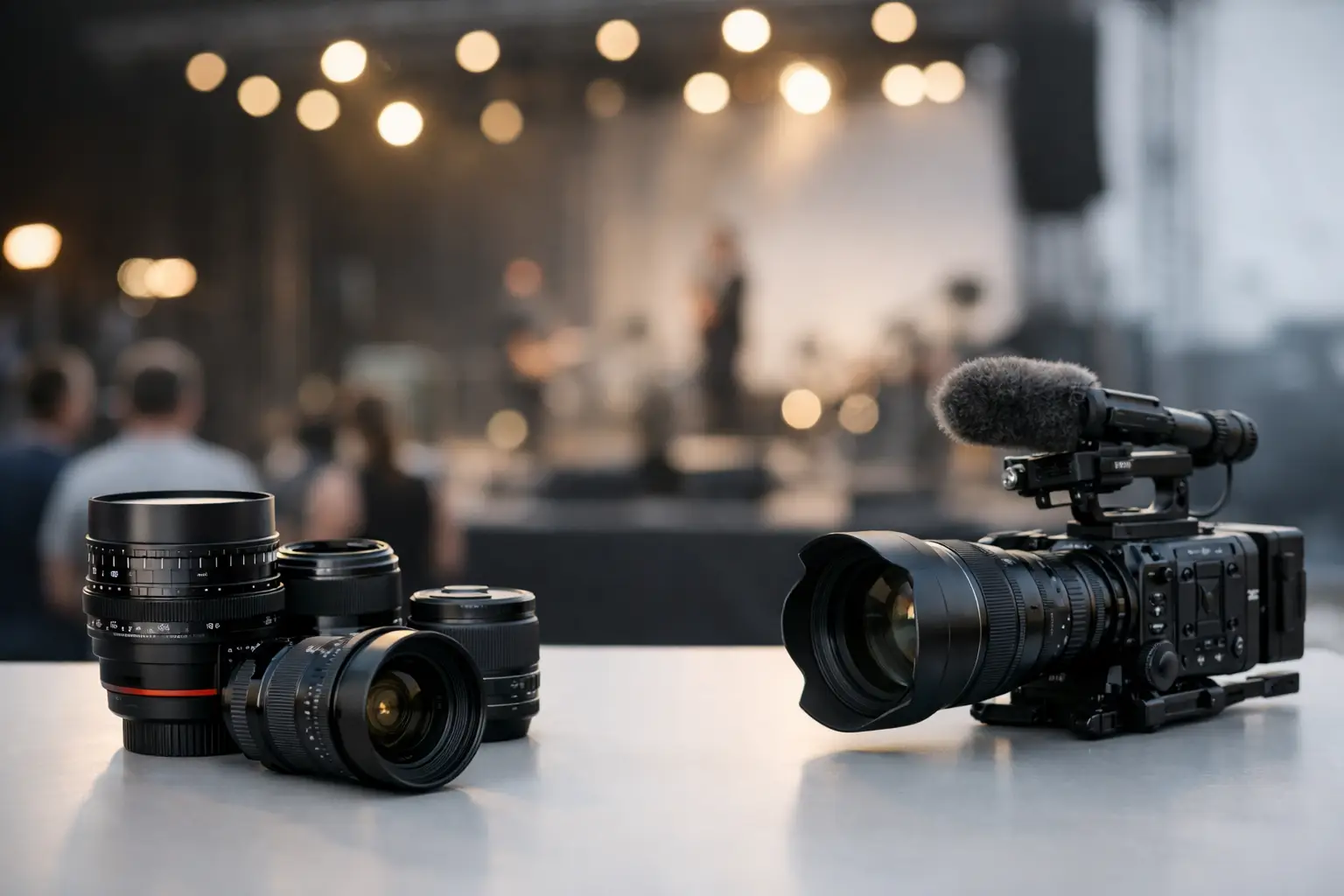
In event filming, the lens often affects the result more than the camera body. That is exactly why lens rental for event filming is a logical solution if a particular job requires a different focal length, greater aperture, or a more flexible kit than you normally keep in your bag. At weddings, conferences, concerts, and corporate events, conditions change quickly, and the choice of lens determines framing, low-light performance, and the operator’s freedom of movement.
Why lens rental for event filming is a justified choice
Buying a separate lens for every scenario is usually not economical. Event filming is a good illustration of how different the requirements can be within a single week - one project needs a wide shot for a dance hall, another a quieter telephoto lens for speakers on stage, and yet another a fast prime lens for a dark ceremony.
Rental makes it possible to adapt the kit to the specific task. This is especially important for freelancers, small teams, and corporate content creators who do not want to freeze budget in gear they will use only a few times a season. In practice, this means fewer compromises and a more precise choice of equipment for each event.
At the same time, it is important to be realistic - rental does not solve a lack of planning. If a lens is picked up at the last minute without testing, the risk remains. That is why not only access to gear is valuable, but also the ability to quickly compare models and understand what will work more reliably in a given situation.
How to choose a lens by event type
Not all events require the same thing. Theoretically, a universal 24-70 mm may seem like the safest option, but in practice you often need to assess the size of the venue, movement intensity, lighting, and how close you are allowed to get to the center of the action.
Weddings and private celebrations
At weddings, a combination of a wider zoom and a fast portrait lens usually works best. Preparation rooms, the ceremony, and the evening part often take place in changing light, so lenses with f/2.8 or an even wider aperture are useful. If versatility is the priority, 24-70 mm is a rational base. If you need stronger background separation and more reliable work in dim light, 35 mm, 50 mm, or 85 mm prime lenses provide a noticeable benefit.
However, there is another side to this. A very wide aperture with moving people means a shallower depth of field and a higher risk of missed focus. If you are filming alone without focus puller support, sometimes a slightly more conservative zoom lens is more practical than a more impressive but more temperamental prime lens.
Conferences, seminars, and corporate events
Here, predictability is often the most important thing. Speakers are in a fixed place, but the filmmaker does not always have access to the stage. That is why a 70-200 mm range or a similar telephoto lens is useful, allowing you to capture close-ups from a distance without disturbing the event.
If you also need wide shots, registration, networking areas, and the atmosphere of the venue, a telephoto lens alone will not be enough. In such jobs, a two-lens kit is a good solution - one wider, one longer. It speeds up the work and reduces situations where an important moment is missed because of a lens change.
Concerts and stage events
At concerts, you need to think not only about focal length, but also about high-contrast lighting, smoke, backlight, and fast movement. Aperture speed is essential here, because shutter speed often cannot be lowered without losing motion quality. If access is limited, a telephoto lens becomes almost mandatory. If you can work at the edge of the stage, a 24-70 mm or 16-35 mm range is also useful for more dynamic wide shots.
Here, prior information about the venue helps a lot. It is one thing to choose a lens theoretically, and another to know whether you will be filming from the FOH area, from the side, or among the audience.
Focal length that is actually useful at events
In event filming, the choice can usually be reduced to three practical groups. Wide lenses, such as 16-35 mm or a similar range, are suitable for venue, atmosphere, and dynamic shots. Standard zooms, especially 24-70 mm, are often the main working tool because they cover both medium and closer shots without constant movement. Telephoto lenses, such as 70-200 mm, provide a safe reserve when the event must be filmed from a distance.
Prime lenses have their own advantage - greater aperture and often a more expressive image. But at events they require more disciplined work. If you are filming alone, changing lenses is not just a technical process, but also a risk of missing an important moment. That is why the choice between zoom and prime is not about what is more professional, but about what is safer for the specific project.
What to evaluate before booking a rental
A lens specification on paper is only the beginning. For event filming, autofocus behavior, stabilization, weight, and balance with the specific camera or gimbal are also important. A lens that works great for interviews on a tripod may not be the most comfortable choice for a long reportage day with movement between different areas.
You should also pay attention to the mount and compatibility with your camera. If you use an adapter, it is recommended to check how it affects autofocus, stabilization, and ergonomics. This is especially important for hybrid jobs, where filming alternates with photography and there is no time for technical surprises.
Another practical point is filter diameter and accessories. If filming outdoors or near large windows is planned, an ND filter may be needed. If the lens uses a different diameter than the rest of the kit, that affects both the budget and the workflow on site.
Is one lens enough
In some events - yes. If you are filming a short corporate event recap in a well-lit venue, one high-quality 24-70 mm lens can cover most needs. It is a practical solution if the priority is speed, mobility, and a smaller amount of equipment.
But in more complex jobs, one lens is often not enough. A wedding day, a conference with a stage and audience, or a concert with limited access usually requires at least two viewpoints and therefore two different focal ranges. A backup option is not a luxury - it is a matter of work safety. If one lens does not suit a particular stage, there will be no second chance at that time window.
That is why lens rental for event filming is often a more sensible choice of a kit rather than a single model. The most practical solution is usually a main lens and an additional lens for specific situations.
How to understand which kit will be the most cost-effective
The cheapest option is not always the most economical. If you take one lens that is technically more affordable, but during filming it limits framing or low-light performance, the real costs appear in post-production and in repeated attempts to compensate for what you could have captured on site.
The most cost-effective kit is the one that reduces risk. That means sufficient range, predictable performance in difficult light, and the ability not to interrupt filming because of lens changes at critical moments. Sometimes that will be one universal zoom. Other times - a zoom plus a fast prime for the evening part or portrait shots.
If you are unsure, it is worth planning not by theory, but by the filming scenario. Where will you be during the ceremony, how close will the stage be, will movement be allowed, how long will handheld filming last, do you need a gimbal - these are the questions that help you choose more precisely than any technical table. In this approach, expert consultation also provides real value, because it helps not just rent a lens, but assemble a working kit without unnecessary expenses.
A practical approach to booking
The closer the event, the less room there is for mistakes. That is why it is advisable to reserve lenses in advance, especially during the busiest seasonal months, when universal f/2.8 zooms and telephoto lenses are in demand. Before pickup, it is useful to check compatibility with the camera, required batteries, memory cards, filters, and transport solution.
If possible, schedule a short test before the event itself. Even for an experienced operator, a new lens means a different focusing feel, weight distribution, and behavior on a stabilizer. This short preparation stage often prevents the most expensive mistake - technically correct equipment that is not practically adapted to the specific job.
In the Latvian market, local availability and consultation are also valuable, especially if the gear is needed quickly and for a specific date. Therefore, when choosing a rental, what matters is not only the selection, but also the ability to get a clear answer about which lens is more suitable for the particular event. This is exactly where a specialized partner such as Master Foto is useful.
A good event video rarely comes from a random choice of gear. The right lens does not make the job easy, but it removes unnecessary limitations and allows you to focus on the story, the rhythm, and the important moments.