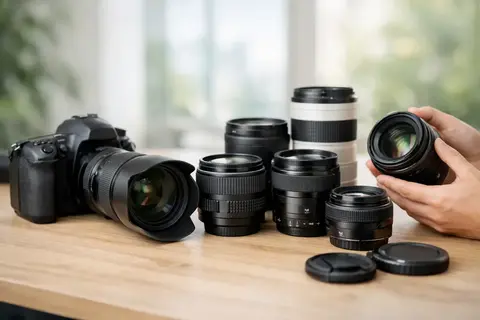
When you suddenly need a 70-200 mm f/2.8 for a specific task, a macro lens for products, or an ultra-wide angle for interiors, buying is not always the most sensible move. Lens rental in such situations lets you work with the right optics exactly when you need them, without tying up your budget in equipment that will sit on the shelf day to day.
This is especially relevant for photographers, videographers, content creators, and business teams whose equipment choices often depend on the specific project, location, and final result requirements. A good lens affects not only image quality, but also workflow speed, framing options, and even how easy it will be to work in poor lighting.
Why lens rental is often more practical than buying
A lens is not a universal tool for every job. What works great for portraits may be awkward in reportage. What works brilliantly in architecture will not be the first choice for event filming. That is exactly why renting is often a more rational path than an impulsive purchase.
The first benefit is flexibility. If one week you need to photograph real estate and the next you need to film an interview with strong background blur, you can choose the optics suited to each task. There is no need to compromise between “good for everything” and “really good for nothing.”
The second benefit is cost control. Professional-grade lenses are expensive, especially if you need multiple focal lengths or specific optics. Rental lets you use high-end equipment without the full purchase budget. This is important both for individual content creators and for companies that use equipment only periodically.
The third benefit is the ability to test a lens in practice. Specifications alone do not answer how optics will feel in real work. Autofocus behavior, weight, balance on the camera, performance against backlight, sharpness at wide aperture, and the overall user experience all matter. Before buying, rental is often the safest test.
When lens rental is especially useful
Lens rental will not be needed regularly by every user, but there are several situations where its advantages become very clear.
One-off or infrequent projects
Wedding season, a sports event, a product campaign, short-term filming, or a trip are typical cases where a specific lens is needed for a few days. If such a task does not repeat often, buying usually does not pay off.
Risk is also important here. If a lens will only be needed once or twice a year, investing a large sum just for its availability is not efficient. Rental lets you keep your budget for other items - lights, audio, tripods - or post-production.
A specific genre of photography or filming
Macro, architecture, sports, wildlife, and cinematic style often require optics that are not used every day. A tilt-shift lens, a long telephoto lens, or a very fast prime lens are professional tools, but not necessarily part of a daily kit.
If the work is niche, rental helps you access the right equipment without unnecessary storage volume. This is especially useful for studios and teams that work with a variety of client assignments.
Before making a purchase decision
For many users, lens selection comes down to two or three models. For example, between 24-70 mm and 24-105 mm, between a 35 mm and 50 mm prime, or between alternatives from different manufacturers for the same mount.
In such cases, theory only helps partially. Rental lets you understand whether the chosen focal range really matches your working style, whether the aperture advantages are significant enough, and whether the lens size becomes a burden in longer work.
How to choose the right lens for rental
The right choice starts not with the brand, but with the task. The more precisely the final result is defined, the easier it is to select the lens.
First, look at the frame type. If you need wide interiors, landscapes, or tight room shots, wide-angle optics will be the priority. If the goal is a portrait, interview, or highlighting details with a beautiful background, 50 mm, 85 mm, or 70-200 mm class lenses often work better. For events and reportage, standard zoom lenses will be more versatile.
Next, assess the lighting. In darker spaces or evening work, a fast aperture and stabilization, if available, matter a lot. In a studio, where light is controlled, focal range, sharpness, and ease of use may be more important than the widest possible aperture.
You should also consider the camera system. Mount compatibility is obvious, but sensor size is no less important. A full-frame and APS-C camera will use the same lens differently, especially in terms of angle of view. If the goal is a specific visual effect, this should be taken into account already at the booking stage.
Lens rental and budget planning
From a cost perspective, lens rental is often better not only for beginners, but also for professionals. That may seem counterintuitive, because an active content creator uses equipment a lot. However, the economics here are not that simple.
If a lens is used every week, buying may be justified. If it is needed only for certain projects, rental is usually financially healthier. In addition, in a professional environment, capital availability matters too - funds can be directed where they bring greater return, rather than being tied up in optics waiting for the next rare task.
There is also the maintenance aspect. A lens is not just glass with a mount. It is a mechanism with autofocus, electronics, moving groups, and optical surfaces that require careful handling. If equipment is not used regularly, ownership itself is not an advantage.
What to clarify before booking
To make the rental go smoothly, it is worth understanding several practical questions in advance. The first is availability on the specific dates. Popular focal lengths and professional models are often booked during busy periods, especially in seasonal events.
The second is the package contents. It is important to know whether the lens comes with a lens hood, caps, tripod collar, carrying case, or other accessories if they are needed for the job. In video tasks, this can also affect compatibility with a follow focus, matte box, or gimbal.
The third is technical condition and usage nuances. For some projects, silent autofocus, minimal focus breathing, or the character of the manual focus ring will be decisive. If the requirements are specific, it is better to clarify them before pickup rather than on the filming day.
It is also worth considering a backup plan. If the task is commercially important, it is often rational to test the lens on your own camera in advance and make sure everything works as expected. This is especially true for video projects, where small incompatibilities become noticeable only during work.
Who benefits most from lens rental
For hobby-level users, rental is a good way to understand their photography style without rushing. Often only after practical use does it become clear whether portraits, street photography, sports, or landscapes are more appealing. Buying expensive optics before that clarity is not necessary.
For a professional photographer or videographer, rental helps maintain a flexible equipment pool. Core lenses can be owned, while specialized models can be added according to the task. This allows for taking on more varied projects without needing to store every possible piece of gear on site.
For companies and marketing teams, rental is often the simplest solution for campaigns, interviews, product content, and event documentation. There is no need to build a permanent equipment fund if content production happens episodically. At the same time, it is possible to use quality optics with predictable costs.
For teams working in Latvia on short projects or on location, local availability is an important factor. If you can find not only a lens, but also camera bodies, lights, audio, and accessories in one place, the organizational process becomes much more efficient. This is exactly where the full-cycle approach provided by a specialized partner such as Master Foto is a practical advantage.
Is lens rental always the best choice
No. If a particular lens is used constantly and is an essential part of daily work, ownership is usually the more logical solution. It provides full availability, a predictable workflow, and less dependence on the reservation calendar.
However, there is rarely an absolute line between “must buy” and “must rent.” For many users, the best model is a combination: basic optics in their own kit, and specialized lenses on rent. It is a pragmatic solution that preserves readiness for work while also allowing access to a broader range of technical possibilities.
If the goal is not simply to get a lens, but to choose the right tool for a specific job, rental often turns out to be a more professional approach than a spontaneous purchase. A good shot starts not with what is on the shelf, but with what best matches the task at that exact moment.