
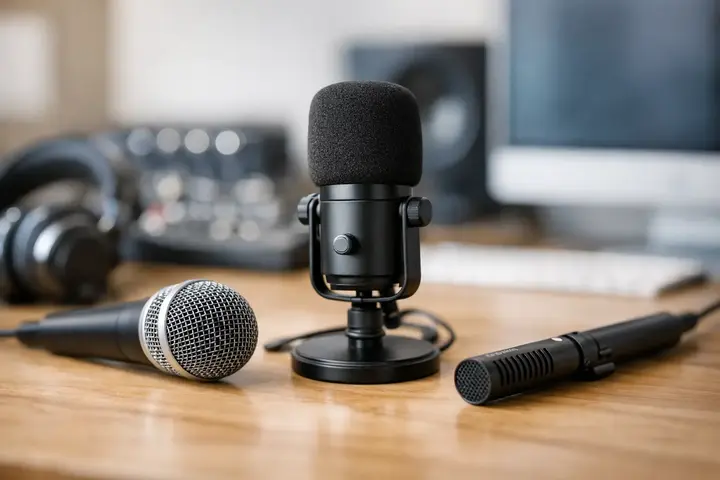
A beautiful 4K image will not save a video if the speaker’s voice is distant, echoes in the room, or wind can be heard in the recording. That is why a microphone buyer’s guide should begin not with a brand or price, but with the question: what exactly will you record, in what environment, and with which device? A properly chosen microphone makes the recording clearer already during filming and reduces the time later spent on audio processing.
In brief
- Start with the recording task: choose a microphone based on the environment, distance to the source, and device connection.
- A USB microphone is a quick solution for a computer; XLR offers more control and better expandability in the studio.
- Choose the capsule type (dynamic, condenser, ribbon) according to the sound source and noise environment.
- The pickup pattern (cardioid, omni, supercardioid) affects noise isolation and microphone placement.
- Wireless systems provide freedom of movement, but require attention to batteries, signal, and backup recordings.
- Accessories (stands, wind protection, cables, pop filter) often determine whether the microphone is ready to work.
What to choose for different tasks
| Task | Solution | Why |
|---|---|---|
| Podcast in a home office | USB or XLR condenser microphone with a cardioid pickup pattern and a desktop stand | USB provides a simple connection, while XLR gives better preamp quality and the option to add a pop filter and shock mount. |
| Interviews on the street or at an event | Wireless lavalier kit or directional lavalier with wind protection | Lavalier allows free movement and keeps a consistent signal close to the voice; outdoors, wind protection is essential. |
| Video shooting with a camera (vlogs, documentary material) | Camera-mounted shotgun/directional microphone with TRS/TRRS compatibility and a windscreen | Shotgun focuses on the voice from the front of the frame, while the windscreen reduces outdoor noise. |
| Studio vocals and acoustic guitar | XLR condenser or ribbon microphone with a stand and acoustic treatment | A condenser and ribbon provide detail and nuance, but they require phantom power and an acoustically controlled environment. |
| Distributed group discussion at an event | Omnidirectional microphone or multiple lavalier microphones with a mixer | An omnidirectional microphone picks up several voices at once; multiple microphones provide clearer channel control options. |
| Recording outdoors in strong wind | Wireless lavalier with full-length wind protection or a boom with a dense wind cover | Strong wind protection is essential to avoid low-frequency noise and plosive sounds in the recording. |
Start with the recording task
A microphone that works well in a podcast studio will not automatically be the best choice for an interview on the street. Meanwhile, a small wireless microphone may be much more practical for a content creator than a large-diaphragm studio model, even if its technical specifications are more modest. The choice is determined by the distance to the sound source, noise level, movement in frame, and the recording device.
For a speaking person seated at a table, a USB or XLR microphone on a stand is usually suitable. For interviews and presentations, a lavalier or clip-on microphone is often chosen, positioned close to the voice. For filming with a camera, a camera-mounted directional microphone is useful, while for dialogue in feature films, advertising, or documentary video, a boom microphone outside the frame is often used.
For music recording, the choice depends even more on the source. Vocals, acoustic guitar, drums, and an amplifier cabinet may each require different microphones. There is no universal model that is equally optimal in all situations, but there are models that perform specific tasks predictably and with quality.
Microphone buyer’s guide: capsule type
The first technical decision is the microphone’s operating principle. In everyday selection, you will most often encounter dynamic and condenser microphones.
A dynamic microphone is usually durable, handles high sound pressure well, and picks up less room noise than a more sensitive condenser model. It is a sensible solution for vocals in an untreated room, a podcast in a home office, events, and loud instruments. Keep in mind that some dynamic microphones require an audio interface or recorder with sufficient gain. If the gain level is too low, the recording will be quiet, and boosting it later will also raise the background noise.
A condenser microphone is more sensitive and can capture more detail, nuanced articulation, and room ambience. It is often suitable for vocals, instruments, voice recording, and controlled studio situations. But sensitivity is also a compromise: in an untreated room, such a microphone will pick up ventilation, street noise, echoes, and keyboard clicks. Many XLR condenser microphones require 48 V phantom power from an audio interface, mixer, or recorder.
Ribbon microphones are a special category with a natural, often softer sound. They are valuable for certain studio and instrument recording tasks, but usually require more careful handling and an understanding of connectivity. They are rarely the most practical first microphone choice.
The polar pattern determines what the microphone will hear
A microphone’s polar pattern describes from which sides it picks up sound. This parameter often affects the result more than a small difference in frequency response.
A cardioid mainly picks up sound from the front and attenuates what comes from behind. That is why it is a common solution for voice, podcasts, live streams, and instruments. The microphone must be positioned correctly: speak into its pickup side, not from the side or the back.
An omnidirectional microphone picks up sound more evenly from all sides. It can be useful for conversations with several people, a more natural sense of room ambience, or lavalier microphones when the speaker turns their head. However, it will help less in a noisy place, because the surrounding environment will be more noticeable in the recording.
Supercardioid and hypercardioid are narrower polar patterns that are useful when the sound source needs to be emphasized and side noise reduced. Keep in mind that they also have some sensitivity behind the microphone. For boom and camera-mounted shotgun microphones, the directional character helps focus on dialogue, but it cannot completely separate the voice from a noisy environment. The microphone still needs to be placed as close to the source as possible.
Connectivity should be chosen together with the recording device
A USB microphone is the fastest route to better voice quality on a computer. It combines the microphone and audio converter in one device, so it is well suited for podcasts, remote meetings, streaming, and voice recording. Before buying, check whether the model has a headphone output for direct monitoring, gain control, and the required connection for your computer or tablet.
An XLR microphone offers more possibilities for expanding the system. It requires an audio interface, mixer, or separate recorder, but in return you get quality preamps, a wider microphone selection, and easier work with multiple channels. This system is suitable for a studio, a more professional podcast, music recording, and video teams.
For camera microphones, a 3.5 mm TRS connection is often used, while smartphones and modern cameras increasingly require USB-C or a digital wireless receiver. TRS and TRRS plugs may look similar visually, but they are intended for different devices. An unsuitable cable can result in a quiet, single-channel, or completely absent signal. Before choosing a set, check the ports on your camera, phone, or computer and whether an adapter will be needed.
Distance and the room matter more than the price tag
A дорог microphone placed two meters away from the speaker will often sound worse than a simpler model placed 15 to 30 centimeters away. Closer placement increases the proportion of direct voice relative to room echo. That is why in an interview, a lavalier microphone on clothing or a boom microphone just above the frame is usually more effective than a microphone on the camera.
At home and in the office, pay attention to hard, reflective surfaces. An empty room with glass, walls, and a laminate floor creates echo that cannot be fully eliminated with noise reduction software. Soft furniture, carpet, curtains, and acoustic panels can be a more useful investment than moving to a more expensive capsule.
For outdoor recording, the main enemy is wind. A foam windscreen reduces light air movement, but more serious filming requires wind protection with a longer, denser cover. You should also think about traffic, people flow, and clothing rubbing against a lavalier microphone. Before an important shoot, always record a short test clip in the exact intended location.
Wireless systems: freedom of movement with their own conditions
A wireless microphone system is especially useful when the speaker moves around, films a demonstration, hosts an event, or creates social media content. The set usually includes a transmitter, receiver, and a built-in or attachable lavalier microphone. In compact solutions, the transmitter can also be used as the microphone itself, but the visible placement on clothing does not always match the aesthetics of the frame.
Evaluate battery life, the presence of a charging case, recording on the transmitter, and a safety track. Internal recording can protect you in situations where the wireless signal is disrupted by the environment or the receiver is not properly connected to the camera. A safety track records a second version of the signal at a lower level so that a suddenly louder voice does not overload the main track.
A wireless system is not automatically better than a cable. It is more convenient for movement, but batteries, the radio signal, levels, and connections must be monitored. For stationary recording, a cable is often the simpler and more predictable solution.
Don’t forget accessories and level control
A microphone without the right mount and cable will not do its job. A desk stand is suitable for talking at a computer, while a floor stand or boom holder makes precise placement in the studio easier. A shock mount reduces bumps and table resonance transfer, while a pop filter or foam windscreen helps control plosive sounds such as “p” and “b”.
The recording level should be high enough, but without overload. Digital clipping distortion cannot be fully corrected in post-production. Leave headroom for unexpectedly louder words or laughter, listen to the recording on headphones, and do not rely only on the camera screen indicator.
If you are building a system for the first time, include the cable, adapter, stand, wind protection, and, if necessary, an audio interface in the budget. Often these accessories are what determine whether the microphone will be ready to use immediately after purchase.
Buy or rent for a specific project
If you regularly record the same type of content, a purchase is usually justified. For example, a company podcast, regular product presentations, or weekly interviews benefit from a stable, repeatable audio setup. For a one-time shoot, a discussion with multiple participants, or a specific instrument recording, renting allows you to use an appropriate professional solution without investing budget in equipment that is rarely used.
Renting is also a practical way to test the workflow before buying. You can find out whether a particular wireless set connects conveniently with your camera, whether the chosen microphone suits the room, and whether your team needs one or several audio channels. Master Foto consultation and the rental approach in such a situation help base the choice on a real project, not just a specification table.
A good microphone is not the one with the longest list of features. It is the model you can place correctly, connect securely to your device, and use in every shoot or recording with a predictable result.
Frequently asked questions
How do I know whether to choose a USB or XLR microphone?
If you want a simple plug-and-play solution for a computer, choose a USB microphone. If you plan to expand the system, record more channels, or get better preamp quality and control, an XLR solution with an audio interface will be better.
Which microphone pickup pattern should I choose for a single speaker?
Cardioid is usually the best choice because it focuses on the front and reduces background sound from behind. If you need more room ambience or a group conversation, consider an omnidirectional microphone.
How can I reduce wind noise when filming outdoors?
Use a foam windscreen for light wind and a full-length deadcat or long wind protection for more serious situations. For lavalier microphones, a clip-on wind filter and correct placement under clothing also help reduce plosive sounds.
Is phantom power always required for a condenser microphone?
Most professional XLR condenser microphones require 48 V phantom power from an audio interface or mixer. Some modern condenser models have internal power or USB connectivity, so check the specifications before buying.
When is it better to rent a microphone instead of buying one?
If the recording is one-time only or you need a special device (for example, a ribbon microphone or a boom system), renting lets you use professional equipment without a large investment. Renting also helps you test the workflow and compatibility with your camera or audio equipment before buying.
What should I check before using a wireless microphone for filming?
Check battery life, transmitter and receiver levels, built-in recording or safety track, and radio signal quality at the location. Do a test recording in the intended place to identify possible interference or connection problems.
Useful links
- Wireless lavalier microphones - Check wireless lavalier kits if you plan interviews or mobile filming with freedom of movement.
- Rode RØDE Wireless GO III RED lavalier kit - An example of compact wireless kits that often suit vlogging, interviews, and social media content.
- Audio cables, adapters - Check cables and adapters to ensure compatibility between the microphone and your device.
- Microphones Sound recording (rental) - Rental lets you try professional microphones for a specific project without a large purchase cost.
- Video cameras - Check cameras and their ports to choose the correct cable type (TRS, TRRS, or digital connection) for microphone connection.