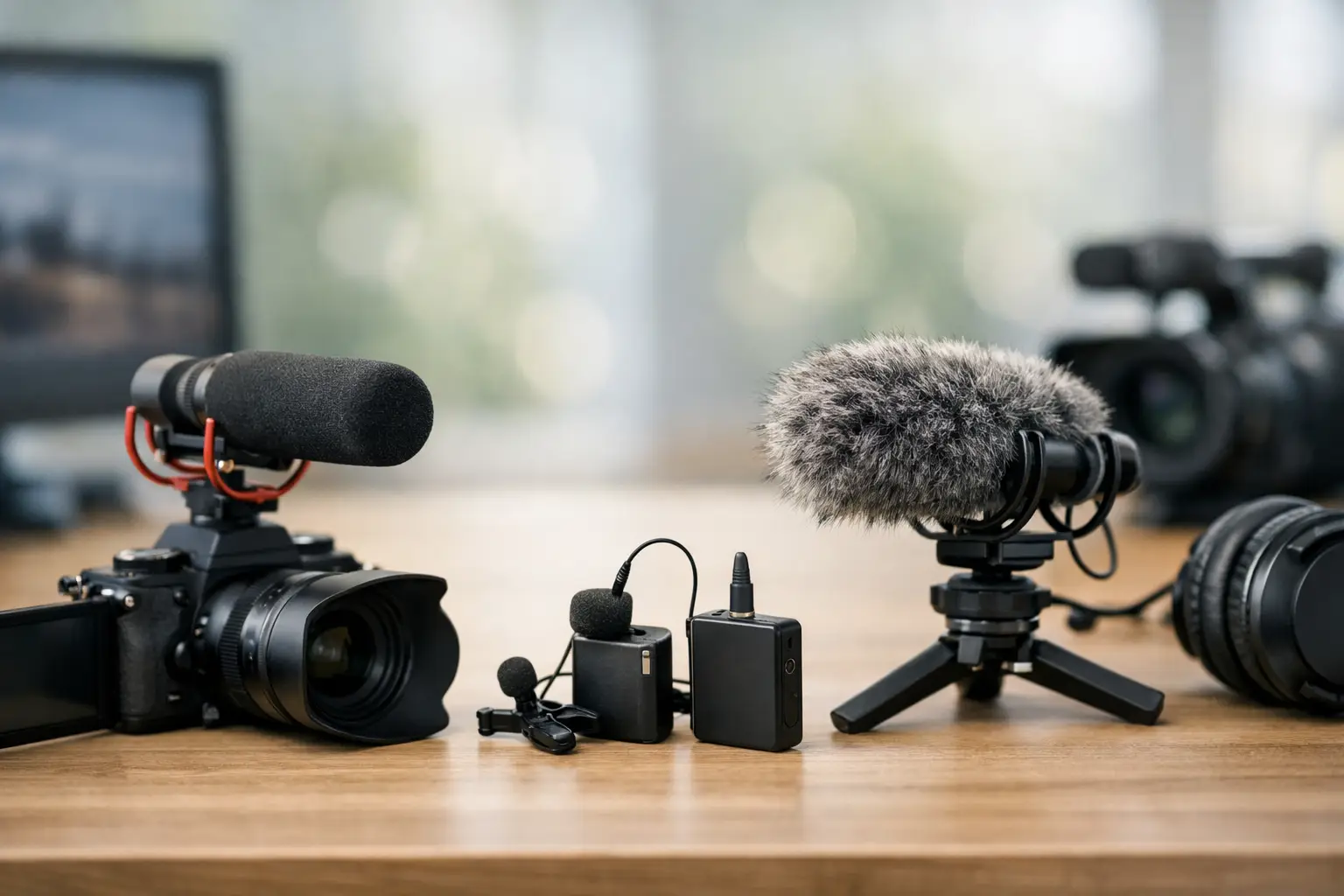
A clear image does not forgive bad sound. That is precisely why a microphone for video recording often determines the final quality more than the camera body or lens - viewers will accept minor image imperfections, but not a room rumbling in the background, a voice that is too far away, or distorted dialogue.
In brief
- Choose a microphone based on the filming situation — distance, movement, and recording device.
- Lavalier microphones are usually best for speech clarity, while shotgun microphones are better for directional recording without a visible mic in frame.
- Check the connections (XLR, 3.5 mm, USB, Lightning/USB-C) and power options (battery, plug-in, phantom) before you start filming.
- Essential accessories (windscreen, shock mount, quality cables) often affect the result more than a more expensive microphone.
What to choose for different tasks
| Task | Solution | Why |
|---|---|---|
| Vlogs and single-speaker videos | A lavalier microphone or a small wireless kit if movement is needed. | A lavalier sits close to the mouth, providing consistent levels and freedom of movement without the microphone being visible in frame. |
| Interviews with multiple people or field reporting | A shotgun microphone on a boom or separate lavaliers for each speaker. | A shotgun focuses sound from a specific direction, while lavaliers provide an individual, stable signal for each participant. |
| Studio, podcasts, or controlled recording | A large-diaphragm condenser or studio USB/XLR microphone with monitoring headphones. | These microphones provide a richer sound in a controlled environment, but they are more sensitive to room acoustics. |
| Outdoor filming with wind and noise | A shotgun with high-quality wind protection or a wireless system with a durable transmitter. | Proper wind protection and a stable wireless signal significantly reduce the impact of external noise. |
| Short-term or special projects | Equipment rental — professional wireless systems or XLR shotgun for the actual shoot day. | Rental gives access to specialized gear without a long-term investment and lets you test the solution before buying. |
Frequently asked questions
Which microphone should I choose for a vlog or YouTube review video?
Most often, the most practical choice is a lavalier microphone or a compact wireless kit — they provide clear voice and freedom of movement. If you prefer not to show a lavalier mic, consider a shotgun on a boom or camera, but then you still need to pay attention to distance.
When is the built-in camera microphone enough?
A camera microphone can be enough for B-roll, reporting, or quick recordings where mobility matters more than excellent speech quality. However, for interviews and content where speech is the main focus, an external microphone is recommended.
How do I know which connection my microphone needs?
Check where the audio will be recorded — camera, phone, audio recorder, or computer — and choose a microphone with the appropriate output (XLR, 3.5 mm TRS, USB, Lightning/USB‑C). If you plan to expand your setup in the future, XLR systems offer more flexibility, but they may require additional accessories.
Is a wireless system always better than a wired one?
Wireless systems provide freedom of movement and easy setup, but you need to consider signal stability, battery life, and the frequency environment. If maximum reliability and quality are the priority, a wired XLR solution is often safer.
How do I choose between a shotgun and a lavalier microphone?
If you need an unobtrusive microphone and can place it close to the speaker (boom or stand), use a shotgun. If movement is important, maintaining a consistent voice level matters, or the microphone needs to be placed directly on the speaker, a lavalier is better.
How can I reduce room echo when recording video?
Reduce the distance between the microphone and the speaker, use absorbing materials, or record in a room with softer acoustics. If possible, choose a lavalier or place the shotgun closer to the speaker; post-processing helps, but it does not fully fix a bad original recording.
Useful links
- Mikrofoni - A broad selection of microphones for video and studio needs, useful for comparisons by type and connection.
- Wireless lavalier microphones - A catalog of wireless lavalier solutions that helps you choose a kit for vlogs and interviews.
- Mikrofoni Skaņas ierakstīšana - Information about microphone rental if professional gear is needed for a specific project.
- Cameras - Check camera compatibility and the connection needed for your chosen microphone, especially XLR or 3.5 mm connections.
- Mikrofonu aksesuāri - Windscreens, shock mounts, and cables often determine the final recording quality, so review accessory availability.
If you plan to shoot interviews, events, advertising content, YouTube videos, or social media materials, a microphone cannot be chosen on the principle that “anyone will be better than the built-in one.” That is a good start, but not a complete solution. Different tasks require different microphone types, connections, and accessories, and a mistake at this stage usually becomes visible already in the first recording.
Which microphone for video recording suits your scenario
The first question is not about the brand. The first question is - what exactly will you film and how far will the microphone be from the sound source.
If a person is speaking to the camera alone, for example creating a product review, lecture, or vlog, very often the best solution is a lavalier or clip-on microphone. It sits close to the mouth, maintains a consistent voice level, and does not require holding the microphone in frame. This is also a particularly practical option for corporate videos, courses, and interviews, where clean speech and freedom of movement are important.
On the other hand, if you are filming with a camera from a short distance and do not want the microphone visible in frame, a shotgun-type microphone will often be more suitable. It focuses on sound from a specific direction and helps reduce ambient noise. But there is one important nuance here - a shotgun microphone is not a magical solution for poor acoustics. Echo in the room will still be audible, especially if the microphone is too far from the speaker.
In studio or podcast-type recordings, a large-diaphragm condenser microphone may also be useful, but it is not the most universal option for video work. It works well in a controlled environment, but is more sensitive to the room and requires more thoughtful setup. If the content is filmed in different locations, such a solution may be less practical than a compact directional or wireless microphone.
Main microphone types for video work
Lavalier microphone
A lavalier is a good solution for interviews, presentations, wedding videos, event coverage, and solo content creation. It can be used both wired and in a wireless system. The wireless variant offers greater freedom of movement, but requires monitoring batteries, transmitter reliability, and the radio environment.
This format is especially effective when speech clarity is the priority. It is less suitable in situations where a natural room sound is needed or several people must be recorded at once without separate microphones.
Shotgun microphone
A shotgun microphone for video recording is a common choice for cameras, rigs, and boom poles. It works well for dialogues, reportage, filming in rooms with controlled acoustics, and outdoors if proper wind protection is used.
It is important to understand that a directional microphone does not work equally in all situations. A shotgun model mounted on the camera will be convenient, but if you are filming from several meters away, voice quality will still decline. In that case, it is better to place it closer to the speaker on a boom or choose a lavalier solution.
Wireless microphone systems
Wireless kits are very popular with content creators, advertising teams, and event operators. They allow fast work, especially if filming involves movement or several shots in a row. Many modern kits simultaneously support clip-on microphones, built-in transmitter microphones, and connection to a camera or phone.
However, when choosing a wireless system, sound is not the only factor to assess. Important factors are working distance, signal stability, battery life, receiver format, and whether the system supports two transmitters at once. This is very important for interview work.
The connection often matters more than the specifications
A microphone can be good, but useless if it is not compatible with your recording chain. That is why before choosing, you should check whether audio will be recorded into a camera, phone, audio recorder, or directly into a computer.
For cameras, the most common options are a 3.5 mm TRS connection or XLR input in more professional bodies and camcorders. Phones and tablets often require a USB-C or Lightning adapter, while computers need USB or an audio interface. If you are planning to grow, it is worth thinking not only about today’s connection, but also about the next step in your workflow. For example, an XLR system offers more flexibility and a more reliable signal, but it can be more expensive at the start and require additional equipment.
Powering is also a common question here. Some microphones are fine with camera plug-in power, others need batteries, and others require phantom power. If this is not checked in advance, you may discover on filming day that there is simply no sound.
What good sound means in practice
Good sound is not just a loud voice. In video recording, intelligible speech, stable level, low background noise, and as little echo as possible are important. That is why you should not look only at the frequency range or marketing promises.
In practice, the distance between the microphone and the speaker is much more important. Even a mid-range microphone placed correctly will almost always sound better than an expensive model that is too far away. This is one reason why lavalier microphones so often win in corporate videos, lectures, and social media content.
Another important aspect is the environment. When filming in an empty office with hard walls, the microphone will pick up a lot of echo. When filming outdoors, the problem will be wind, traffic, and random ambient noise. That is why accessories are not a minor detail - wind protection, shock mounts, and proper cables are often just as important as the microphone itself.
When a camera microphone is enough and when it is not
A camera-mounted microphone is a good compromise for reportage, events, documentary situations, and B-roll filming, where quick work is needed and there is no opportunity to put a separate microphone on each person. It is convenient, compact, and helps achieve much better sound than the built-in microphone.
However, for interviews, talking-head content, and advertising videos with clear text, it is not always enough. If the most important thing in the frame is the human voice, the microphone should be placed closer. The more speech quality matters, the less you should rely on what is mounted directly on the camera.
Purchase or rental - which is more cost-effective
If you film regularly, your own microphone is usually a justified investment. It provides a predictable workflow, familiar sound, and less risk in every project. This is especially true for individual content creators, corporate marketing teams, and videographers with recurring tasks.
On the other hand, for projects with lower frequency or specific requirements, rental is often more sensible. For example, if you need a professional wireless system, an XLR shotgun microphone, or multi-channel recording only for a specific filming day. In such situations, it is worth evaluating not only the price, but also the possibility of receiving advice on compatibility with the existing camera, recorder, and setup.
This is exactly where a full-cycle photo and video equipment center is a practical advantage - you can compare, buy, or rent according to the scope of the project, rather than adapting the project to randomly chosen equipment.
How to avoid the most common selection mistakes
One of the most common mistakes is overspending on a microphone without investing in accessories. Without a proper windscreen, shock mount, or reliable cable, even a good microphone can deliver unsatisfactory results. The second mistake is choosing based on popularity rather than the use case.
The opposite is also often seen - the cheapest option is taken with the idea that the sound can be fixed later in editing. Some noise can be reduced, but a badly recorded voice cannot be fully saved. If the original recording is thin, echoing, or distorted, processing will not make it professional.
Another practical mistake is ignoring testing. Before the real shoot, you need to check levels, connections, batteries, and recording monitoring through headphones. It takes a few minutes, but it can save you from re-shooting and losing material.
How to choose safely
If you need one universal tip, it is simple - choose a microphone according to the filming situation, not according to the advertising description. For one project, a lavalier will be best; for another, a shotgun; for a third, a wireless two-transmitter system with adapters suitable for both camera and phone.
If you are unsure, start with questions about the environment, distance, number of participants, and recording device. Then the choice becomes much more precise. In an Master Foto-level specialized environment, this approach usually saves both budget and time, because the right microphone for video recording is not the one with the longest specification list, but the one that simply works in the specific task without surprises.
Good audio equipment does not make content interesting, but it ensures that what you say is heard exactly as intended.