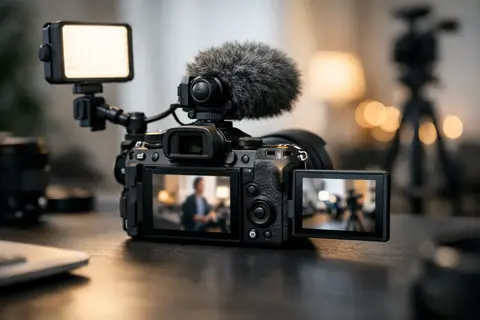
If you plan to film interviews, commercials, events, or social media content, a mirrorless camera for video shooting is usually the most logical starting point. It offers a good balance between image quality, size, autofocus, and lens selection, and in many cases it is more convenient than a traditional camcorder or a heavier cinema system. The question is usually not just about the brand. It is more important to understand exactly what you will be filming and under what conditions the camera will work.
In brief
- Determine your shooting scenario (solo vlog, weddings, commercials, events) before choosing — it affects the priorities.
- Priorities in video shooting: reliable autofocus, audio ports, stabilization, and recording bit depth (e.g., 10-bit).
- Plan the entire system — lens, microphone, light, batteries, and memory cards often affect the final result more than the most expensive body.
- Test autofocus, ergonomics, and overheating behavior in practice; a short-term rental before purchase can help avoid a wrong choice.
- Choose a sensor based on your needs: full-frame for better low-light performance, APS-C for a more compact and cost-effective system.
What to choose for different tasks
| Task | Solution | Why |
|---|---|---|
| A social media vlog and posts for filming one person | Compact mirrorless camera with reliable face/eye autofocus, a tilting screen, a good all-purpose zoom lens, a wireless microphone, and a small LED light. | Practicality and fast operation are more important than maximum technical potential; good autofocus and audio improve production quality immediately. |
| Wedding and event filming | Full-frame mirrorless camera or high-end APS-C with good low-light performance, stabilization, dual card slots, and spare batteries. | Variable lighting and long recordings demand reliability, fast autofocus, and longer operating time. |
| Commercials, music videos, and commercial projects | Camera with 10-bit recording, log profiles, and wide dynamic range, plus an external recorder/monitor and professional lenses. | Color correction and high loading flexibility in post-production require higher-quality codecs and bit depth. |
| Hand/limited movement filming on a stabilizer | Mid-range mirrorless body with in-body image stabilization (IBIS) and a lightweight gimbal; choose a compromise between weight and stability. | IBIS helps with everyday filming, but for more dynamic movements, a gimbal will provide a cleaner result. |
| Indoor product or course entries | APS-C or a full-frame camera with a good standard lens, controllable continuous lighting, and a high-quality microphone. | In stationary conditions, stable lighting and audio are more important than very high resolution. |
Frequently asked questions
Is it better to choose a full-frame or APS-C sensor for video shooting?
A full-frame sensor usually delivers better low-light performance and more cinematic depth-of-field control, which is great for weddings and commercial projects. APS-C is more compact and more affordable — it will often be the more practical choice for social media, courses, and everyday work if the budget is limited.
How important is autofocus for video work?
Autofocus is critical, especially in solo filming, while moving, or with a wide aperture — it reduces rejects and speeds up the workflow. Evaluate autofocus behavior in practice, as laboratory specifications often do not reflect real-world situations.
When is 10-bit recording and log profiles needed?
10-bit recording and log profiles are important if you plan to do serious color grading and work on commercial projects or advertisements. For simple social media content, this is usually not necessary; in that case, easy operation and good autofocus are more important.
Will in-body stabilization replace a gimbal?
Body stabilization (IBIS) greatly improves handheld shooting, but for dynamic shots—such as walking, running, or intensive camera movements—a mechanical gimbal will still deliver better results. A good practice is to combine IBIS with a gimbal if cinematic moving shots are planned.
What functions should be checked before purchase?
Check the recording modes, crop factors, autofocus behavior in real-world shooting, microphone and headphone ports, battery performance, and camera ergonomics of 4K with your lenses. If you use a gimbal, check the total weight and balance, as well as the HDMI connection formats for an external monitor or recorder.
Is it worth renting a camera before buying one?
Yes — renting allows you to try autofocus in practice, check ergonomics and compatibility with existing lenses or stabilizers, especially before more expensive purchases. It reduces the risk of buying a device that does not meet expectations in a specific workflow.
Useful links
- Mirrorless cameras - Category in which to look for mirrorless camera models mentioned in the context of the article.
- Lenses - The article emphasizes that the lens often affects the final result more than the body — this category can be used to choose a universal or specialized lens.
- Video stabilizers - The article mentions that a gimbal may be necessary for dynamic filming; this category helps you find stabilizer solutions.
- LED VLOG light - Continuous light and small LED lighting solutions are mentioned as an essential component of the system, especially for social media content and product shots.
- Photo and Video Equipment (rental) - The article recommends renting equipment before buying; this section helps you find rental options.
- Memory cards - The article mentions the need to plan memory cards (frame rate, codecs) — this category makes it easier to choose the right cards.
- Batteries, accumulators and chargers - In the case of long recordings, the importance of batteries is emphasized in the article; this category allows you to choose backup power.
Why a mirrorless camera for video shooting is so in demand
In recent years, mirrorless cameras have become the standard choice for a very wide range of users - from content creators to commercial videographers. The reason is simple: one and the same system allows you to capture high-quality video, change lenses, connect a microphone, film handheld or on a stabilizer, and often also shoot photos in the same project.
Another important advantage is system flexibility. If today you are filming YouTube or Instagram videos, but tomorrow you need to go to a client event or record a product demonstration, a mirrorless camera can adapt to different tasks. This is important both for individual content creators and for company teams, where one piece of equipment often has to be used for multiple formats.
However, not all mirrorless cameras are equally suitable for video work. In the specifications you may see similar numbers, but in practice the differences show up in autofocus, overheating control, file codecs, dynamic range, and ergonomics.
How to assess whether this is the right camera for your work
Before looking at specific models, it is worth defining the work scenario. If you film yourself alone, reliable face and eye autofocus, a tilting screen, and convenient audio connectivity will be critically important. If you shoot events, in-body stabilization, good performance in low light, and longer continuous recording time will matter more. If you create commercials or client projects, 10-bit recording, log profiles, and more flexible color grading in editing become relevant.
A common mistake is choosing a camera based on just one feature, such as 4K resolution. That is not enough. 4K may be cropped, have a crop factor, limited frame rates, or weaker detail. Also, 6K or open gate will not always be the most valuable benefit if your workflow is fast social media content and the priority is simplicity rather than maximum post-production flexibility.
Sensor size - full frame or APS-C
A full-frame camera usually offers better performance in low light, shallower depth of field, and often broader professional options. This is attractive for wedding videographers, commercial videographers, and those who want a more cinematic image.
The APS-C system, on the other hand, is often more compact and economical. Lenses can be lighter, the overall system more affordable, while image quality is completely sufficient for most online content, corporate video, and everyday filming. If the budget is limited, APS-C is very often a more practical decision than a cheap full-frame body with compromises in other areas.
Autofocus - the real benefit, not just a specification
In video work, autofocus is not a luxury. It is often crucial for workflow speed. Especially if you film alone, while moving, or with a wide aperture. The ability to reliably track a face, eyes, or subject lets you work faster and reduces the risk of unusable footage.
Systems from different manufacturers differ not only in accuracy, but also in predictability. There are cameras that look good in laboratory conditions but tend to hunt for focus in real projects. Therefore, if video is a priority, autofocus behavior should be evaluated in practice, not just from marketing materials.
Mirrorless camera for video shooting - key features
In practical selection, there are several points to pay attention to right away. The first is recording quality. 4K is currently the baseline, but it is important to understand at what frame rate and with what bit depth it is recorded. 10-bit video gives significantly more possibilities in color correction than 8-bit recording, especially if you work with log profiles or client projects.
The second is stabilization. If you film handheld, in-body stabilization can significantly improve the result. However, it does not replace a gimbal in all cases. When walking, running, or filming dynamic movement, there will still be situations where a mechanical stabilizer gives a better result.
The third is audio connections. A microphone input is practically mandatory if you want more than simple sketch videos. A headphone output is a big plus because it lets you monitor recording quality immediately. Many people only appreciate this after the first ruined interview recording.
The fourth is thermal stability and battery life. Some cameras deliver impressive video quality, but overheating limits appear during longer recordings. If you film ceremonies, podcasts, lectures, or longer interviews, this factor is much more important than a theoretically prettier specification.
Screen, ports, and ergonomics
A tilting screen is essential for solo filmmakers and content creators. A full-size HDMI port is a safer solution for an external monitor or recorder than micro HDMI. Button layout, customizable menus, and quick access to video settings also affect workflow speed more than it may seem at first.
Ergonomics become especially important during longer shoots. If the camera is too small but used with heavier lenses, the balance can be uncomfortable. On the other hand, a body that is too large will not always be suitable for travel, vlogging, or work on a compact gimbal.
Which filming scenarios require a different approach
If you film social media content, product reviews, or courses, the priority is often simple operation, reliable autofocus, and good 4K without complicated post-production. In this case, the most expensive body is not necessarily required. It is much more important to invest in lighting, a microphone, and one good universal lens.
If you work with events and weddings, you need a camera that performs reliably in changing light, focuses quickly, and does not stop at a critical moment. Two card slots, good battery endurance, and thoughtful ergonomics are often more valuable in this segment than exotic video features.
If the goal is commercials, music videos, or commercial projects with color grading, then dynamic range, 10-bit recording, log profiles, external recording options, and more professional workflow support become more important. Here the camera is no longer just a convenient tool. It becomes part of the post-production chain.
Budget - the body is not the whole system
In video camera selection, the biggest mistake is often spending the entire budget on the body. In practice, the result is just as strongly affected by the lens, microphone, light, memory cards, spare batteries, tripod, or stabilizer. If the camera is good but the audio is poor and the lighting is uncontrolled, the final material still will not look professional.
That is why the system should be planned as a whole. For example, a mid-range mirrorless camera with a good standard zoom lens, a wireless microphone, and a simple LED light will often deliver a more convincing result than a higher-end body without the rest of the equipment. This is exactly where a specialized approach and the ability to compare not only cameras but the entire kit is useful.
If you are not sure whether a particular model fits the project, a rational solution can be rental before purchase. This is especially relevant when you need to evaluate ergonomics, autofocus in real work, or compatibility with existing lenses and stabilizers. In such cases, a local equipment center with consultations and rental, such as Master Foto, provides a practical advantage over a blind purchase based on a table.
When a mirrorless camera is not the best solution
Although mirrorless systems are very versatile, they are not automatically the best option for everyone. If you film very long events with minimal operator involvement, a traditional camcorder may be more convenient because of long recording time, zoom, and workflow. If you work in high-end cinema production, a dedicated cinema camera can offer better cooling, more professional connections, and more flexible recording.
Also in vlogging, the largest sensor does not always win. Sometimes a more compact camera with simpler operation is more convenient for everyday use. Therefore, the right choice is not the most expensive camera, but the one that best matches your shooting style, team, and delivery deadlines.
What to check before making the final decision
Before buying, it is worth checking how the camera records 4K at different frame rates, whether there is a crop factor, how reliable the face autofocus is, whether there is a microphone input and headphone output, what the battery life is, and whether the menus are clear enough for quick operation. If you use a gimbal, you should also check the combined weight of the body and lens.
It is also important to look one step further. Does the system have a sufficient lens selection? Are spare accessories, batteries, chargers, cages, filters, and audio solutions available? A camera is not a one-time purchase. It is a platform on which future projects will rely.
The right mirrorless camera for video shooting not only improves the image. It reduces the number of mistakes, speeds up work, and lets you take on new projects more confidently. If the choice is based on a real filming scenario rather than just impressive specifications, the equipment starts working for you from the very first shoot day.