
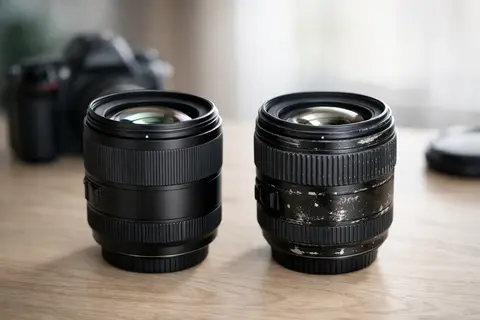
A lens is usually not bought for just one season. That is precisely why the question — new or used lens — is not only about the price difference. It is a decision about reliability at work, image quality, service options, and how much risk you are willing to take.
If you photograph as a hobby, a used lens is often a way to get higher-end optics for a more reasonable budget. If a lens is needed for regular client work, filming, events, or commercial projects, other factors become more important — warranty, predictable technical condition, and delivery safety. The right choice depends not on one universal principle, but on your work scenario.
In brief
- Choose based on use case — for professional work, a new lens is often better; for a hobby, a used one may be enough.
- A used lens can offer better optics at a lower price if the sample is in good condition.
- Check autofocus, aperture blades, lens surfaces, the mechanism, and stabilization before buying.
- If you are not sure, try or rent the lens before purchasing to assess its real-world use.
What to choose for different tasks
| Task | Solution | Why |
|---|---|---|
| Professional reporting and events | Choose a new lens or a carefully checked used sample with a warranty | Reliability and predictable performance reduce downtime risk, which is critical when deadlines and client orders matter. |
| Studio portraits and landscapes | Consider used prime optics or a used professional-grade lens | Prime lenses often deliver higher image quality relative to their price if the optics are in good condition. |
| Occasional or hobby use | A used lens or a cheaper new model depending on budget and requirements | If use is less frequent, investing in a new, expensive model may not be economically justified. |
| Specific focal lengths (macro, birds, cinema) | Short-term rental or trial before a major purchase | A short-term trial helps evaluate weight, breathing, and compatibility without a long commitment. |
New or used lens — the main difference
From a technical point of view, both choices can deliver very good results. Image quality does not get worse simply because a lens is used. If the optics are in good condition, the glass is not damaged, autofocus works correctly, and the mechanical parts are not worn out, a used lens can also serve for a long time and in a predictable way.
The difference lies in the level of risk. A new lens usually means a manufacturer’s warranty, clear origin, full комплектation, and a lower chance of encountering hidden defects. A used lens offers a lower entry price, but requires a more careful inspection and a greater understanding of what exactly to look for.
So in practice, the question is not only whether used gear is good. The question is whether that specific copy is good and whether its price matches its condition.
When a new lens is the more logical choice
A new lens is most often chosen by users for whom predictability matters. This especially applies to professionals, content creators with regular deadlines, and businesses for whom equipment is a work tool rather than an experiment.
A new lens is the safer solution if you plan intensive use. This applies to reportage, weddings, sports photography, commercial video, and studio work, where any autofocus error, mechanical defect, or diaphragm issue can create costs. If equipment failure means missing a job, the lower price of a used lens no longer looks as attractive.
Another argument in favor of a new lens is newer technology. In some models, improvements are not just marketing. They can mean faster and quieter focusing, better compatibility with new cameras, more effective stabilization, or improved optical performance at wide apertures. In video work, this is especially important because the focus motor, focus breathing, and stability in the frame affect the final result more than it initially seems.
If you are buying the first lens for a specific system and are not sure about your technical knowledge, a new product also reduces the chance of mistakes. Fewer surprises, fewer compromises, clearer warranty conditions.
When a used lens is a smarter purchase
A used lens is often a very pragmatic choice. Especially if you want access to a higher-end series but do not want or cannot pay the full price of a new product. In many cases, it is the lens, not the camera, that delivers the biggest gain in image quality, contrast, sharpness, and low-light performance.
That means that for the same budget, you can choose either a new budget-class model or a used, more professional-class lens. The second option is often technically more advantageous if the copy is in good condition. For example, in portrait, studio, or landscape photography, a well-preserved used prime lens can serve for years and deliver high-end results.
A used lens is also especially interesting if you are looking for a specific focal length for a more niche purpose. Macro, a telephoto for birds, an ultra-wide angle for interiors, or a fast portrait lens — in such categories, it does not always make sense to pay full price for a new model if you will use it only occasionally.
For experienced users, the advantage is even greater. If you know the typical weak points of a particular model and can test the optics on the spot, the used market allows very rational decisions.
What to check if the choice is a used lens
The condition of a used lens should not be judged only by scratches on the body. Visible wear may be cosmetic, while a seemingly clean lens may have internal problems.
First, check the front and rear elements. Small signs of use do not always affect the image, but scratches, coating damage, fungus, or noticeable haze are already important warning signs. Second, pay attention to autofocus. It should work accurately, smoothly, and without hesitation. If focusing is slow, noisy, or inconsistent, repair may turn out to be expensive.
Mechanics are also important. The zoom ring and focus ring should turn smoothly. There should be no excessive play, unusual resistance, or the feeling that the mechanism is worn out. If the lens has stabilization, its operation should be checked both by sound and in practice. The diaphragm should work correctly, without sticking and without signs of oil on the blades.
If possible, the lens should be tested on your own camera. That is when compatibility nuances, focusing accuracy, and the real image quality at different apertures become apparent.
Price is not the only calculation
One of the most common misconceptions is the assumption that a used lens always means a better deal. Not always. If the price difference between a new and a used model is small, the buyer is effectively taking on risk without sufficient financial compensation.
Here you need to look more broadly. How long do you plan to use the lens? Is an official warranty important to you? Will the specific model be easy to resell later? Could a potential repair wipe out all the initial savings? Sometimes a used purchase is excellent, but sometimes it is more expensive in the long run.
If you need one universal 24-70 mm or 70-200 mm lens for professional work, safety is often more valuable than the initial savings. On the other hand, if you are looking for a second or third lens for a specific style, a used option may be exactly what you need.
New or used lens for different users
For a beginner, the most important thing is often not to lose flexibility. If you still do not know whether you are more interested in portraits, travel, video, or sports, an overly expensive new lens can limit the budget for other important purchases. In such a situation, a well-chosen used lens is a sensible start, as long as there is a chance to test it or get advice.
For an enthusiast who already understands their needs, the choice is usually strategic. If a quality leap is needed, used premium-class optics often deliver a better result than a new entry-level model. In this segment, the model and condition matter most, not the fact that the lens has been used.
For professionals, the priority is usually reliability, availability, and service. That does not mean that a used lens should not be considered, but the requirements are much stricter. If the equipment makes money, any unexpected downtime costs more than the price difference between a new and a used copy.
Not sure about the choice? There is also a middle ground
Sometimes the best way to understand whether a particular lens really suits you is not to buy it right away. This especially applies to more expensive telephoto lenses, cinema optics, macro solutions, or specific video lenses. If you are not sure about the focal length, weight, operation on your camera, or real-world use, a short-term trial before purchase is a very rational step.
This is exactly where an approach becomes important in which purchase, rental, and consultation are available in one place. For Master Foto clients, this often helps avoid the wrong purchase — first understand the need, then choose the appropriate equipment.
How to make the right decision
If you are choosing between a new and a used lens, start not with the price but with the use case. Ask yourself how critical reliability is, how often you will use the lens, and whether any risk is acceptable. Then evaluate the specific model, not just the category.
A new lens offers clarity and security. A used lens offers value for money. The right answer is often not universal even within one brand or one budget. In some situations, a used lens is the smartest purchase. In others, it is an unnecessary compromise.
The best decision usually comes when the equipment is matched to real work, not to an idea of what counts as affordable. If the lens helps you reliably complete the task and matches your working pace, it is the right option regardless of whether it is new or used.
Frequently asked questions
How do I decide whether to buy a new or used lens?
Start with how often and in what context you will use the lens. Assess reliability requirements, potential resale scenarios, and possible repairs; then compare model prices and condition trade-offs.
What must be checked in a used lens before buying?
Inspect the front and rear lens elements for scratches, coating damage, or fungus. Test autofocus, the mechanical play, zoom and focusing rings, aperture blade movement, and, if present, stabilization operation.
Does a used lens always save money in the long run?
No — if the price difference versus a new one is small, the risk can make a used purchase less worthwhile. Consider possible repairs, spare parts availability, and demand on the second-hand market.
What are the main advantages of a new lens for video work?
New models often offer an improved focus motor, less breathing effect, and better stabilization. This helps maintain a steady frame and more accurate focusing during filming.
What should I do if I am not sure about choosing a specific focal length?
Rent or try the lens on your camera to assess weight, balance, compatibility, and the actual image result. This reduces the risk of buying equipment that is suitable but impractical to use.
Useful links
- Kameras - To try the lens on a specific camera and check compatibility.
- Video filmēšanas tehnika - Additional information about video lenses and equipment used for filming.
- Objektīvi un aksesuāri (noma) - An option to try or rent a specific lens for a short time before buying.