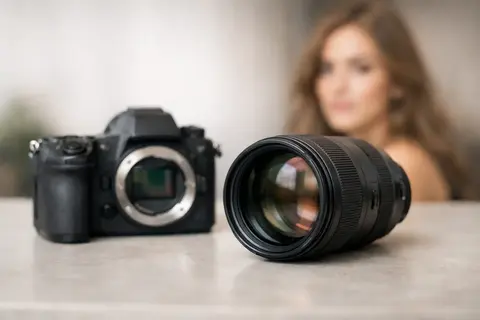
If you are looking for a portrait lens for a full-frame camera, the most important question is not just about sharpness or the aperture number. In portraiture, the lens also determines perspective, working distance, the character of the background, and how comfortably you can work in a studio, at an event, or in natural light. That is exactly why there is no single “best” option for everyone.
In brief
- The choice of portrait lens for a full-frame camera determines perspective, working distance, and background; 50, 85, 105, and 135 mm are most commonly used.
- 85 mm is a safe all-around option for individual portraits, 50 mm is flexible for environment-inclusive shots, 105/135 mm for isolated background separation.
- Brightness (f/1.2–f/1.8) provides shallower DOF and good low-light performance, but increases weight, cost, and focusing requirements.
- Before purchasing, consider the autofocus, weight, the character of the bokeh, and the possibility of renting or testing the lens in real sessions.
What to choose for different tasks
| Task | Solution | Why |
|---|---|---|
| Studio head portraits (tight close-ups) | 105 mm or 135 mm fixed portrait with a medium or large aperture | These focal lengths beautifully compress perspective and isolate the background, creating aesthetically isolated portraits; a greater working distance is required. |
| Business and individual portraits (classic view) | 85 mm fixed lens (e.g., f/1.8 or f/1.4) | 85 mm provides a reasonable working distance, flattering facial proportions, and pleasant background separation. |
| Lifestyle and environmental portraits | 50 mm fixed lens or a lightweight versatile prime | 50 mm is flexible in smaller spaces and when you want to include the environment in the frame, it does not create pronounced perspective distortions. |
| Measures, quick job change between compositions | 70–200 mm telephoto zoom | Telephoto zoom lets you quickly switch from a half-body shot to a tight portrait without changing lenses; the trade-off is greater weight and usually a smaller maximum aperture. |
Frequently asked questions
What is the main difference between 50 mm and 85 mm portrait lenses?
50 mm is more flexible and better suited for environmental portraits or in tight spaces, as it includes more of the surroundings. 85 mm offers more flattering facial proportions and better background separation at a similar aperture.
Do I need an ultra-bright lens (f/1.2 or f/1.4)?
A very fast lens gives a very shallow depth of field and better low-light performance, but increases weight, price, and the need for precise focusing. If you work quickly or photograph moving subjects, a more practical option is often f/1.8 or f/2.
Is it better to choose a prime lens or a zoom lens for portraits?
Fixed lenses usually offer better optical quality, greater light-gathering ability, and often more beautiful bokeh. Zoom lenses, on the other hand, provide flexibility in work, which is useful at events and in situations where there is no time to change lenses.
How important is autofocus for a portrait lens?
Autofocus is especially important when photographing moving subjects, children, or video content with eye focusing. Better collaboration between the lens and the camera speeds up work and reduces unnecessary re-framing.
Is it worth renting a lens before buying it?
Yes — renting lets you try the focal length, weight, and handling in real-world conditions and understand whether the lens suits your style. This is especially useful if you are considering buying more expensive, heavier, or specialized optics.
Useful links
- Objective lenses - Category to find various fixed and zoom portrait lenses.
- MIRRORLESS Lenses - A separate section for mirrorless system lenses — useful if you shoot with a full-frame mirrorless camera.
- Studio flash rental - Related to the advice that in a studio you can often shoot at narrow apertures and use flash.
- NOMA - Recommendation to try the lens on rent before purchasing; the RENTAL page offers the following options.
A full-frame camera gives more freedom when working with depth of field and classic portrait focal lengths. But this advantage only makes sense if the lens matches your shooting style. Someone who creates tight headshots in a studio will have different needs than a content creator who photographs lifestyle portraits indoors or outdoors.
Which portrait lens for a full-frame camera is best
In practice, the portrait segment most often revolves around 50 mm, 85 mm, 105 mm, and 135 mm focal lengths. Each has its own use, and the differences are not only technical. They also affect how a person looks in the frame and how you feel as a photographer during the process.
50 mm on a full-frame camera is a flexible solution. It works well for half-body portraits, environmental portraits, and situations where space is limited. With 50 mm you can get a natural look without exaggerating facial proportions, but for very tight close-ups you need to work carefully. If you get too close, the perspective will become less flattering.
85 mm is considered by many photographers to be the classic portrait focal length. It allows you to maintain a pleasant working distance, beautifully separates the subject from the background, and does not create pronounced perspective distortion. If you have to choose one universal portrait lens for a full-frame camera, 85 mm is often the safest starting point.
105 mm and 135 mm are more specialized tools. They work especially well for tighter portraits, beautifully compress perspective, and provide very strong background separation. However, indoors they can become inconvenient because they require more distance to the subject. In a small studio or apartment, this quickly becomes a real limitation.
Focal length is not just a number
In portraiture, focal length determines not only the width of the frame, but also communication with the person in front of the camera. With 50 mm you are usually closer, and that often creates more direct, lively contact. This is a plus if you are photographing non-professional models, families, or content creators who need a more relaxed atmosphere.
With 85 mm or 105 mm, the distance increases. For some, this helps because the subject feels less “crowded” and the camera is not right in their face. For others, especially inexperienced clients, the greater distance can make communication more difficult. That is why the right lens is not only an optics choice, but also a choice of working style.
If you photograph employee portraits, business profiles, or commercial sessions with a clear brief, 85 mm often provides a good balance. If the emphasis is on the environment, the workplace, or the story around the person, 50 mm may be more suitable. Meanwhile, 135 mm is a very powerful tool when you want a clean, isolated portrait with pronounced background blur.
A fast lens or a more practical lens
Many buyers start by asking whether they need f/1.2, f/1.4, or whether f/1.8 is enough. The answer is simple - it depends on the working conditions and the budget. A larger maximum aperture gives shallower depth of field, more options in low light, and often a premium optical design. But it also means more weight, a higher price, and sometimes less tolerance for focusing errors.
In portraits shot with a very wide aperture, focus must be precise on the eye. At f/1.2 or f/1.4, a mistake can be visible immediately, especially on a full-frame camera with high resolution. If you photograph moving children, work in a reportage style, or do fast sessions without the chance to repeat many shots, an f/1.8 lens is often the more practical solution.
That does not mean a more expensive and faster lens is not worth the investment. It simply means the benefit should be weighed against the real use case. In a studio, where you are working with flashes at f/5.6 or f/8 anyway, ultra-fast optics will not be the deciding factor. In available-light portraits in the evening, however, it can be very useful.
When to choose 50 mm
50 mm is a good choice if you photograph portraits with the environment, work in small spaces, or want one lens that is also suitable for everyday use. It is a popular option for weddings, lifestyle sessions, and content creation where flexibility is needed. Just keep in mind that in tight close-ups, perspective becomes more sensitive to shooting distance.
When to choose 85 mm
85 mm is a classic choice for individual portraits, business portraits, fashion work, and also some studio tasks. It gives a very balanced rendering of the face and a beautiful background. If you cannot decide between versatility and portrait character, 85 mm is usually a safe investment.
When to choose 105 mm or 135 mm
These lenses are suitable for photographers who deliberately create tighter, aesthetically isolated portraits. They are excellent outdoors, in spacious studios, and in situations where there is time and room to work from a distance. For everyday general use they will be less flexible, but in a specific portrait style - very convincing.
What else to consider when choosing a portrait lens for a full-frame camera
Autofocus is more important than it often seems at the time of purchase. Portraiture is not just a static headshot. If you photograph movement, emotions, couples, children, or video content, autofocus speed, accuracy, and quietness become very important. This especially applies to mirrorless systems with eye tracking, where the interaction between the lens and the camera directly affects the pace of work.
You should also look at the lens weight and balance. A heavy 85 mm f/1.2 lens can produce an excellent image, but after several hours in hand or on a gimbal, that is no longer insignificant. A lighter 85 mm f/1.8 is often more comfortable for mobile work, travel, and long sessions.
Another point is the image character. Two lenses with the same focal length and similar aperture can in practice produce different bokeh, contrast, skin tone transitions, and microcontrast. If portraiture is your main genre, it is worth evaluating not only laboratory sharpness tests, but also how the lens renders a human face in a real frame.
A zoom lens as an alternative
Although the classic portrait choice is often prime lenses, a 70-200 mm zoom on a full-frame camera can also be a very powerful portrait tool. It is especially useful at events, business sessions, and situations where there is no time to change lenses. With one optic, you can quickly switch from half-body to tight portrait.
The compromise is usually greater weight and a smaller maximum aperture compared with very fast prime lenses. However, in many projects the working flexibility outweighs this difference. If portraiture is not your only genre, but one of several, a good telezoom can be a more rational purchase.
Purchase, rental, or testing before deciding
A lens that seems technically ideal will not always be comfortable in your everyday work. That is why before buying it is worth understanding whether you will use the lens regularly and for a specific style, or only for occasional projects. This is exactly where rental can be a very practical step, because it allows you to evaluate focal length, weight, and handling in real conditions.
If you photograph rarely or are still developing your portrait style, investing immediately in the most expensive option is not always necessary. For a professional whose daily work includes portraiture, a quality lens pays off both in the image and in working speed. For Master Foto clients, this choice is often between flexibility and specialization, not between a “good” and a “bad” lens.
The right portrait lens for a full-frame camera is the one that does not interfere with your work and helps you achieve a predictable result repeatedly. If you are torn between 50 mm and 85 mm, think not about the specification table, but about the distance from which you want to photograph, how much of the environment you want to keep in the frame, and the conditions in which you work most often. A good decision in portraiture usually starts not with the maximum aperture, but with a clear brief.