
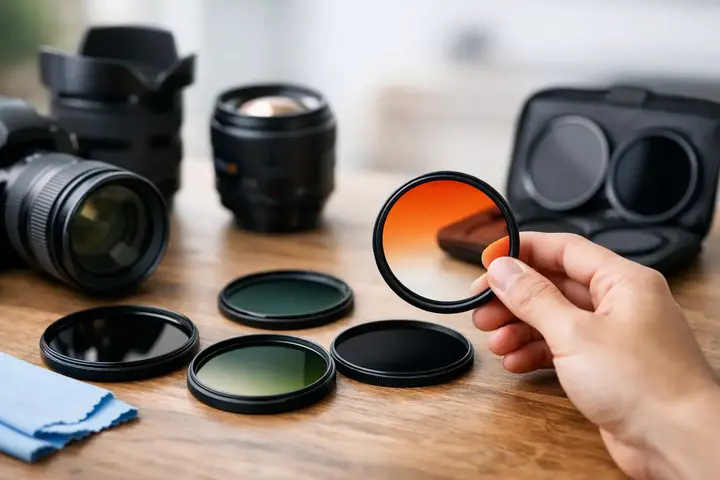
Many filter purchases start with the wrong question - not “which filter is the best?”, but “what problem am I solving in the frame?”. That is exactly why a lens filter selection guide should begin not with brands, but with use cases. A filter can help control reflections, reduce the amount of light, protect the front element, or affect the character of the image, but not every lens and not every task needs the same solution.
Filters are still relevant even in an age when much can be corrected in post-processing. Removing reflections from glass or the water surface, extending exposure in bright daylight, and adding a bit of atmosphere to video footage are not effects that can always be simulated well on a computer. This is where the right choice matters.
In brief
- Start with the question “what problem am I solving in the frame?” rather than “which filter is best?”.
- Choose the filter type by use case: CPL for glare and saturation, ND for exposure control, UV/protective filters for physical protection.
- Pay attention to diameter (Ø), frame thickness, and coatings — they directly affect vignetting, reflections, and color neutrality.
What to choose for different tasks
| Task | Solution | Why |
|---|---|---|
| Landscape photography on a sunny day | Use CPL + fixed or variable ND depending on how much exposure extension you need. | CPL reduces reflections and enhances the sky tone; ND lets you extend exposure without overexposed parts of the image. |
| Videography with a cinema shutter speed and a wide aperture | Primarily ND filters (fixed or variable ND) with good optical quality. | ND provides the light control needed to keep shutter speed and bokeh without overexposure. |
| Travel and reportage where protection is important | A quality protective filter or UV filter with multi-coating and a thin frame. | It protects the lens from dust, scratches, and weather effects without adding a significant optical compromise. |
| Portraits and advertising when softening light is needed | A light mist/black mist filter with a moderate effect. | A mist filter adds light diffusion and softens contrast, while moderation preserves skin texture and post-processing flexibility. |
| Wide-angle landscapes without vignetting | Choose a slim frame and the correct diameter (do not mount overly thick filters on ultra wide lenses). | A thinner frame reduces the risk that the filter will cause vignetting in wide-angle shots. |
How to understand which filter you really need
Before looking at diameter, coating, or frame thickness, it is worth defining your main scenario. If you photograph landscapes, a polarizing filter or a neutral density filter will most often be useful. If you film video with a wide aperture in daylight, an ND filter will almost always be necessary. If you work in reportage mode, while traveling, or at events where protecting the front element is important, a protective filter or UV filter is more often chosen.
This is where the main nuance begins - a filter is not a universal upgrade. A cheap or unsuitable model can reduce contrast, create flare in backlight, affect sharpness, or add an unwanted color cast. That is why quality matters in addition to category.
Practical guide to choosing lens filters by filter type
UV and protective filters
In modern digital photography, UV filters are rarely used for ultraviolet correction as their main purpose. In practice, they more often serve as protection for the front element against dust, minor scratches, sea salt, rain, or dirt. If you work in harsh environments - near the sea, in motorsport, at events, or while traveling - such protection can be justified.
However, there is another side to this. An extra glass surface in front of the lens can increase the risk of flare, especially with cheap filters or in strong backlight. If you use a high-end lens, it makes sense to choose a filter of matching quality with a good multi-layer coating and a thin frame. Otherwise, “protection” can come at the cost of image quality.
CPL or circular polarizing filters
A polarizing filter is one of the most practical tools for a photographer working outdoors. It helps reduce reflections from water, glass, leaves, and other surfaces, while often making skies more expressive and colors more saturated. The effect is not the same in all conditions - it depends on the sun angle and the camera position.
A CPL filter is especially useful in landscape, automotive, architectural, and product photography. At the same time, it should be remembered that it reduces the amount of light, usually by about 1 to 2 stops. Wide-angle lenses may show uneven sky tonality, and that is not a defect but a consequence of physics. Therefore, polarizing should be used carefully with very wide frames.
ND filters
ND or neutral density filters reduce the amount of light without changing color balance. In photography, they allow longer exposures, for example to make water look flowing or motion appear blurred. In video work, an ND filter is often essential if you want to maintain a shutter speed appropriate for cinematic language while shooting with a wide aperture.
Here you must choose between fixed-strength and variable ND filters. A fixed ND usually provides more predictable image quality and a lower risk of artifacts. A variable ND is more convenient, because one filter covers several density levels, but cheaper models may cause color shifts or the so-called X pattern at stronger darkening. If shooting is dynamic, a variable ND is often more practical. If maximum image purity is the priority, a fixed ND is often the safer choice.
Mist and other creative filters
Mist, diffusion, or black mist filters soften contrast, emphasize light bloom, and give the image a softer, more cinematic character. They are popular in video work, portraits, and advertising content. Moderation is very important here - too strong an effect can quickly become conspicuous and difficult to control in different lighting.
If you are not sure, a weaker density is usually a safer starting point. It gives a visible but not exaggerated effect and preserves more flexibility in post-processing.
Size, diameter, and compatibility
The most practical mistake in filter selection is the wrong diameter. The lens filter size is usually marked on the front ring with the Ø symbol, for example 67 mm, 72 mm, or 82 mm. The filter must match this size if you plan to screw it directly onto the lens.
If you have several lenses with different diameters, you do not always need to buy a filter for each one separately. It is often more cost-effective to choose a filter for the largest diameter and use step-up rings for smaller lenses. This is economical and practical, especially for CPL and ND filters. At the same time, it should be noted that a step-up solution will not always be convenient with the original hood, and in some configurations ergonomics worsen.
Frame thickness is also important. On wide-angle lenses, an overly thick filter can cause vignetting. That is why ultra-wide lenses more often use slim-type filters.
What determines filter quality
A filter is not just a glass circle with a thread. Quality is affected by optical clarity, coatings, frame construction, and color neutrality. A multi-layer coating helps reduce reflections, improves light transmission, and makes cleaning easier. This is not a marketing detail - in practice the difference is visible, especially in backlight or night frames with bright light sources.
A good frame means not only mechanical durability, but also ease of use. A CPL filter should rotate smoothly, an ND filter should be precise, and the thread should screw on without effort. If a filter sticks, is hard to remove, or jams easily, it creates unnecessary problems in the field.
The cheapest option is not always bad, but filters are a category where the price difference often reflects a real quality difference. This is especially true for ND and CPL filters, where optical compromises immediately affect the final material.
How to choose a filter according to your working style
For a hobby photographer who mainly shoots while traveling and in everyday life, a high-quality protective filter and one CPL filter for nature or urban scenes are often enough. This provides a practical benefit without an overly complicated system.
For a landscape photographer, a logical kit usually includes a CPL and one or more ND filters. If shooting takes place early in the morning, near water, or in changing weather, these filters deliver results that cannot be fully replaced by software.
For a videographer, the priority is usually an ND filter. If you film outdoors with bright lenses, without ND you will have to close the aperture or change the shutter speed, and that immediately affects the character of the image. If projects include interviews, advertising, or musical content, you can additionally consider a mist filter, but only if the specific visual language requires it.
If you are not sure which filter to buy first, a rational approach is to test the category in practice first. This is exactly where a specialized store consultation or rental option is useful, because a filter that seems necessary in theory does not always become an everyday tool in practice.
Common mistakes to avoid
One of the most common mistakes is buying a filter based on price alone. Another is assuming that a filter will automatically improve any image. Another problem is choosing the wrong strength, especially in the ND segment. An ND that is too weak will not produce the desired effect in bright daylight, while one that is too strong will be inconvenient for everyday use.
Do not ignore the level of the lens either. A very cheap filter mounted on a quality lens becomes the weak link in the system. Conversely, with budget optics, it does not always make sense to invest in a premium filter if the usage scenario is simple. The right choice is almost always proportionate to the equipment and the task.
If you are looking for a long-term solution, it is worth thinking not only about today’s lens but also about future ones. That is why choosing a filter system is often a strategic purchase, not just a one-day purchase. In a specialized environment like Master Foto, it is easier to make such a choice accurately, because what matters is not only the product, but also its compatibility with your camera, lens, and working style.
A good filter is not an accessory for the sake of ticking a box. It is a tool that either solves a specific task or simply adds extra glass in front of the lens. That is why the safest choice is simple - start from your scenario, not from the shelf.
Frequently asked questions
Does a UV filter really protect the lens?
Yes, a UV or protective filter can protect the front element from dust, scratches, and moisture. However, you should choose a quality filter with multi-coating to avoid reducing image quality.
When is it better to use a fixed ND instead of a variable ND?
A fixed ND usually provides more stable and predictable image quality without X artifacts. A variable ND is more convenient for quickly adjusting density, but cheaper models can cause color shifts or artifacts at higher darkening levels.
Does a CPL filter work with all lenses?
CPL works great in many situations, but in wide-angle lenses uneven sky toning may appear. The strength of the effect depends on the angle of the sun, so try it in the real landscape before long-term use.
How do I choose the correct filter diameter if I have several lenses?
Usually you choose the filter for the largest lens and use step-up rings to attach it to smaller-diameter lenses. This is an economical solution, but check whether the step-up causes ergonomics or lens hood issues.
What coatings should I look for on filters?
Look for multi-coating finishes that reduce reflections, improve transmission, and make cleaning easier. Better coatings also reduce color shifts and improve contrast against backlight.
Are mist/black mist filters suitable for all video content?
Mist filters can create a cinematic feel and reduce harsh contrast, but they are not suitable for every project. Their intensity should be chosen moderately, because too strong an effect can limit post-processing options.
Useful links
- Lens filters - A broader category with different filter types and sizes that helps choose the appropriate diameter.
- CPL polarizing filters - A detailed selection of CPL filters and models that are useful for landscape and architectural photography.
- ND neutral density filters - A choice between fixed and variable ND filters needed for exposure control in video and photo.
- Protective filters - A category with UV and protective filters that are useful for mechanical lens protection during travel and outdoor work.
- Protection from rain - Tips and accessories for protecting gear and filters in wet or dusty conditions.