
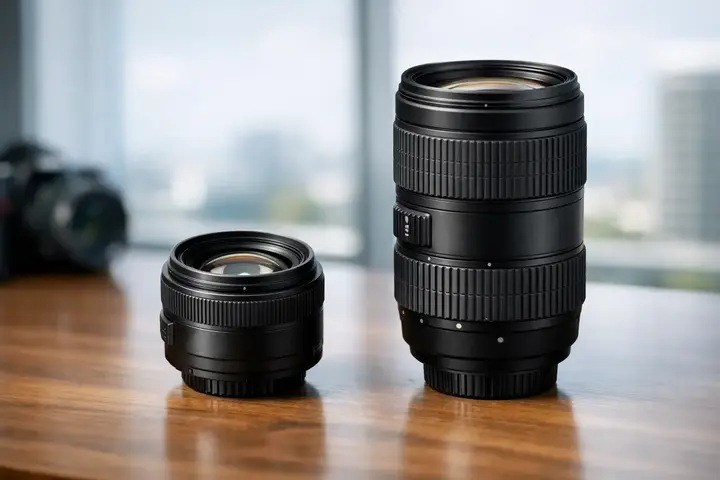
When it’s time to choose your first or next lens, the question usually isn’t just about focal length. In practice, it’s a question of working style. Lens or zoom lens — the right answer depends on what you photograph, how quickly you need to react, and how much control you want over the look of the image.
This choice is often oversimplified. Prime lenses are often presented as the “quality” choice, while zoom lenses are seen as a compromise. In real work, things are not that black and white. Many professionals use both in everyday work, because each solution has clear advantages and equally clear limitations.
In brief
- The choice between a prime lens and a zoom lens should be based on the type of work, speed of response, and the required aperture.
- Prime lenses often offer better aperture, compact size, and character; zoom lenses provide flexibility and faster framing in changing situations.
- For beginners, it is recommended to start with a practical solution (a versatile zoom or one fast prime) rather than technical stereotypes.
- If you are unsure, try renting — it helps you understand which optics actually fit your camera and working style.
What to choose for different tasks
| Task | Solution | Why |
|---|---|---|
| Studio portraits and product photography | Prime lens (e.g., 50 mm, 85 mm with a large aperture) | Better aperture, more pronounced background blur, and a consistent image character make the workflow easier in a controlled environment. |
| Weddings, events, reportage | Zoom lens (e.g., 24-70 mm or 24-105 mm; additionally 70-200 mm if distance is needed) | Quick transition from wide shots to close-ups without changing lenses reduces the risk of missing moments and speeds up work. |
| Travel and everyday content in a “run-and-gun” style | Compact versatile zoom (e.g., 24-70 mm or APS-C equivalent) | Reduced weight and flexibility provide a variety of shots without the extra burden of additional optics. |
| Concerts, low-light video | Fast prime lens (f/1.4–f/1.8) or a professional zoom with a large aperture | A larger aperture allows you to work with lower ISO or a faster shutter while maintaining image quality and an aesthetic background. |
| Sports and distant work | Telephoto zoom lens (e.g., 70-200 mm or 100-400 mm) | A zoom allows you to quickly adjust distance and framing while retaining the ability to isolate the subject from the background. |
| A beginner who does not know their priorities | Start with a high-quality versatile zoom or one fast prime depending on the main genre | A versatile zoom provides flexibility, while one prime helps develop composition skills and creative vision faster. |
Lens or zoom lens — the main difference
To make the choice understandable, the terms should first be separated. A prime lens means a model with one specific focal length, such as 35 mm, 50 mm or 85 mm. You change framing by moving yourself. A zoom lens has an adjustable focal length, such as 24-70 mm or 70-200 mm, so several viewpoints are available in one lens.
It is this flexibility that determines most of the differences in practice. A prime lens usually offers a larger maximum aperture, a smaller size and often higher optical performance at a comparable price. A zoom lens, on the other hand, reduces the need to change optics and lets you adapt more quickly to the situation.
If you shoot in a controlled environment, such as portraits, product shots or studio work, a fixed focal length is often a very rational choice. If you work at events, in reportage, weddings or travel content, where the situation changes in seconds, a zoom gives a practical advantage.
When a prime lens is the better solution
The strength of a prime lens is not only sharpness. The decisive advantage is often light gathering. Lenses with an f/1.8, f/1.4 or even f/1.2 aperture let you work in lower light and achieve more pronounced background blur. This is especially valuable in portraits, wedding photography, concert photography and indoor video work.
Another benefit is consistency. Working with one focal length, the photographer or videographer quickly gets used to a specific angle of view. This disciplines composition and helps predict the frame more precisely even before raising the camera. For many, it speeds up rather than slows down the work.
Prime lenses are often more compact as well. That matters when you need to carry the camera every day, while travelling or during a long filming day on a gimbal. Less weight means more comfortable work and less fatigue.
However, the practical downsides should also be considered. If you can’t move closer or farther away, for example at a concert, in a sports hall or during a ceremony, a single focal-length lens may simply not allow you to capture the needed shot. In those moments, optical quality won’t help if the framing isn’t possible.
When a zoom lens is the smarter choice
A zoom lens shows its value best for dynamic tasks. In event photography, corporate work, weddings, news segments and documentary video production, there is no time to change lenses for every framing. One twist of the ring lets you go from a wide establishing shot to a close-up.
This flexibility saves not only time. It also reduces the risk of missing a moment, as well as the need to change lenses often in dusty, humid or very active environments. For a single work body, that can be decisive.
Standard zoom ranges are especially versatile, such as 24-70 mm for full-frame cameras or their equivalents in APS-C and Micro Four Thirds systems. With such a lens, you can shoot interiors, portraits, reportage and product content without constantly changing optics. Another classic workhorse is the 70-200 mm range, which is very well suited for events, sports and portraits from greater distance.
Keep in mind that zoom lenses are often larger, heavier and more expensive, especially in the professional class with a constant f/2.8 aperture. Also, not all zoom lenses maintain sharpness equally well across the entire range. That is why here it is important not only to look at the specifications, but also at the specific lens class.
Image quality — is the difference still important?
In the past, the difference between prime and zoom lenses was more pronounced. Modern premium zoom lenses are optically very strong in many cases — with good sharpness, contrast and chromatic aberration correction. So saying that a zoom always means lower quality is no longer accurate.
The difference is more visible in specific situations. If you need a maximum aperture, very strong background blur, better low-light performance or a certain image character, a prime lens often still wins. If the final result is published on social media, on a company website or in standard print formats, a good zoom is often more than enough.
In video work, you should also look at focus breathing, autofocus behavior, stabilization and the feel of manual focusing. Here, the lens with the highest sharpness in lab tests does not always win.
Budget and kit logic
If the budget is limited, buying one good prime lens often brings more benefit than a cheap all-purpose zoom. For example, a 35 mm or 50 mm lens with good light-gathering ability can be a very strong start for portraits, everyday content and video. This especially applies to beginners who want to understand composition and exposure basics in practice.
On the other hand, for a user looking for one workhorse for varied tasks, a quality standard zoom is often more financially justified. It reduces the need to buy several separate lenses and simplifies work on location.
The system’s future development plan is also important. If you already know you will expand the kit later, a good path is to start with a versatile zoom and then add one or two prime lenses for specific tasks. If the main genre is already clear, such as portraits or product photography, you can start the other way around too.
How to choose by photography and filmmaking genre
In portrait photography, a prime lens usually offers more advantages. 50 mm, 85 mm or their equivalents help create an aesthetic perspective and pleasant subject separation. But in event portraits, where people move and distances change quickly, a 24-70 mm or 70-200 mm zoom is often more effective.
In wedding work, rarely is one approach enough. In the ceremony and reportage, responsiveness matters, so a zoom is a very logical choice. In couple portraits and the evening part, however, a prime lens can deliver a more expressive result and greater freedom in lower light.
In travel and everyday content creation, weight and versatility become decisive. If you don’t want to carry multiple lenses, a compact zoom is more practical. If image character, small size and intentional shooting are the priority, a single 35 mm or 40 mm lens can be ideal.
For video creators, the choice often depends on the filming style. For interviews, staged shots and controlled work, prime lenses are very suitable. In run-and-gun style, at events and in company videos where you need to work quickly and without interruptions, a zoom usually wins.
Lens or zoom lens for a beginner
A beginner does not need to look for a theoretically perfect answer. They need to look for a solution that encourages regular shooting. If you already have a kit zoom, there is no need to replace it immediately. First, it is worth understanding which focal lengths are used most often and in which situations light or quality starts to be lacking.
If you feel that photos indoors are too dark or you want a more pronounced background, the next step is usually a fast prime lens. If you don’t like constantly changing lenses and flexibility is the main thing, a higher-end zoom will be the better investment.
In practice, the wrong choice is usually neither one nor the other. The wrong choice is buying a lens based on general stereotypes rather than your own working rhythm.
When renting is smarter than guessing
If doubts remain, the safest way is to try the lens in a real project. In theory, 85 mm may seem like the ideal portrait solution, but in practice the space may be too tight. Likewise, 24-70 mm may seem universal, but after several hours on the camera it may turn out to be too heavy for your working style.
In such situations, equipment rental is a rational step. It lets you compare several options without a hasty purchase and understand whether a particular lens matches your camera, genre and working pace. That is precisely why a specialized approach, where you can compare, consult and, if needed, rent equipment, often helps make a more accurate decision than reading specification tables alone.
If you have to choose between a prime and a zoom lens, look not at which forum praises what, but at how you actually work. A good lens is not the one that is theoretically the best. A good lens is the one that helps you get the needed shot in a specific job without unnecessary struggle with the equipment.
Frequently asked questions
Is a zoom lens always worse in optical quality than a prime?
No — modern premium zoom lenses often deliver very high optical performance. The difference usually appears in specific conditions, such as at maximum aperture or in a very specific bokeh character.
Which should I choose if I photograph weddings and portraits?
For weddings and reportage, a zoom (e.g., a 24-70 mm and 70-200 mm kit) is usually more practical because of its efficiency. However, in couple portraits and in the evening, a fast prime can produce a more expressive result.
Are prime lenses always lighter and more compact?
Many primes are more compact and lighter compared with zoom models with similar aperture, but professional lower-cost primes and short-range zooms can vary. You should evaluate the specific model and work requirements.
How does budget affect the choice between prime and zoom?
Usually one quality prime can offer more advantages at a lower price than a cheap versatile zoom, but if you need one universal solution for different tasks, a quality zoom may be more financially sensible. Plan your system development and priorities before buying.
Why do video creators choose primes or zooms depending on the style?
For controlled filming situations, primes provide better aperture and character, while run-and-gun or event video requires zoom flexibility and fast framing. In addition, you should evaluate autofocus, focus breathing, and stabilization in the specific lens.
Is it worth renting a lens before buying?
Yes — renting allows you to practically test a specific lens on your camera and in a real project, which reduces the risk of buying the wrong one. It is especially useful if you cannot clearly say whether you want flexibility or character from a prime.
Useful links
- Lenses - category - A general selection and overview of lens categories, useful for readers who want to browse available models.
- MIRRORLESS lenses - category - Recommended if the reader is looking for zoom and prime options suitable for a mirrorless system.
- Nikon Nikkor Z 24-70mm f/2.8 S II lens - An example of a professional standard zoom lens that illustrates the discussion about the 24-70 mm class.
- Viltrox AF 50mm F1.4 Pro Sony E/FE-Mount Full Frame mirrorless - An example of a fast prime lens associated with sections about the advantages of a prime lens.
- Lenses and accessories - rental - A recommendation for readers who want to try a lens in a real project before buying.
- Canon RF 24mm F1.4L VCM Lens - Shows an example of a fast wide-angle lens that can be useful in video and low-light situations.