
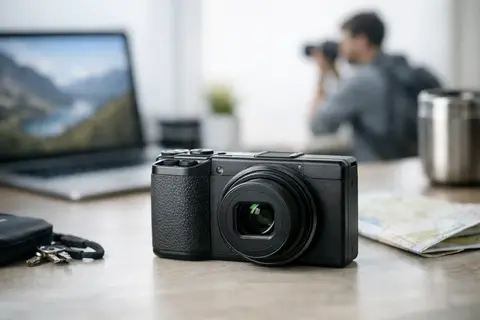
A pocket camera with a APS-C sensor does not have to look impressive to be a serious work tool. The Ricoh GR IV continues the GR series approach: a maximally compact body, fixed 28 mm equivalent wide-angle optics, and image quality usually expected from a significantly larger system camera. It is not a universal camera for every task, but for the right user, its limitations are also its strength.
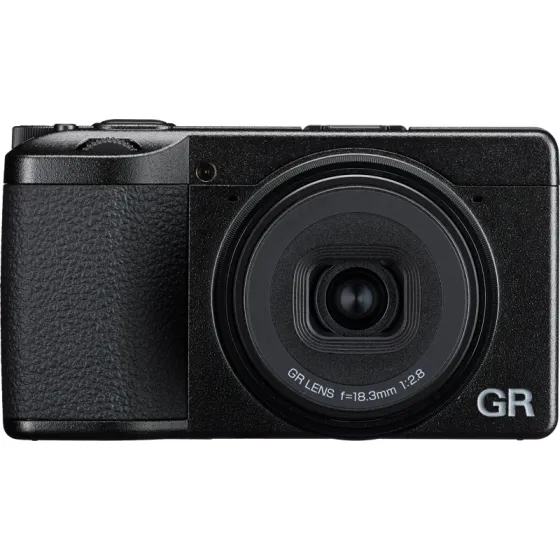 ProductRicoh GR IV PENTAX (GR4)View product
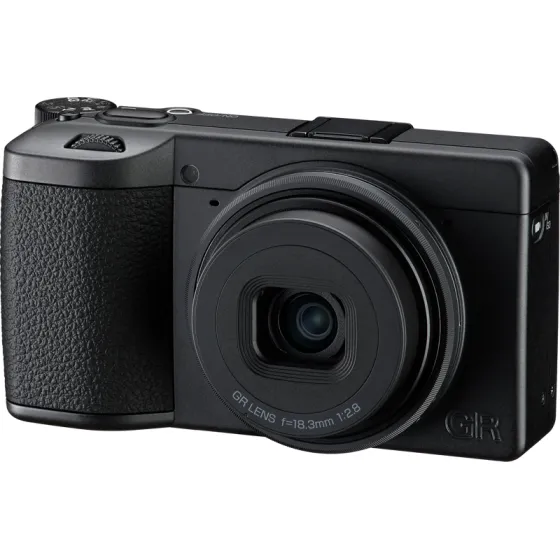 ProductRicoh GR IV Monochrome PENTAX (GR4 Monochrome)View product
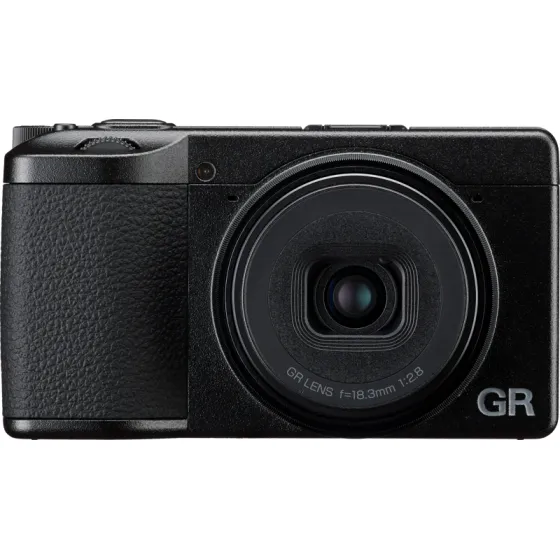 ProductRicoh GR IV HDF PENTAX (GR4 HDF)View product
In brief
- Ricoh GR IV is a pocket APS-C compact camera with a fixed 28 mm equivalent lens — ideal for street, travel, and documentary photography.
- It offers approximately 25.7 MP RAW capability and five-axis image stabilization, but it does not have zoom or an electronic viewfinder.
- Best used as a simple everyday or secondary-body solution: bring a spare battery, a high-quality SD card, and, if needed, a small external LED light.
- The fixed 28 mm lens requires intentional composition — great for environmental portraits and wider stories, less suitable for distant portraits and sports.
What to choose for different tasks
| Task | Solution | Why |
|---|---|---|
| Street photography | Use the GR IV with Snap Focus or fast autofocus, a wrist strap for discreet carrying, and quick response. | The small size and 28 mm field of view let you work unnoticed and capture spontaneous moments while maintaining higher image quality than a phone. |
| Travel photography | Bring a spare battery, a high-quality SD card, and a lightweight travel tripod for cleaner evening shots. | The GR IV’s size encourages carrying it all the time, while power and stability accessories extend shooting time and quality. |
| Environmental portraits and interiors | Add a small external LED light or fill light and work with foreground elements to create storytelling portraits. | The 28 mm perspective lets you include the environment and story context, while extra gear improves lighting and image quality indoors. |
| Professional second body | Use the GR IV as a discreet backup body for reportage and behind-the-scenes work, keeping spare batteries and SD cards within reach. | The small size and quiet operation make it suitable for situations where larger gear would be conspicuous. |
The GR series is most often chosen by fans of street, travel, documentary, and everyday photography. The Ricoh GR IV is intended for someone for whom having the camera at hand is more important than interchangeable lenses, a large zoom range, or a set of video functions. This is a deliberate tool for photography, not an attempt to combine every possible function into one body.
The main idea of the Ricoh GR IV
At the core of the Ricoh GR IV is a APS-C format sensor with approximately 25.7 effective megapixels and a next-generation GR image processing processor. The advantage of such a sensor is not just resolution. It provides more reserve for working in low light, more natural depth of field control, and wider possibilities for correcting RAW files after shooting.
The camera uses a fixed 18.3 mm F2.8 lens, which corresponds to approximately a 28 mm full-frame field of view. This is a classic focal length for city environments, architecture, travel, reportage, and situations in which the photographer is close to the action. If you are used to shooting with a phone as your main camera, the 28 mm field of view will feel familiar, but the GR IV offers significantly better file quality and more precise control over exposure.
An important new feature is five-axis image stabilization, which helps when shooting with longer exposure times, especially in the evening, indoors, and in shaded places. Stabilization does not replace a short exposure time for moving people or vehicles, but in static scenes it reduces the need to raise ISO sensitivity. In practice, this means cleaner shots in conditions where, without stabilization, you would have to look for a tripod or accept more image noise.
Comparison
| Model | Suitable for | Main difference |
|---|---|---|
| Ricoh GR IV | Universal street and travel photography | Classic color rendering |
| Ricoh GR IV HDF | Portraits, evening, and atmospheric photography | Highlight Diffusion Filter |
| Ricoh GR IV Monochrome | For lovers of black-and-white photography | Specialized black-and-white image output |
Who Ricoh GR IV will be a good choice for
This model will be most appreciated by a photographer who regularly carries a camera with them. A large system camera often stays in a bag or at home because taking it with you feels like a separate decision. The GR IV can fit into a jacket pocket or a small bag, so it encourages spontaneous photography more - on the way to work, on a walk, on a business trip, or on a family outing.
In street photography, not only image quality matters, but also discretion. A small camera attracts less attention than a large camera body with interchangeable lenses. This helps you work more naturally in public spaces and react faster to situations. GR series users especially value the Snap Focus principle - the ability to predefine the focusing distance and shoot without autofocus lag for each frame. This approach is effective when you know your distance to the subject and want a fast, repeatable result.
For travelers, the GR IV is an interesting alternative to a larger photo kit. It will not replace a telephoto lens for wildlife, sports, or distant details, but for city, interior, food, people, and landscape shots, 28 mm is often versatile enough. The wide field of view lets you include the environment in the frame without losing the story context.
The camera can also be suitable for a professional as a second body. A wedding, reportage, or commercial project photographer can use it for behind-the-scenes shots, personal documentary work, or situations where larger gear would be unnecessarily conspicuous. However, it should be chosen as a specialized supplement, not as a replacement for a full system with various focal lengths.
The 28 mm focal length requires a deliberate approach
A fixed lens is not a compromise that will suit everyone. It determines how you see the frame. With a 28 mm lens, you often need to move closer, include more surroundings, and work more carefully with the foreground. This creates lively images with a sense of presence, but it is not ideal if you want to photograph portraits from a distance with a blurred background.
Portraits are possible, especially in an environmental portrait style, but for close face shots this field of view is not the most favorable. The GR IV is also not the best choice for sports, birds, concerts from the audience area, and other distant subjects. These tasks require a camera with interchangeable lenses or a compact model with a high-quality zoom.
What to consider before buying
Before choosing, it is worth honestly answering one question: do you want one small camera for a specific view, or one camera for everything? The Ricoh GR IV is very strong in the first scenario and deliberately limited in the second. This clear specialization is one of its biggest advantages.
The camera does not have an electronic viewfinder, so framing is done on the screen. This is convenient in everyday use, but in bright sunlight some photographers still find a viewfinder more precise. Also, keep in mind that the GR series body is not designed as a weather-sealed professional system camera. When shooting in rain, dust, or near the sea, extra caution is required.
Another practical aspect is power and data planning. The small body uses a compact battery, so for an intensive shooting day it is sensible to buy a spare battery. The camera also offers a significant amount of built-in memory, which can save the situation if the memory card is forgotten or full. However, for regular work, an SD card is still a necessary accessory, especially for RAW shooting.
Accessories that are actually useful
The GR IV user experience is improved more by a few thoughtfully chosen accessories than by a large bag of random add-ons. A spare battery is the most practical addition for travel and long photo walks. A quality SD memory card ensures reliable RAW file storage, while a wrist strap helps keep the camera ready without making it cumbersome.
If you shoot in the evening or create architecture and landscape frames, a small travel tripod will be useful. Meanwhile, an external light may be needed for indoor portraits, since there is no built-in flash. Accessory selection should be based on your specific working style, not on the principle that a compact camera must have a full set of extras.
Ricoh GR IV compared with a smartphone and a system camera
A smartphone wins in quick sharing and is always in your pocket. However, the GR IV offers a larger sensor, RAW format, physical controls, and an optical character that computational photography cannot always convincingly imitate. It is a justified choice if you want to intentionally shape the image and later edit it carefully.
Compared with a system camera, the GR IV wins in size and simplicity. There is no need to choose a lens, change optics, or carry a large bag. On the other hand, a system camera will be superior in flexibility, autofocus capabilities in specific genres, working with telephoto lenses, flash systems, and video tasks. None of these solutions is absolutely better - the choice depends on your shooting habits.
If you want to see the Ricoh GR IV in person before buying, it is worth evaluating the body ergonomics, button layout, and whether the 28 mm field of view matches your vision. Master Foto consultation can help compare this model with alternative cameras and choose a suitable memory card, battery, or tripod.
The Ricoh GR IV rewards most the photographer who does not expect a universal solution. If the 28 mm perspective feels natural to you and the camera will often be with you, its small size may turn out to be more important than a long list of functions.
Frequently asked questions
Who is the Ricoh GR IV best suited for?
The GR IV is best for street, travel, and documentary photography, where a camera that is always at hand matters. It offers an APS-C sensor and RAW capability, providing a significant quality step up from a smartphone.
Can the Ricoh GR IV replace a system camera?
No — it is not a universal replacement for a system camera, because it does not have interchangeable lenses or telephoto options. However, the GR IV can be an excellent second body or primary tool for photographers who want simplicity and discretion.
How does Snap Focus work and is it necessary?
Snap Focus lets you pre-set a focus distance and shoot without autofocus lag, which is useful in street situations and for quick reactions. It takes a bit of practice, but it can speed up shooting and increase reliability in certain distance scenarios.
What should you bring if you plan an intensive day with the GR IV while traveling?
It is recommended to bring at least one spare battery, a high-end SD card, and, if needed for evening shooting, a small travel tripod or an external LED light. This will reduce the risk of running out of power or memory and improve evening or indoor shots.
Is the GR IV suitable for portraits?
Yes, but with conditions — the 28 mm focal length is better for environmental portraits than for close-up face portraits. For a more pleasing blurred background or close-ups, it is better to choose a system camera with a longer focal length or a portrait lens.
Useful links
- Kameras - A wider camera selection and comparisons if the GR IV does not meet your requirements.
- LED VLOG gaisma - External LED lighting solutions for portraits and improved indoor lighting.
- Ulanzi ML05 MagLock Fill Light (White) - A small fill light that is easy to carry on trips and use in environmental portraits.
- Statīvu aksesuāri - Light travel tripods and accessories for stabilization during evening shots.
- LED lampas kamerai - Compact LED solutions that mount on the camera or work as fill light in portraits.