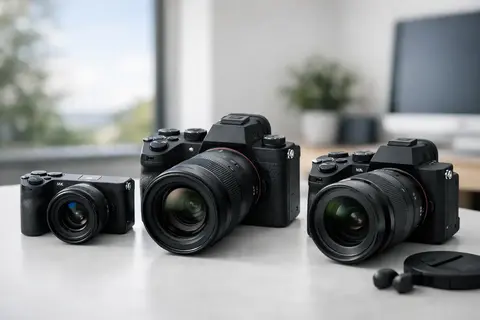
If you are looking for a Sony mirrorless camera review with a clear focus on real-world use rather than just a specifications table, the most important question is simple - what exactly do you plan to photograph or film. In Sony’s system, the differences between models are often not just in megapixels or frames per second. Often the autofocus, body ergonomics, video recording limits, lens selection, and how comfortably the camera works on a longer project are decisive.
In brief
- Define the primary use case (photo, video, or both) — the choice between full-frame and APS-C often determines the result.
- Priorities: autofocus and stabilization — especially in reportage, weddings, and solo video work, they save time.
- For video users, pay attention to 10-bit recording, thermal behavior, and audio integration.
- Lenses often determine final image quality more than the body sensor specs — invest in a lens if the budget is limited.
- Use the system as a whole: batteries, memory cards, tripods, and lighting equipment can be critical in the workflow.
What to choose for different tasks
| Task | Solution | Why |
|---|---|---|
| Wedding and reportage photography | Full-frame Sony with fast and reliable autofocus, lenses with a larger dynamic range (f/1.4–f/2.8), and spare batteries | Full-frame gives better results in low light and a wider dynamic range; fast AF helps capture more usable frames in stressful situations. |
| Travel and vlogging | Compact APS-C Sony body with impressive stabilization or a lightweight hybrid camera setup and lightweight lenses | APS-C offers a good price/performance ratio and lower total weight, which matters when moving around; compactness encourages more frequent camera use. |
| Solo video, interviews and courses | Model with 10-bit recording, good in-body stabilization, reliable AF, and an easily accessible audio port; plus a tripod and microphone | 10-bit and log profiles provide greater flexibility in color grading, while good AF and audio integration reduce post-production time. |
| Product and studio photography | High-resolution full-frame camera or APS-C with quality macro or prime lenses, a photo background and adjustable lighting | Product photography often requires detail and color accuracy, which are delivered by optics and controlled lighting. |
| Fast journalistic/mobile work | High-speed body with good AF tracking, lightweight telezoom lenses and fast memory cards | Quick reaction and reliable AF are crucial in moving situations; fast cards and spare batteries ensure continuous operation. |
Frequently asked questions
How do I choose between a full-frame and APS-C Sony camera?
The choice starts with the use case: if you primarily shoot weddings, portraits, or product studio work and need maximum image quality, full-frame is often better. If size, mobility, and budget are important, APS-C can offer a better price/performance ratio.
How important are lenses compared to the camera body?
In practical work, optics often determine the final image quality more than a newer body, especially in terms of sharpness, bokeh, and contrast. Therefore, on a limited budget, it is often better to choose a better lens rather than the most expensive body.
What should I look for in a Sony camera if video is the main focus?
Pay attention to 10-bit recording, log profiles, the camera’s thermal behavior during long recordings, body stabilization, and audio ports. AF behavior in video mode and crop modes in 4K recording can also be decisive in practical use.
Does autofocus in the Sony system really work better than competitors?
Sony autofocus technology, especially eye and face tracking, is one of the brand’s strengths and in practice helps capture more useful frames. However, in specific scenarios and with some specialized subjects (e.g., fast-moving birds), performance can vary between models.
What accessories will I need when starting with the Sony system?
Plan for extra batteries, quality memory cards, a suitable tripod, and at least one versatile lens. For video work, add an external microphone and, if needed, a stabilizer or rig system.
Do older Sony models still make sense?
Yes — older models often still offer solid AF and good image quality for everyday needs. However, if you need specific modern features (e.g., 10-bit internal recording or improved cooling for video), it is worth comparing them with newer models.
Useful links
- Mirrorless cameras - A broad mirrorless camera category where Sony models and other manufacturers can be compared.
- Memory cards - High-resolution and 10-bit video recording require fast and reliable memory cards.
- Tripods - A stable tripod is important for video interviews, course recordings, and studio photography.
- Lenses - Optics often determine the final image quality — here you can find both original and third-party lenses.
Sony’s mirrorless system has in recent years established itself as one of the broadest and most flexible choices on the market. This applies to both full-frame and APS-C segments. Therefore, for a buyer in Latvia, the choice is often not between a good and a bad camera, but between a suitable and a less suitable model for a specific task.
Sony mirrorless camera review by use case
In practical selection, it makes no sense to look at Sony cameras as a single group. Different models are designed with different priorities. One camera will be strong for wedding photography and portraits, another - for reporting, and yet another - for video production or solo content creation.
If the priority is photography, especially portraits, events or commercial work, Sony’s Alpha full-frame series usually offers a larger dynamic range, better performance in low light, and broader options with professional-class lenses. If a compact size, travel and a lower budget are important, APS-C models are often the more rational choice.
For video users, the differences are even more important. Here it is not only about 4K or 6K oversampling options, but also about overheating control, log profiles, 10-bit recording, stabilization, and connections for audio equipment. A camera that is great for photo work is not necessarily equally convenient for long filming sessions.
Full-frame Sony cameras - when they are the right choice
Full-frame Sony mirrorless cameras are usually chosen by users who expect maximum image quality and greater flexibility in professional work. This applies to wedding photographers, portrait specialists, advertising content creators, and videographers working in changing lighting conditions.
The Sony A7 series is one of the most common reference points. Depending on the specific model, it can be a balanced all-rounder or a more specialized tool. For example, models with an emphasis on resolution will be useful for studio work, product photography and landscapes, while models with an emphasis on speed and video functions fit better into hybrid work.
Full-frame has clear advantages, but also its own compromises. The bodies themselves may be compact, but the system as a whole becomes heavier and more expensive with fast lenses. If a client is starting from scratch, it is important to evaluate not only the camera body, but also the long-term lens lineup, spare batteries, memory cards and, if needed, audio or lighting equipment.
APS-C Sony models - a smart choice for many users
Sony is especially attractive in the APS-C segment for those who want good quality without the cost of a full-frame system. Travel photography, everyday content creation, YouTube, social media video, family events and even semi-professional commercial projects are areas where these models perform very convincingly.
The Sony A6000 series has long been popular precisely because it offers good autofocus, a relatively compact body and an affordable entry into the Sony ecosystem. If mobility and quick operation are important to the user, APS-C often offers a better price-to-performance ratio than the cheapest full-frame camera.
Lens availability should also be taken into account. APS-C users have a sufficiently wide selection, especially for everyday and video needs, but in the more professional segment some users eventually move to full-frame. That does not mean that APS-C is only a transitional solution. Rather, it is a suitable solution for a specific working style where weight, cost and flexibility are important.
Sony mirrorless camera review for video needs
If the camera is primarily needed for filming, the sensor alone is not enough. You need to look at whether the model offers 10-bit recording, sufficiently reliable eye and face detection autofocus, in-body stabilization, and a sensible workflow for longer recordings.
Sony’s strength in the video segment is autofocus reliability and a broad offering of hybrid cameras. This is important both for a solo operator and for a small team without a focus puller. A camera that can consistently keep focus on the speaker, products or a moving subject saves time not only during filming, but also in editing.
However, there are important nuances between models. In some cameras, the crop mode in 4K recording can change the framing. Others may have more limited cooling options or less convenient connections for an external monitor and microphone. Therefore, video users are advised to look at the camera as a system rather than an individual body.
If you plan to film interviews, courses, podcasts or advertising content, audio integration, battery life and body construction for work on a tripod or in a rig system will also be important. If the plan is dynamic reporting or weddings, then stabilization, autofocus and reliable low-light performance come to the fore.
What Sony does especially well
Sony has long been developing autofocus technologies, and this is exactly where the brand remains very strong in many models. Eye autofocus for people, animals and, in some models, also birds or vehicles is not just a marketing feature. In practical work, it helps to get more usable frames, especially in reporting, weddings and video shooting.
The second strength is the lens ecosystem. The Sony E-mount system has a wide range of original and third-party lenses. This means that the user can assemble a system with both premium optics and more rational solutions according to budget and work specifics.
The third advantage is the breadth of choice. Sony offers cameras for different tasks - from more compact everyday use to professional hybrid filming. This is also important in the long term, because you can grow within the system gradually without changing the mount and while preserving your lens investment.
Where to look critically
No system is without compromises. For some users, Sony cameras still feel too compact ergonomically, especially when working with larger telephoto lenses or during long photo sessions. If the camera does not feel secure in the hand, it affects the working pace more than a small difference in specifications.
The menu in older models is not always the most intuitive either. If the camera is used only occasionally, this may be less important. If the work is fast-paced and settings need to be changed during filming, interface logic becomes a real factor.
You should also pay attention to memory card requirements, battery life, and the thermal behavior of the selected model in video work. The higher the recording bit depth and resolution, the more important not only the body becomes, but also the entire surrounding infrastructure.
How to choose the Sony camera that suits you best
If you are buying for the first time, it is best to start with three questions. The first - is your priority photo, video, or both equally important. The second - how important size and weight are in everyday work. The third - what the total system budget is, not just the body.
If the budget is limited, it is often wiser to choose a slightly simpler body and a better lens. In practice, image quality is very often determined by the optics, not just the camera generation. On the other hand, if the working model is video or reporting, the body’s autofocus, stabilization and reliability may be more important than maximum resolution.
For those who are still not sure about a specific model, it is worth not only comparing the equipment, but also holding it in your hands or trying it on a project. This is where the practical benefit of a specialized retailer’s approach comes in, where it is possible not only to purchase but in some cases also to evaluate the solution with expert consultation or rental support, as offered by Master Foto.
Is Sony the most suitable option for you
A Sony mirrorless camera review almost always leads to one conclusion - the system is very strong, but the right choice depends on the type of work. If you need fast and reliable autofocus, a wide lens selection and strong hybrid performance for photo and video tasks, Sony is one of the safest options. If the priority is maximum ease of use in a specific genre or a certain ergonomics, comparing it with other brands is still worthwhile.
A good camera is not the one with the longest feature list. A good camera is the one you want to take to work, that you trust at the important moment, and that you can sensibly equip with the right lenses and accessories. That is where a good choice begins.