
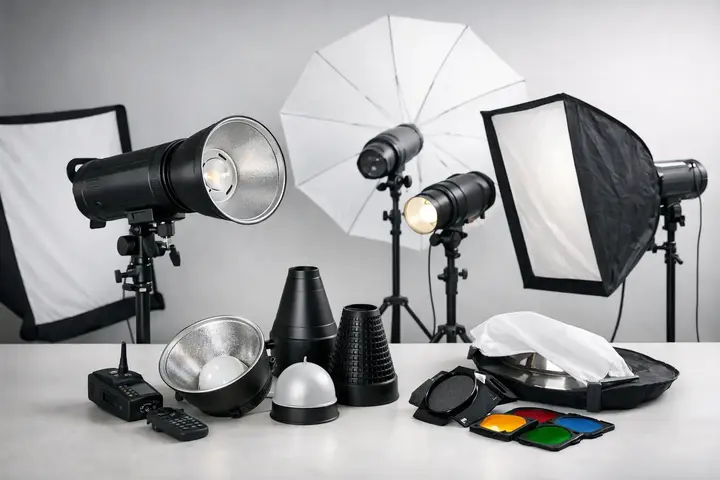
If one light looks too weak in a portrait session, but two- or three-light setups seem too complicated, the problem is usually not the amount of gear. More often, the question is which studio flash set selection will be right for your shooting style, space, and workload. A poorly chosen set can mean unnecessary expenses, unnecessarily high power, or, on the contrary, insufficient reserve in situations where the light needs to work precisely and repeatably.
This is a practical topic both for those building their first home studio and for photographers who already work with clients and want a more stable, faster, or more flexible lighting system. A good set is not just the number of flashes in the box. It is a solution where power, light quality, control, mounts, and how quickly you can get from idea to finished frame all have to align.
In brief
- Start with the main question: what will you photograph most often, how large is the space, and whether the equipment needs to be moved.
- Evaluate power together with modifiers — a softbox/octabox changes the result more than WS/power alone.
- Choose a platform with broad accessory support (e.g., Bowens mount) and make sure the sync solution and recycle time are suitable.
- If you are unsure, buying a kit gives you a fast start; if you know the workflow, build the system piece by piece.
- When buying a kit, check exactly what is included: stands, trigger, modeling light, and transport bag.
What to choose for different tasks
| Task | Solution | Why |
|---|---|---|
| Home portraits and social media content | 1–2 medium-power monoblocks with a large softbox and a stable stand | A simple setup gives soft, controlled light and is easy to reproduce in a small space. |
| Product photography for e-commerce | Several smaller modifiers (stripbox, rectangular softbox), precise stands, and a reliable trigger | In product photography, repeatability and precise light control are important, which specialized modifiers provide. |
| Fashion, group, and studio sessions | Two or three high-power heads, different modifiers (octabox, fill light), and stable synchronization | Repeatability, sufficient power, and the ability to separate the subject from the background are critical for group work and large formats. |
| On-location/outside-studio work | Battery flashes or a hybrid platform with portable stands and a transport bag | Mobility and quick setup without access to mains power are often more important than maximum power. |
How to understand which studio flash set selection is suitable
The first filter is the shooting task. If you mainly create individual portraits, small product photography, or content images for social media, one or two main heads are often enough. A single light with a suitable softbox can deliver a very high-quality result if the space is controllable and you use a reflector. A two-light set, on the other hand, gives much greater flexibility - one light can be used as the key, the other as rim, background, or fill light.
If you photograph families, groups, fashion shots, or commercial assignments on a daily basis where repeatability matters, two lights often become the minimum, while three allow you to work much more freely. A third light is not a luxury in every case, but it significantly helps when you need to separate the model from the background or illuminate a product precisely without compromise.
The second filter is the room size. In a small room, very powerful studio flashes are not always an advantage. A powerful head can force you to stop down more than you want, or make it difficult to work with a wider aperture. At the same time, in a larger studio, when photographing through large light modifiers or lighting groups, insufficient power quickly becomes a limitation.
How much power is needed in practice
A studio flash set selection often starts with the question of watt-seconds. There is no single universal answer, but there is a good guideline. For a small room, portraits, and e-commerce products, a lower or medium power range is often enough. Such a solution is easier to control, especially if you work close to the subject and use a softbox, umbrella, or beauty dish.
Medium and higher power heads become relevant if you use large octaboxes, photograph full-length shots, groups, or want to confidently overpower ambient light. If you plan to do part of the work outside the studio, power reserve is also valuable. However, this must be considered together with portability, power source type, and the overall system weight.
It is important not only to look at the maximum power, but also at the adjustment range. In practice, this means how low you can set the flash without losing stable color temperature and exposure consistency. Many beginners look only at the maximum, but in day-to-day work the low end of the power range is often just as important.
Monolights, battery solutions, and the logic of the set
The classic choice for a studio is usually mains-powered monolights. They are straightforward, stable, and suitable for a permanent workspace. If you photograph indoors and rarely move the lights over long distances, this is usually the most rational starting point.
Battery flashes are a logical choice if the same system must be used both in the studio and on location. They provide mobility, fewer cables, and faster setup on site. The trade-offs are a higher price, battery management, and sometimes larger compromises when it comes to prolonged high-volume shooting.
When choosing a set, you should not only look at whether the box contains two heads and two stands. The question is whether this system can be expanded after three months. If later you want to add a third light, another modifier, a more powerful head, or a battery solution, it is important that all of this fits within the same logic rather than being separate incompatible parts.
Light modifiers determine the result more than many think
Two sets with similar power can produce very different results if they have different light modifiers. That is why a set should not be judged only by the flash specifications. For portraits, a softbox or octabox often works very well because it gives soft, controlled light. In product photography, it is important to be able to direct and repeat the light precisely, so a rectangular softbox, stripbox, or additional grids are useful.
If the set includes only simple umbrellas, that may be enough to start with, but not always in the long run. Umbrellas are fast and convenient, but they spread light more widely and less controllably. In a small room, that can mean more unwanted reflections on walls, in the background, or on the product.
A Bowens-type mount or another widely available standard is a practical advantage. It means a wider choice of accessories and easier system development. If you plan to work in different genres, the availability of light modifiers is just as important as the power of the heads themselves.
Synchronization, recycle time, and color stability
The most annoying problem in studio work is not an unattractive design, but unreliable operation. If the trigger system does not work consistently, if the flash recycle time is too slow, or if the exposure changes for no apparent reason, the work slows down and the client feels it.
That is why, when choosing a set, you should pay attention to synchronization. Today, a practical standard is wireless control, which allows you to adjust power from the transmitter and divide the lights into groups. This speeds up the work, especially when the lights are placed high up or in hard-to-reach locations.
Recycle time is important in portrait, fashion, and children’s photography, where the moment changes quickly. Slower recycling may be acceptable for quiet product photography, but not for a session with a dynamic pace. Color temperature stability, in turn, is critical for commercial work where a uniform result is needed throughout the series without excessive post-processing.
What must not be forgotten in the set contents
Sometimes a good offer looks complete only at first glance. Later it turns out that you need to buy a separate radio trigger, modeling light bulbs, heavier stands, or a transport bag. That is why it is worth clarifying exactly what is included and what will be needed on the very first working day.
Stand quality is often underestimated. A lightweight stand may be enough for a small light source, but with a larger softbox it becomes a safety risk. The same applies to sandbags, adapters, and spare mounts. If the set is intended for regular work, these details are not secondary.
Modeling light is also essential, especially for beginners and in small studios. It helps you see the shadow direction, light falloff, and reflections before taking the shot. If you work with video and photo in parallel, keep in mind that a classic studio flash does not fully replace continuous light. In some projects, the right answer is not a more powerful flash, but a different type of lighting.
When to buy a set and when to build a system piece by piece
A set is a good choice if you need a clear start without excessive matching. It is especially useful for a first studio, a small company content corner, or a photographer who wants to start working quickly with a proven basic configuration. It is usually also more cost-effective than buying all components separately.
Building a system piece by piece is more often chosen by those who already know their workflow precisely. For example, one very powerful head with a high-quality large softbox may be more valuable than a mid-range two-light set if you photograph a specific type of portrait. Similarly, a product photographer may find it more important to invest in precise modifiers and stable stands rather than a third light.
Therefore, it is not correct to assume that more is always better. The more accurate approach is to assess whether the specific set reduces your limitations or just increases the amount of gear on the shelf.
A practical approach to the first choice
If a studio flash set selection must be made without prior experience, start with three questions. What will you photograph most often, how large is the space, and whether the equipment will need to travel. From these answers, it usually becomes clear whether you need a one- or two-light starter solution, what power is sufficient, and how important mobility will be.
The next step is to understand which accessories will be needed right away, not just theoretically later. For portraits, this will often be one larger softbox, a sturdy stand, and a reliable trigger. For product photography, several smaller modifiers and more precise light control may be more important. If you plan to grow the system, choose a platform with available accessories and a clear expansion path.
If you are unsure between two similar options, the most practical criterion is not the maximum number in the specs, but which solution will be more convenient in everyday work. It is everyday usability that determines whether the light will be used often and with confidence. If needed, it is worth consulting a specialized retailer, such as Master Foto, especially if the choice is between a purchase and a rental for a specific project.
A correctly chosen set does not make the shot good for you, but it removes technical obstacles at the moment when you need to work quickly, precisely, and repeatably. And that is usually the most important thing in studio work.
Frequently asked questions
How do you choose the right power for a studio flash?
The choice depends on the lens, room size, and modifier type. For a smaller room and close portrait work, medium power is often enough, while larger octaboxes, groups, or shooting outside the studio benefit from extra power reserve.
Is it better to buy a kit or build a system piece by piece?
A kit is good if you need to start quickly with a functional basic setup. Building the system piece by piece is valuable if you already know the workflow and priorities well — it lets you invest deliberately in modifiers or a more powerful head.
How important is the choice of light modifiers?
Light modifiers often determine the final look more than the flash’s technical specs. Softboxes and octaboxes create a soft look, while stripboxes, grids, or rectangular softboxes allow precise control of reflections and highlights in product photography.
Why should you pay attention to recycle time and synchronization?
A slow recycle time slows down the workflow, especially in portrait, fashion, or children’s sessions with a dynamic pace. A stable wireless trigger and consistent exposure ensure a faster workflow and less post-processing.
Monoblocks or battery flashes — which should you choose?
Mains-powered monoblocks are usually more stable and cheaper in the long term if you mainly work in the studio. A battery solution provides mobility and faster setup on location, but requires battery management and is often more expensive.
Useful links
- Studijas zibspuldžu komplekti - The kit category is useful if you are looking for a ready-made solution for a quick start in the studio.
- Studijas zibspuldzes - A broader range of studio flashes lets you compare monoblocks and power variants.
- Piederumi zibspuldzēm - Check triggers, adapters, and mounts that ensure the system can be expanded.
- Foto lietussargi - Umbrellas are a low-cost starter modifier; the link is useful if you are considering budget solutions.
- Statīvi - Quality stands are the foundation of safety and stability, especially with large softboxes.
- amaran Lantern 65 zibspuldzes daudzvirzienu mīkstās gaismas pārveidotājs softboks Bowens stiprinājums - An example of a softbox type with a Bowens mount that improves light softness and expands accessory options.