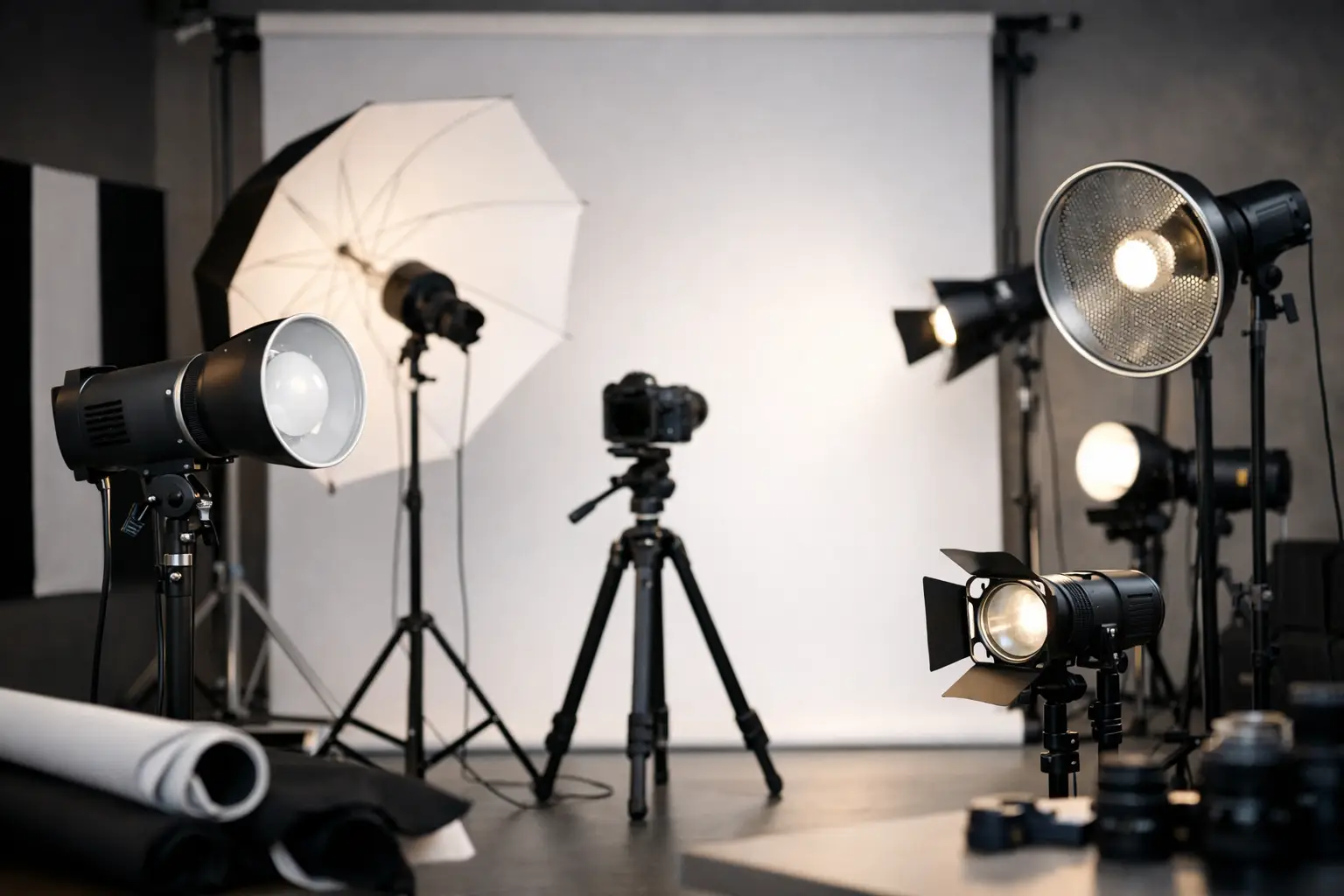
If in the first test the frame looks too flat, but in the second it is already overexposed, the problem is often not in the camera. Usually it starts with the light. A studio flash selection guide helps you understand which parameter to look at first and when it is not worth overpaying for features that will not be used in a specific job.
In brief
- Start with the use case—studio, on-location, or product photography determines the priorities.
- Pay attention to power (Ws), minimum power, and recycling time, not just the maximum value.
- Choose an ecosystem with broad support for light modifiers and radio control so it is easy to expand.
- Manual mode provides repeatability in the studio; TTL and HSS are useful on location and in specific scenarios.
- If you are not sure, try the equipment from a rental before buying to reduce the risk of a bad investment.
What to choose for different tasks
| Task | Solution | Why |
|---|---|---|
| Portrait photography in a home or small studio | A 200–300 Ws monoblock with good minimum power control, stable modeling light, and a widely available softbox mount. | Enough power for portraits, the ability to work with a wide aperture, and easier light shaping without excessive cost. |
| Product and e-commerce photography | Monoblocks with good color stability and precise power reproducibility, plus the option to expand the kit with reflectors and softboxes. | Repeatability and color consistency are essential to ensure identical results across multiple frames and sessions. |
| On-location shoots and outdoor work | A battery flash with fast recycling and built-in radio control, sufficient power reserve, and replaceable batteries. | Mobility and fast recycling reduce time loss on location, but weight and extra spare batteries must be taken into account. |
| Content creators — photo + video | A flash kit for photography and a separate continuous light for video recording, or a hybrid system with a convenient LED modeling light. | A flash does not provide continuous light for video; the combination delivers good results in both areas without compromise. |
| Motion and fashion photography | A flash with short flash duration, fast recycling, and stable repeatability; consider portable battery solutions if mobility is needed. | Flash duration and recycling time directly affect the ability to freeze motion and work with fast sequences. |
Frequently asked questions
What power (Ws) is needed for a small home studio for portraits?
Usually 200–300 Ws is enough, especially if you use softboxes and work with a moderately wide aperture. If you plan to use larger modifiers or blow out a white background, consider the 400 Ws class.
Is TTL necessary for professional studio work?
TTL can speed up work on location or in dynamic situations, but in the studio manual mode provides precise repeatability. Many professionals use TTL as an aid, while leaving the main light control to manual mode.
What does HSS mean and do I need it?
HSS (high-speed sync) lets you use shorter shutter speeds, for example when shooting outdoors in bright sun with a wide aperture. If you plan to use flashes both in the studio and on location, HSS can be a useful feature, but for purely studio work it is not mandatory.
How do I choose between a mains-powered and a battery flash?
A mains-powered monoblock usually provides more power reserve and longer sessions without worrying about charging. A battery flash gives mobility and is more convenient on location, but you should consider additional battery costs and possibly greater weight.
Why is minimum power important in a small studio?
If the flash cannot reduce power enough, you may have trouble working with a wide aperture in small spaces without overexposure. Good minimum power gives greater flexibility in composition and depth-of-field control.
Does it make sense to buy a large kit right away, or is it better to start with one light?
Many beginners and even professionals start with one powerful monoblock and one modifier to learn the basic principles of light. If needed, the kit can be expanded later; renting equipment first can help you understand your real needs.
Useful links
- Flash lighting - A category with additional information and accessories that are useful when choosing studio flashes.
- Studio flashes - The rental section allows you to try different models before buying, which helps reduce bad investments.
- Continuous lighting - A useful resource for content creators who combine photo flashes with continuous light for video.
- Flash accessories - A section with support accessories and modifiers that are important for system expansion.
A studio flash is not just a more powerful alternative to the camera hot shoe flash. It is a system where not only the light pulse matters, but also repeatability, recycle time, compatibility with light modifiers, radio control, and the working environment. A portrait photographer will have one set of priorities in the studio, product photography will have another, and location shoots yet another.
How to start a studio flash selection guide
The safest starting point is not the model or brand, but the use scenario. If you photograph portraits in a small room, there is no point chasing maximum power that you will only use rarely. On the other hand, for full-length portraits, group shots, or working with large softboxes, a power reserve becomes very practical.
You should also consider whether the light will be stationary in the studio or regularly moved. Mains power usually means stable work during longer sessions and fewer compromises in terms of output. Battery-powered models provide mobility, but they cost more, and you need to think about battery cycles, charging, and spare batteries.
If you are still only building your first kit, a logical choice is often one or two monoblock-type flashes with straightforward controls and widely available light modifiers. This allows you to expand the system gradually instead of overpaying right away for a complex setup.
Power in watt-seconds - what it actually means
Studio flash power is usually specified in Ws, or watt-seconds. This number gives a reference point, but by itself it does not tell the whole story. 200 Ws, 300 Ws, or 600 Ws models differ clearly on paper, but in real work the result is affected by the reflector, light modifier, distance to the subject, and camera settings.
For a small home studio, a 200 to 300 Ws flash is often enough for portraits, especially if you shoot at a moderately open aperture. If you plan to use large octaboxes, photograph against a white background, or achieve greater depth of field in product photography, it is safer to look at the 400 to 600 Ws segment.
Minimum power is also important. If the flash is powerful but cannot be reduced enough, it will be difficult to shoot with a wider aperture in a small room. This is a typical case where a larger number does not always mean more convenient work.
TTL, manual mode, and HSS
If you want complete repeatability in studio work, manual mode is still the primary choice. It is especially useful for product, e-commerce, and classic portrait tasks, where the lighting setup does not change and precise control is important.
TTL can be useful on location, in reportage style, or in dynamic situations where the distance to the subject changes. It speeds up work, but does not always produce the same result frame after frame. That is why in the professional environment TTL is often seen as a workflow accelerator rather than an essential standard.
HSS, or high-speed sync, becomes relevant if you want to shoot at shutter speeds shorter than the camera’s standard sync limit. It is useful outdoors to keep a wide aperture in bright daylight. If the flash is intended only for the studio, HSS may not be a priority. If you plan to use one system both in the studio and on location, this feature becomes much more valuable.
Studio flash selection guide by type of work
For a portrait photographer, the most important things are usually light quality and convenient shaping. That means stable power adjustment, modeling light, and compatibility with softboxes, octaboxes, beauty dishes, and grids. If the system accepts widely available mounts, it will be easier to expand later.
In product photography, repeatability is especially important. Here you should look at how stable the color temperature is across the power range and whether the flash delivers a consistent pulse. Cheap devices sometimes work well in simple tasks, but in more demanding commercial work, differences between frames become noticeable.
For fashion, sports, or motion shots, flash duration and recycle time are essential. If the flash recycles slowly or the pulse is too long, freezing motion can be unconvincing. In this segment, technical specifications are more than theory - they directly affect the final result.
Content creators who work with both photo and video should look more carefully. A studio flash is excellent for photography, but it is not suitable as the main light source for video. If you need one universal solution for both formats, it is sometimes better to build a flash setup for photo needs and a separate continuous light for video tasks.
Modeling light, radio control, and ease of use
Modeling light helps you see shadows and the direction of the light before taking the shot. It speeds up setup and reduces guesswork, especially for beginners. If you work regularly, you will also appreciate a more powerful LED modeling light, which gives a clearer idea of the lighting pattern.
Radio control is effectively the standard today. It allows you to adjust power, group multiple lights, and trigger flashes without extra cables. When choosing a system, you should check how broad the ecosystem is - whether different power levels, battery models, compact heads, and other accessories are available. If you plan to expand the kit later, this is a very important factor.
Ease of use in everyday work also means a clear interface. If the menu is confusing or power adjustment is slow, it will interfere with the session more than it seems in the store. That is why before buying it is worth not only comparing specifications, but also understanding how comfortable it is to work with the specific model in practice.
Light modifiers and mounting system
Often it is the light modifiers that determine how flexible your studio system will be. The flash body itself is only the beginning. If you plan to use different softboxes, reflectors, snoots, or beauty dishes, you need to pay attention to the mount.
More popular mounting standards usually mean a wider choice of accessories and more predictable costs in the future. This is important not only for professionals, but also for enthusiasts who start with one light and gradually expand the kit. A closed or rare system may be good for a specific model, but more expensive to develop around.
Here is a simple principle - if you do not know which modifiers you will need in a year, choose a system with broad accessory availability rather than a highly specific solution.
When one flash is enough, and when you need a kit
You can do much more with one studio flash than it may seem at first. Portraits with a logical lighting setup, simple product shots, and content photography for small brands often start with just one source, one softbox, and a reflector.
A two- or three-light system becomes valuable when you need to separate the background, create rim light, or work faster without constant rearrangement. In commercial work, this saves time. However, for a beginner, a larger kit does not always mean a better result. Often it is much more important to understand one main light well.
If in doubt, a practical option is to first try a specific power and form factor solution through rental. This helps you understand whether you need a compact battery-powered model, a stationary monoblock, or a full multi-light kit. This approach often reduces the risk of a wrong purchase more than long comparison of specifications.
The most common mistakes when choosing a studio flash
The most common mistake is focusing only on maximum power. The second is ignoring the ecosystem, mounts, and accessory availability. The third is buying studio light for the needs of one project without thinking about daily work.
Another mistake is confusing your needs in photo and video tasks. If the main work is photography, a flash will be a more effective tool than continuous light. If video dominates, you should look in another category. Universal solutions are rare, and they usually require compromises.
It is also important to realistically assess the room. If the ceilings are low and the studio is small, a very powerful flash without sufficiently low minimum power can create more limitations than benefits.
The right studio flash is not the one with the most features. It is the one that fits reliably into your workflow, room, and budget, allowing you to predictably get the desired result in the next session. If the choice is based on real use rather than only a specification table, the equipment works for you instead of requiring constant adjustments.