
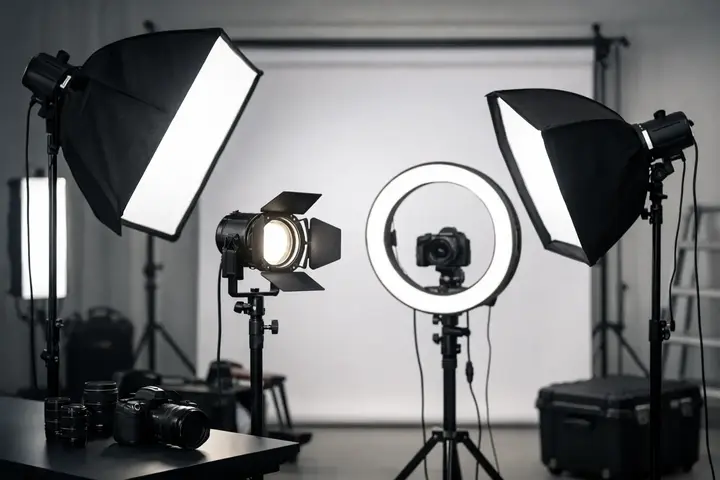
If the shoot day is already planned, but your own lights are insufficient or the existing kit does not suit the specific task, studio light rental is often the most practical solution. It lets you work with suitable equipment for a specific project without investing budget into gear that would then sit on the shelf most of the time. This is especially relevant for portrait sessions, product photography, interview filming, advertising content, and short-term campaigns.
This service is useful not only for professional teams. Content creators, small businesses, and photographers who usually work with natural light also often end up in situations where controllable, repeatable, and technically stable light is needed. At such a moment, the most important thing is not to pick any lamp, but to understand which lighting solution will actually be effective for the specific job.
In brief
- Rental is more cost-effective when lighting needs change or are needed only temporarily.
- Before booking, assess room size, power supply, and the team’s skill level.
- Think in terms of a kit: lamps + modifiers + stands — modifiers often determine the final result.
- Strobe light is usually better for photography; LED is more convenient for video and immediate control.
What to choose for different tasks
| Task | Solution | Why |
|---|---|---|
| Portrait and fashion content shoots | Strobe light or powerful continuous lights together with a softbox/octabox and grid | In portraits, the shape, softness, and control of light matter; modifiers help achieve the desired contrast and character |
| Product photography (e-commerce, props) | A combination of small point sources, diffusion, and specific modifiers plus a sturdy stand | Precise control of reflections and modifiers is often more important than lamp wattage, helping handle reflections and details |
| Interviews and video content | Bi-color or stable CRI LED panels with dimmers, diffusion, and quiet stands | Video requires color temperature stability, no flicker, and immediate visual control on set |
| Outdoor shoots or client spaces with limited power supply | A compact kit with battery power and easily transportable modifiers | If you need to move around a lot or power is limited, mobility is more important than maximum output |
| Testing new setups before purchasing | Comparing rental kits of different types (strobe vs LED, various modifiers) in short-term rental | Rental lets you practically test what is needed in a real workflow before making a capital investment |
When studio light rental is more justified than buying
Buying makes sense when lights are needed regularly and the work profile is clear. Rental, on the other hand, is more advantageous in situations where needs change. In one project, a powerful LED panel is needed for video shooting; in another, a strobe light with a softbox for a portrait; in yet another, a compact kit for working at the client’s premises.
Flexibility is the main benefit here. There is no need to buy a universal solution with compromises, because you can choose equipment according to the specific task. This also helps test different configurations before purchasing. If you are thinking about building your own studio kit, rental gives you the chance to check what is truly needed in day-to-day work and what only looks more useful on paper than in reality.
Another important aspect is budget allocation. For many projects, the biggest gain is not building your own equipment park, but being able to direct finances to the team, location, decor, makeup, or post-production. If lights are needed for only one or two days a month, rental is often the more rational decision.
What kind of work studio light rental is for
Studio lights are not one category with one correct answer. The choice depends on what you are photographing or filming, how quickly you need to work, and the environment in which the shoot takes place.
For portraits and fashion content
In portrait work, the shape, softness, and control of light are important. Here, strobe lights or powerful continuous lighting solutions are often used together with softboxes, octaboxes, reflectors, and grids. If a strong contrast is needed, the configuration will be different than for business portraits or a beauty campaign.
It is also important to assess the pace of work. If shooting is dynamic and the number of frames is large, strobe light can be very effective. If a video operator is also working in the team at the same time, or the client wants to see the light behavior immediately, an LED solution will be more transparent.
For product photography
In product shooting, precise control is crucial. Small reflective surfaces, glass, metal, and packaging require not only power, but also suitable light modifiers. Often the modifiers determine the result more than the lamp itself.
Rental is especially convenient here, because each product may require a different approach. One task may only need two light sources and diffusion; another may require a background, a boom stand, or a specific reflector for accents.
For video filming and interviews
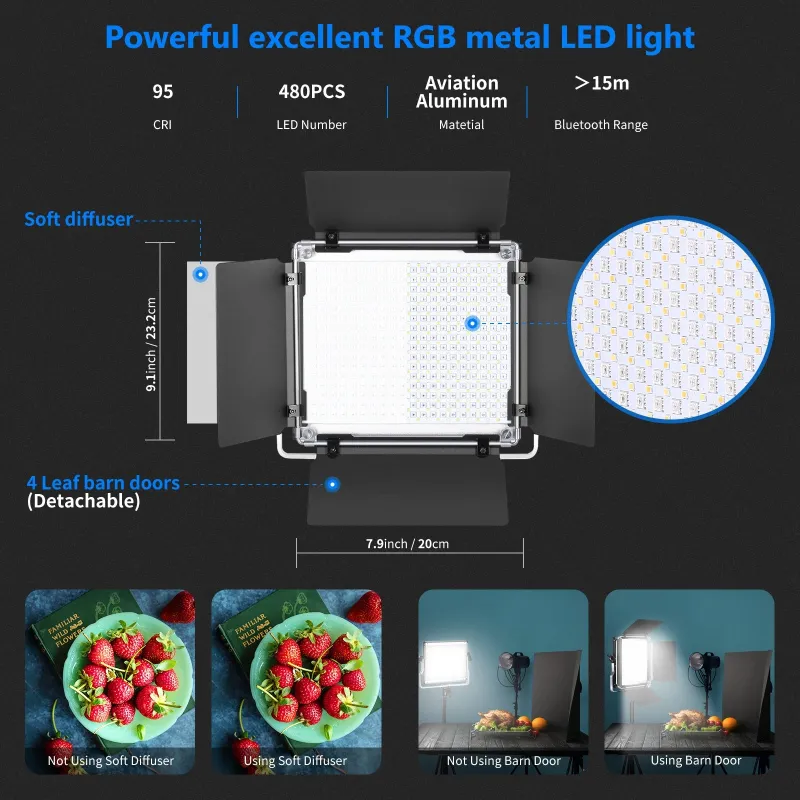
In video work, continuous light dominates. Important factors are color temperature stability, color rendering, lack of flicker, and the ability to adjust intensity quickly. Interviews often require quiet, predictable, and easily adjustable light, especially when filming in a small room.
Here you also need to think about power availability, warm-up time, battery use, and transportation. The most powerful solution is not always the best one. In a small office, too strong a light can create more problems than benefits.
What to evaluate before booking
To make studio light rental truly helpful rather than creating unnecessary complications, it is worth starting with three questions: what are you filming or photographing, where will it take place, and how many people will be working in the team. From that follow both the type and amount of equipment.
First, the space should be assessed. In a small studio or a client’s office, there may simply not be enough room for large modifiers. Ceiling height is also a practical factor - not only for comfort, but for the direction of the light. Second, power supply and logistics should be considered. If shooting takes place in several locations in one day, a compact kit will be more valuable than a more technically impressive but inconvenient system.
Third, you should look at the compatibility of the lights with the rest of the equipment. If you plan to use background systems, stands, boom arms, triggers, or a specific mounting solution for modifiers, everything has to fit into a single workflow. A pro projector that is good on its own does not always mean a good kit.
Strobe light or LED - which is more appropriate
This is one of the most common questions, and the answer is almost always dependent on the type of work. Strobe light is traditionally a very powerful solution for photography. It allows you to work at a lower ISO, precisely freeze motion, and use larger light modifiers without losing power.
LED lights, on the other hand, are more convenient for video work and situations where immediate visual control is needed. You see the result before the shot is taken, which makes the job easier for less experienced users and teams where photo and video production happen at the same time.
However, there are compromises too. Strobe lights may require a better understanding of synchronization, power ratios, and flash behavior. LED lights, in turn, may not always provide the same power reserve, especially when working with large light modifiers or competing with bright daylight. Therefore, the right choice is not the abstractly best model, but the most suitable tool for the specific task.
Why modifiers are often more important than the lamp itself
In practice, the final image or video is very often determined not only by the light source, but by how the light is shaped. A softbox softens, a reflector concentrates, a grid limits spill, a translucent diffuser reduces contrast, while a beauty dish creates a completely different character than a large octabox.
That is why, when planning studio light rental, it is worth thinking at the kit level. If the task is a cosmetic product advertising image, the shape of the light will be critically important. If you are filming an interview, what may matter is not only the main light, but also a small background accent or hair light that separates the person from the background.
A good rental solution is not just issuing a lamp. It is a suitable setup where stands, mounts, and light modifiers match the specific scenario.
What to pay attention to if you are renting equipment for the first time
If this is your first experience with studio lights, the main mistake is usually choosing too ambitious a kit. A three- or four-light setup sounds good, but without a clear plan it can only prolong setup time. In many cases, a quality result can be achieved with one key light and one fill light or reflector.
You should also consider setup time. What looks simple on paper sometimes turns into a complicated workday if the team lacks experience with stand stabilization, light modifier assembly, or power balancing. That is why a consultation before booking often saves not only money, but also production time.
On the Latvian market, local availability is also valuable. If the rental partner understands both photo and video workflow specifics, the choice becomes faster and safer. In this respect, the advantage of Master Foto is precisely the full-cycle approach - it is possible not only to rent equipment, but also to receive practical guidance on which configuration to choose for a specific project.
Studio light rental for businesses and content teams
For company marketing teams and in-house content creators, rental is often the strategically right solution. Content is needed regularly, but not always often enough to maintain a full studio equipment park. Moreover, the tasks tend to be very different - one week a product catalog, the next week a management interview, then social media video.
In this model, rental helps maintain flexibility and professional quality without unnecessary capital investment. Especially when additional equipment is also needed - stands, backgrounds, audio equipment, or video accessories. A single source of equipment reduces coordination risks and makes preparation for the shoot easier.
If projects become regular and repeat in a similar format, then partial purchasing can be considered. But even then, rental does not lose its importance. It remains a good solution for peak loads, larger projects, and specific needs that make no sense to maintain in the everyday kit.
A good lighting solution is not the one with the most watts or the largest size. A good solution is the one that lets you achieve the required result predictably and without unnecessary delay, exactly in your shoot.
Frequently asked questions
When is rental more cost-effective than buying lights?
Rental is more cost-effective if needs change between projects or lights are needed rarely. It is also a good choice if you want to direct the budget to other parts of production, such as the team or post-production.
How do you choose between strobe light and LED?
Strobe light is often better for still photography because it provides high power and the ability to work at lower ISO. LED is more convenient for video work and situations where immediate visual control and smooth light adjustment are needed.
What should you consider when choosing a rental kit for a space?
Evaluate the size of the studio or client space, ceiling height, and available power supply. Large modifiers may not work in impractical conditions, so a more compact solution is often better.
How many lights and modifiers will I need if I’m a beginner?
Often, quality results can be achieved with one key light and one fill light or reflector. Choosing too ambitious a kit without a clear plan can lengthen setup time and complicate the workday.
Why are modifiers often more important than lamp wattage?
Modifiers shape the character of the light — they soften, concentrate, or limit spread, and therefore often determine the look of the final image. Choosing the right modifier also lets you use the lamp’s potential more efficiently and often avoid the need for a more expensive higher-output light.
How do you avoid problems if renting for the first time?
Start with a clear work plan and choose a simple, compact kit appropriate for the task. Before booking, consult about space requirements, power supply, and necessary mounts, because this saves setup time.
Useful links
- Video lights - Especially useful for choosing and renting video and interview kits.
- LED light panels - To compare bi-color panel solutions for video and hybrid projects.
- LED light sticks - For creative atmosphere and accent lighting in product or video shoots.
- Stands - For stability and safe placement of lights and modifiers in the studio or on client location.
- Photo backgrounds - Background choice often needs to be planned together with the lighting kit, especially for product photography.