
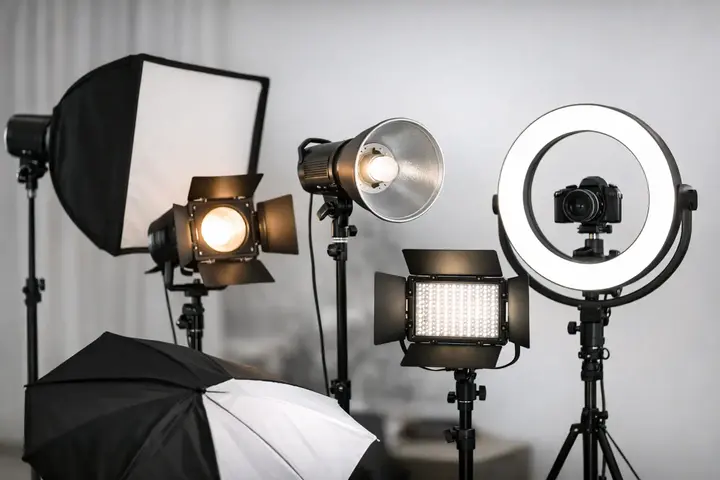
Overexposed packaging, harsh reflection lines on a bottle, and an uneven shadow under the product - these are typical signs that studio lights for e-commerce products have not been chosen correctly. In product photography and filming, light is not just a technical add-on. It directly affects whether an item looks convincing, accurate, and ready to sell.
In e-commerce this is especially important, because the customer cannot hold the product in their hands. They judge by the image, color accuracy, the feel of the material, and the clarity of details. If the light is uncontrolled, the product looks cheaper than it really is. If the light is thoughtfully planned, even a simple catalog looks professional and trustworthy.
In brief
- Evaluate the character of the light (soft vs hard), not just power or watts.
- LED is more practical for photo+video work; flashes are suitable for high-quality photos and white-background work.
- Modifiers (softboxes, stripboxes, grids, diffusers) determine the final look more than the light head.
- Plan the purchase based on the use scenario: small items, medium-sized items, or large objects — different requirements.
- Consider renting for a project if the equipment is needed rarely; buying pays off for frequent, regular use.
What to choose for different tasks
| Task | Solution | Why |
|---|---|---|
| Small products (jewelry, cosmetics, accessories) | A kit with two LED lights, diffusion panels or light boxes, and a macro stand; broad diffusion and a grid for accents. | Soft, even light reduces reflections and preserves detail contrast; a grid helps control the reflection area. |
| Medium-sized products (shoes, bags, household appliances) | A larger light source: softboxes or LED panels with separate background lighting and reflectors. | A wide surface provides even illumination without harsh contrast; background lighting helps achieve a clean white background. |
| Shiny surfaces and bottles | Stripbox or long LED sticks with controlled diffusion and a grid for accents. | A stripbox creates controlled reflection lines that emphasize contours without random hotspots on glass or metal. |
| Large objects (furniture, sports equipment, model shooting) | More powerful LED panels or monoblocks, sturdy stands, boom solutions, and large modifiers or softboxes. | Large objects require both power and scale — wide modifiers and stable mounting solutions ensure consistent results. |
| For fast social media video production | Compact RGB LED kits with simple controls and wireless control, plus quiet stands. | LED lets you see the result instantly and adjust the light quickly; quiet fans are important for audio quality in video recording. |
Why studio lights for e-commerce products are so essential
In product content, the main task is not to create a dramatic mood, but to achieve a repeatable result. This applies to product photos on a white background, lifestyle shots, and short video clips for social media or an online store. Studio lights allow you to control brightness, color temperature, shadow hardness, and reflections.
It is exactly this control that separates random lighting from a working tool. With window light, you can get beautiful shots, but it changes depending on the time of day, season, and weather. Studio lighting, on the other hand, lets you work at the same quality regardless of external conditions. This is important not only for large e-commerce stores, but also for smaller businesses that regularly add new products and want visual consistency.
Power alone is not enough
A common mistake is to judge lights only by watts or brightness. In product photography, the character of the light is just as important. Hard light emphasizes texture and contours, but can create harsh reflections on glass, metal, or plastic. Soft light smooths surfaces and is easier to control, but sometimes the product’s shape disappears if everything becomes too flat.
That is why you need to look at the whole system - the light source, modifiers, placement, and the material of the object being photographed. Cosmetics, jewelry, bottles, and consumer electronics will all have different requirements. What works well with matte cardboard packaging will not always be a good solution for a glossy surface.
LED or flash
If the work involves both photo and video, continuous LED light is often the more practical choice. It lets you see the result immediately, easily adjust shadows, and makes it simpler for teams that create content quickly and regularly. LED solutions are especially convenient in a small studio or office space, where easy setup matters.
Flashes are still very effective when you need high power, a short pulse, and a consistent result in photographs. They work well for larger sets, white-background photography, and situations where lower ISO and maximum image quality are needed. But if the team films more than it photographs, LED will be a clearer starting point.
Color temperature and CRI are not minor details
Product photo quality is often ruined not by exposure, but by inaccurate colors. If the item’s shade in the image differs from the real one, the return risk increases and trust decreases. That is why you should evaluate the color quality of the light - especially CRI and TLCI values, if video content is also being produced.
Good studio lighting solutions provide stable, predictable color rendering. This is essential for clothing, cosmetics, food products, and interior goods, where even small tone shifts can be noticeable. If content is produced in series, stability between different shooting days becomes even more important.
What kit to choose for different e-commerce tasks
There is no single universal kit for everyone. The choice depends on product size, material, content volume, and whether you need photo, video, or both formats.
For small items such as accessories, cosmetics, or electronics, two light sources and one top or rear accent are often enough. The most important thing here is soft, even light and precise control of reflections. Softboxes, diffusion panels, and reflectors provide more than just extra brightness - they shape the product’s appearance itself.
For medium-sized items such as shoes, bags, or household appliances, a larger light surface is needed. Otherwise, you will see unnecessary contrast or transitions on the object, which are then difficult to correct in post-production. If you plan to shoot on a white background, separate background lighting helps achieve a clean background without overexposing the product itself.
For large objects such as furniture, sports equipment, or filming models with a product, the requirements increase. You need not only more power, but also stands, boom solutions, wider modifiers, and a stable space. In such cases, it is worth thinking not only about purchasing, but also about renting for a specific project if this scale is not part of everyday work.
Modifiers determine more than the light source itself
Many buyers start with the light head and only later realize that the main result is influenced by the modifiers. In product content, a softbox, stripbox, reflector, diffuser, grid, or light tent is not an accessory for formal completeness. These are working elements that determine how the product will look in the frame.
Softboxes are a safe base for most e-commerce tasks because they create predictable, soft light. A stripbox is especially useful for bottles, glass, and other vertical objects where controlled reflection lines are needed. Grids help keep the light in a more precise area and reduce unwanted spill on the background or glossy surfaces.
If jewelry or small-detail products are being photographed, more diffusion often helps more than stronger light. The shinier the material, the more you need to think about the shape of the reflection rather than exposure alone. This is one of the reasons why, when choosing product photography equipment, it is worth consulting a specialized seller instead of looking only at price and power figures.
Practical considerations that are often noticed too late
Choosing studio lights for e-commerce products often starts with the creative side, but in day-to-day work very practical nuances become important. How quickly can the gear be set up? Do the stands take up too much space? Are the fans quiet enough for video recording? Will the system be possible to expand in six months?
If content is created in a small office, a compact LED kit with simple controls can be more effective than a technically more powerful but more cumbersome solution. For intensive product studio work, however, not only light quality will matter, but also durability, availability of spare accessories, and stable operation over a longer work cycle.
Power supply and installation options also need to be considered. Not every room is suitable for large stands or overhead systems. If the team works in different locations, portability becomes just as important as technical specifications.
When to buy and when to rent
Not every company needs a full studio kit right away. If product photography happens only occasionally, for example for seasonal collections or a single catalog project, renting may be the more rational option. It lets you use more suitable equipment for a specific task without investing budget in gear that will sit on a shelf most of the time.
If, however, content is produced regularly - every week or even every day -, a purchase usually pays off faster. This is especially true if you need a consistent visual language across the entire product catalog. Another advantage here is workflow: there is no need to wait for availability, plan reservations, or adapt to a different configuration each time.
So a good decision is often not just between cheap and expensive light. It is between short-term flexibility and long-term efficiency. For some businesses, the optimal solution is a basic kit for everyday use and renting specialized equipment for more demanding tasks.
How to avoid common selection mistakes
Most problems start when studio lights are bought without a clear usage scenario. If you do not know which products will be photographed, what the background will be, how much space the room has, and whether video is also planned, the purchase often becomes a series of compromises.
The second mistake is over-saving on stands and modifiers. The light head can be replaced later, but unstable stands, awkward assembly, and poor diffusers create far more problems in daily work than they first seem. The third mistake is choosing a system without room to grow. If later you need to add another light, a controller, or other modifiers, it is important that the platform allows it.
That is why, before buying, it is worth defining three things: exactly what you will film or photograph, how often you will do it, and in what space you will work. These three questions help you understand much more precisely whether you need a compact LED solution, a powerful flash system, or a combined kit with the option to rent part of the equipment as well. In this approach, there is also the Master Foto practical advantage - you can not only choose the equipment, but also align the purchase with a real working scenario.
Good product lighting is not visible as an effect. It is visible in the fact that the product looks clear, accurate, and convincing. If the equipment is chosen correctly, each next shoot becomes not more complicated, but faster and more predictable.
Frequently asked questions
Is it better to choose LED or flashes for e-commerce products?
If you need combined photo and video content, LED is usually the more practical solution because it lets you see the lighting effect in real time. Flashes are beneficial if the goal is maximum image quality for photos, lower ISO, and a short pulse.
How can you reduce harsh reflections on glass or metal surfaces?
Use broad diffusion surfaces (softboxes, diffusers) or a stripbox to change the shape of the reflection and avoid point highlights. Grids and a precise light angle help keep the light only in the needed area.
How many light sources are usually needed for e-commerce product photography?
Often 2-4 sources are enough: two main lights, one top or rear accent source, and background lighting. The exact number depends on the product size, material, and whether you also shoot video.
When should you rent lighting instead of buying it?
Renting is rational if the equipment is needed only occasionally or for one large project. If content is created regularly, buying usually pays off faster and provides stability in the workflow.
How do you check light color consistency?
Pay attention to CRI and TLCI ratings and use white balance tests with color measurements on real products. Stable colors are especially important for clothing, cosmetics, and food products.
Which modifiers are most often useful for e-commerce products?
Softboxes, stripboxes, diffusion panels, and reflectors are the basic tools for most tasks. Grids and small diffusers help refine the light zone and control the illumination in the background.
Useful links
- LED gaismas paneļi - A broader selection of LED panels that are useful for lighting medium and large products.
- LED gaismas nūjas - Useful solutions for bottles and shiny surfaces — an alternative to a stripbox with sliding reflection control.
- Softboksi - Softboxes are basic modifiers for creating soft, even light in e-commerce photography.
- Difuzori - Diffusers help avoid harsh contrast and control the shape of reflections on shiny materials.
- Studijas zibspuldzes - Information about choosing flashes and kits suitable for high-quality catalog photos.
- Fonu komplekti ar turētāju - Background kits help achieve a clean and consistent white background in e-commerce photos.
- Video gaismas (noma) - Rental is a convenient solution when specific video or lighting equipment is needed for a less frequent project.